
Ever wonder what the six teeth on all Venetian gondolas signify? (The six districts of Venice.) Or why and how chicken wing flats are stripped out to form a “meat umbrella” during competitive eating contests? (Much easier to consumer them faster.) Or why some movie stars are credited as “with” or “and”? (They indicate a major star playing a small but significant role.) Or where the “V for Victory” originated? (Occupied Belgium in 1941, as a warning to the Nazis.) Then Ben Schott’s Significa is just the book for you.
A sort-of sequel to his fascinating Schott’s Original Miscellany (2002), the U.K. journalist’s latest book focuses more precisely than its predecessor on specific lingua francas of various communities. But what does Schott mean by “significa”?
In his acknowledgments, Schott graciously attributes the germ of his idea to a 1959 book by Iona and Peter Opie, entitled The Lore and Language of Schoolchildren, that he devoured while himself a schoolchild. Schott lavishes praise upon the Opies’ opus, which surveyed thousands of British pupils in an effort to gather their various nicknames, code words, rituals, and social rules. “It takes seriously something usually dismissed as obvious or insignificant,” Schott writes, “and it pins the thorax of something usually disregarded as fleeting. This is the essence of significa.”
In his own book, too, Schott seeks to ascribe significance and meaning to an extraordinarily disparate range of seemingly trivial secret lingos, mores, and catchphrases. Across more than 50 short, lavishly illustrated chapters varying from rare books to Vegas casino dealers to reality television to mall Santas to sommeliers to Diamond District Yiddish, he excavates more than a thousand such cultural terms and illuminates their meaning for the everyday reader.
For example, Schott takes the reader on a tour of fonts and typefaces (the distinction between the two is extremely subtle), where we learn about “unicase” (when upper and lowercase letters occupy the same height) and “test words” like “squatchee” (templates that typeface designers use to evaluate their creations—what one such designer called “a Swiss army knife for Thai font testing as it has all of the key shapes, such as straights, curves, diagonals, and basic vowel placements”).
He ventures into the gym (“the Glorious House of Gainz”) to educate us about “January Joiners” or “resolutionaries” (self-explanatory), “‘mirin'” (admiring your own physique in a gym mirror), and the nuances between being “cut,” “jacked,” “swole,” “yolked,” and just plain “huge.” Equally bro-coded are the crypto jockeys, who succumb to “hopium” (blind optimism in Bitcoin positions), indulge in “JOMO” (the joy of missing out on a bad investment), and mock nonfungible tokens as worthless “right-click-save-as” digital copies. And he shows how foodies relentlessly mock “eat cutes” (influencers who, for instance, refer to sandwiches as “sandos”), “instavores” (those who cannot eat anything without first photographing and posting), or “hipster vegans” (urbanites who survive on “limited-edition kale burgers and vegetarian chicharrones”).
Along similar lines, even non-sneakerheads like me recognize the term “colorway” (the general color scheme of a shoe), but we surely wouldn’t know that “bred” refers to a mixed black and red colorway. We also wouldn’t be wise to a “duck walk” (a flat-footed gait designed to preserve the “crispness” of new kicks), an “airport flex” (sporting a favorite pair at 35,000 feet), or to “deadstock” (unworn pairs no longer in production).
Then, too, anyone who’s ever read a spy novel recognizes terms like “mole” (first used in 1622 by Sir Francis Bacon), “humint,” and “double cross” but likely not “pavement artist” (street-level surveillance experts), “paper-mill” (fake intel fed to suspected moles), or “eyewash” (fake internal information designed to protect sources). I’ll leave “TWATS” and “route washing” to the reader’s imagination.
One especially fascinating chapter considers British fox hunters and the “sabbers” (saboteurs) who thwart their sporting endeavors, including by monitoring and intimidating the participants, as well as by “foiling” the distinctive fox scent by spraying eucalyptus oil and citronella along popular trails. He then moves from the fields to the streets, tracking London cabbies, who must master “The Knowledge” (an extensive battery of tests on London geography), including by “cottoning the run” (measuring distance using string to approximate a point-to-point trek) and occasionally entrap passengers with “clock and a half” (tricking them into paying 50 percent more than the meter). And, sticking with the urban theme, he examines “graff writers” (graffiti artists) who toss up “throwies” (simple, casual renderings of the tagger’s name), adhere “slaps” (large, pre-tagged stickers available for quick posting), and employ “stingers” (fire extinguishers repurposed for low-accuracy spraying).
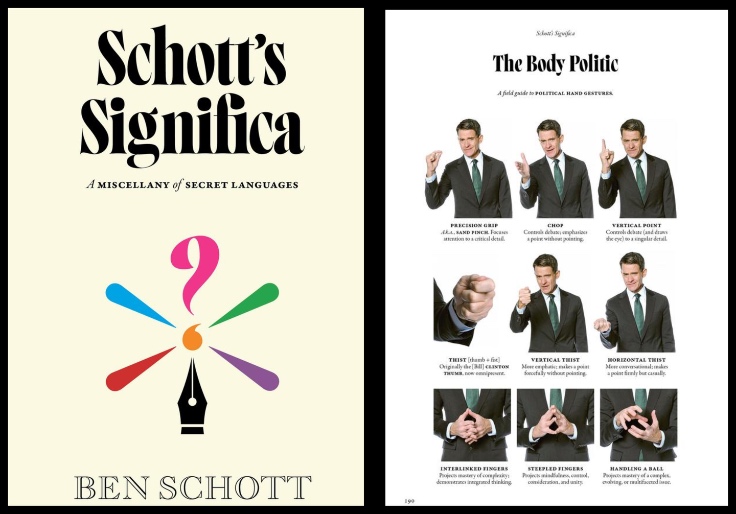
Schott also includes about eight visual “field guide” chapters devoted solely to the hand signals associated with, among other things, Italian expressions, political speeches, stock exchange traders, English horse-racing “tic-tac men,” and Occupy Wall Street hippies. One such chapter covers the discreet semaphores at New York’s ritzy Eleven Madison Park restaurant, including where a party should be seated, whether a server is occupied with an urgent task, or whether a guest seeks still or sparkling water.
Be forewarned: Significa isn’t a book in the sense that we typically encounter nonfiction. Its diverse chapters follow no real sequence, nor do they build on one another, nor do they impart any overall message, apart from the general theme that a tremendously wide range of subcultures inherently develop complete jargons comprehensible only to their own members.
Can you find this stuff through a simple Google (or AI) search? Some of it, yes, but how would you know where to look or even know you might be interested in looking? In this respect, Schott’s book should be read as a glossary, as a reference book, as a legend to a map of underexplored regions of the world. It’s a journey well worth taking.
Schott’s Significa: A Miscellany of Secret Languages
by Ben Schott
Workman Publishing Company, 304 pp., $35
Michael M. Rosen is an attorney and writer in Israel, a nonresident senior fellow at the American Enterprise Institute, and author of Like Silicon From Clay: What Ancient Jewish Wisdom Can Teach Us About AI.