
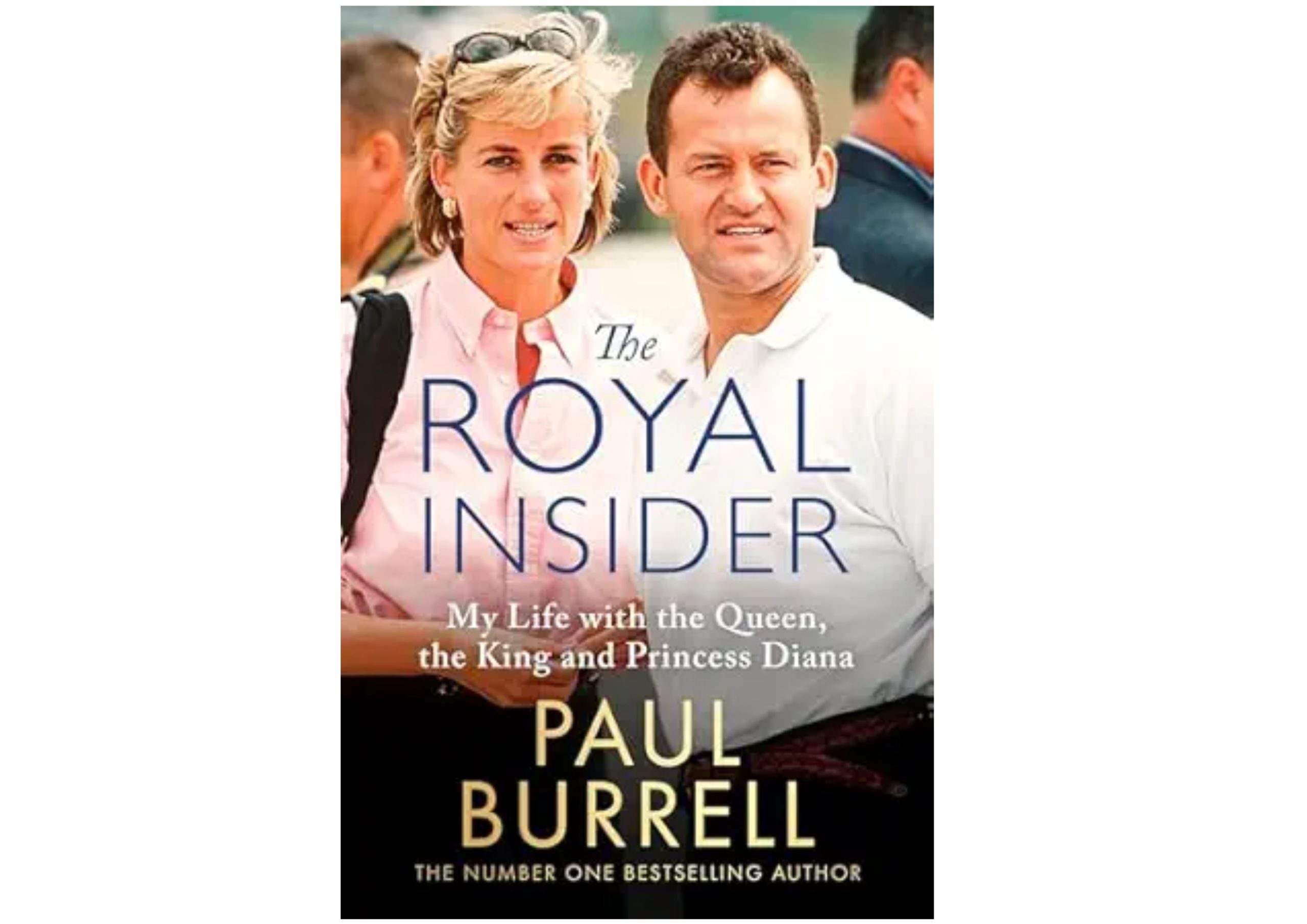
Paul Burrell was a footman to Queen Elizabeth II from 1976 to 1987, and then an eyewitness to the marriage of Prince Charles, who is now King Charles III, and the late Diana, Princess of Wales, who is now beatified as a human sacrifice to the House of Windsor. The Royal Insider is a cattily camp, tittle-tattling tell-all in the finest traditions of royal biography. It is also an autobiography, self-serving in its shameless autotherapy. Serious scholars of Windsor whispering may be tempted to skim the story of Burrell’s lonely childhood and troublesome prostate, the faster to gorge on his generous dollops of behind-the-scenes gossip. That would be a mistake. The Royal Insider is a study in the psychology of service.
“Orphans always make the best recruits,” M tells James Bond in Skyfall. M is for “mother”: The Service seeks the loyalty of recruits who seek the ideal form of what they have lost. Burrell is a miner’s son from a village in northern England. He was born in 1958, though not much had changed since Queen Victoria’s day. His brother followed their father down the pit. Paul dreamed of joining the black-and-white movie pinups on his bedroom wall and spent hours “letting my imagination run away to Hollywood.” He was also obsessed from birth with the Royal Family, though that is normal in England.
We were taught to say our prayers by kneeling beside our beds—I could see the potty under the bed and the face of Bette Davis as I recited the Lord’s Prayer.
Years later, I learned that our Queen did just the same—making us all equal in God’s eyes. Although I doubt that she had the luxury of staring at the face of a Hollywood idol … and I know that she never had a potty under the bed!
We are invited to imagine the late Elizabeth II, an emperor’s daughter, squatting over a chamber pot like Henry VIII huffing and puffing before his Groom of the Stool. The monarch is just like us, a prisoner of the body; the monarch cannot be like us, because the monarch incarnates a primitive metaphysic and its political shadow. Each snapshot image of the royal confessional degrades as it upgrades—like an acid facial scrub, scraping back dead dermal matter to buff up the inner glow. This double performance is what made Diana, as Tony Blair opportunely suggested in the hours after her death, the “People’s Princess.” She too sparkled in a tiara while also doing perfectly ordinary English things like tipping off the press so they could film her taking her young sons on yachting vacations with her new boyfriend, a movie producer who at one point was buying a kilo of coke at a time.
Burrell was 18 years old when he entered the Royal Household via the tradesman’s entrance. Behind the red carpets and gilding of the public rooms lay a backstage “homosexual culture” and a “pantomime world of dress-up.” The royals called the footmen by their nicknames. The deputy sergeant footman, Martin “Bubbles” Bubb, showed Burrell his state livery (pink velvet knee breeches, pink silk stockings, and patent leather shoes), his day livery (black tailcoat and scarlet waistcoat), and the Royal Ascot livery for the races (scarlet tailcoat, white bow tie), and warned him to lock his door his first night: “They will be looking for you tonight. There’s been a book opened on you. The first one to get you wins.”
“I was only eighteen. I had never had a sexual experience and here I was in the Queen’s home, not knowing what would happen next,” Burrell writes, as though Elizabeth II was in the habit of doing the ordinary English thing of tiptoeing down the corridor and assaulting her servants. A firm but unseen hand stroked Burrell’s doorknob on the first night. The first time he forgot to lock his door, he was woken by a man climbing into his bed. He threatened to call the police. Prince Charles’s valet, Stephen Barry, staggered away naked down the corridor.
The staff called Buckingham Palace “Gin Palace.” Footmen siphoned off the royals’ stash of Gordon’s gin and smuggled it up to their rooms in water kettles. The flunkeys shared “leftovers from the Royal table” and snaffled snifters of brandy that had been laid down at the time of the Battle of Waterloo. Their charges were royally smashed from lunchtime on. The Queen and the Queen Mother (George VI’s widow, also called Elizabeth) started with two glasses of “rocket fuel,” a fifty-fifty aperitif of Gordon’s and Dubonnet on ice with lemon.
Elizabeth’s palate never matured beyond teenage sweetness, so she stuck with German whites at lunch, but the Queen Mother loved a “full-bodied claret.” Burrell poured vintage Chateau Margaux into a crystal decanter, then left it to warm on a hot plate, so it could be drunk “at the temperature of mulled wine,” just as ma’am liked it. She also loved champagne but not the bubbles, so she stirred them out of her glass with a “special ivory swizzle stick.” The reader begins to understand why the French invented the guillotine.
Elizabeth presided over tea at 5 p.m., like Marie Antoinette on her milking stool at Le Petit Trianon. She asked how her guests took it and poured it herself. Perhaps she said the customary English line, “Shall I be mother?” Burrell, now nicknamed Buttons after Cinderella’s servant, watched “a gentleman commit the cardinal sin” of putting his milk in before the tea. An elderly duchess screamed, “Oh dear! Are you a MILF, a ‘milk in first’?” The humiliations of the porcelain minefield were assuaged by the ceremonial wheeling in of the drinks trolley straight after tea for “a couple of half-and-half gin and tonics,” and then, once everyone was dressed for dinner, “a couple of martinis” from the communal jug (plenty of ice, a whole bottle of Gordon’s, a “tiny drop of vermouth,” and lots of lemon peel).
“Just show the jug the bottle of vermouth, Paul,” the Queen Mother advised Buttons, presumably while she was prone on the carpet. The Queen would sink “two or three” martinis as a sharpener before dinner, and “probably take the jug with her” to the table. Her sister Princess Margaret had a hollow leg and could put away “a bottle of Famous Grouse” in an evening. Prince Philip was a lightweight, preferring a shot of Glenfiddich whisky or a bottle of Double Diamond bitter, but sometimes he would “mix a martini and take it to the Queen as she was dressing for dinner: a simple act of love between a husband and a wife.”
The privy chambers of royalty are never fully private. Our periwigged lurker calls Charles III “spoiled and eccentric.” His valet squeezes the toothpaste onto the royal brush using a silver key, to avoid waste. He expects the cord on the royal pajamas to be ironed flat, like his shoelaces. He threw a book at Burrell’s head “like a petulant child.” He and Diana fought viciously: “Having set a candle-lit dinner for two on a card table, I arrived in the sitting room to find Charles crumpled on the floor in his silk dressing gown, covered in salad dressing and surrounded by broken china and glass.” Prince Harry has “a wrecking-ball mentality and seems to be living his own Truman Show.” The freeloading playmate of Jeffrey Epstein previously known as Prince Andrew “isn’t the sharpest knife in the drawer.” Burrell also calls Andrew “out of touch and removed from ordinary life.” This was written before Andrew found himself in touch with the British police and removed from ordinary life to a police station for the night.
Elizabeth II was just like Judi Dench as M: “remote and untouchable,” and a demanding “maternal figure.” Burrell hints that he touched the royal inside her, but Liz gave little away behind closed doors. We are reduced to peeps through Her Majesty’s gilded keyhole. To stay alive until the Platinum Jubilee that marked her record-setting 70 years on the job, Elizabeth endured a Keith Richards-like regime of “regular blood transfusions” and “giving up her much-loved gin and tonics, gin and Dubonnets and martinis” for apple juice, with “tomato juice on a Sunday as a treat.” Like FDR, she avoided being photographed in her wheelchair. She worked until the very end, expiring two days after meeting Liz Truss, the last in a line of prime ministers that began with Winston Churchill. This afforded a final, touching confirmation of Elizabeth’s attunement to her subjects. Millions of ordinary Britons also felt their grip on life weakening at the prospect of the Truss premiership.
While the queen kicked the bucket, and the royal embalmer performed his “very secret” mummification of her cadaver in the crypt at Windsor, Burrell was in Kruger National Park, South Africa, preparing as a contestant on the reality television show I’m a Celebrity…Get Me Out of Here! He got the news from Tall Paul, a fellow flunkey. Rather than return to London and “become part of the media circus,” Burrell “found comfort in the idea of just going into the jungle with fourteen celebrities,” not forgetting a camera crew, in order to “grieve more privately” before an audience of millions.” It’s what Diana would have wanted.
Diana the consummate camera-chaser understood Paul best of all. His life “was never the same” after she died, and he “wished she had taken me with her.” Charles, he writes, compounded the “Shakespearean tragedy” of her death by marrying his mistress and insisting that she be called Queen Camilla. When Diana visits Paul in his dreams, she tells him to remind the people that she is not dead. “Camilla is not my queen,” Paul affirms like a Jacobite. “She never will be.”
If The Royal Insider was written by a ghost, the perpetrator needs an exorcism. A servant of power, Burrell sets scenes of pompous circumstance, but his loose syntax makes him a master of inadvertent subversion. His metaphors are not shaken or stirred, but mixed with the vigor of a man preparing a bucket of gin and Dubonnet with a shovel. As Elizabeth II lay dying, the household at Balmoral “went around their business as usual and meals were still served.” That must explain why Balmoral was “at the heart of the tectonic shifting of plates.” This gastro-geological confusion should not be confused with the “seismic shift” that followed her death as her heirs “moved up a rung on the ladder.”
The only way a seismic shift can affect your position on a ladder is by causing you to fall off. This is what happened to Burrell, and also to Prince Harry, the fellow servant of kingship with whom, quite naturally and wholly superfluously, he feels an ambiguous kinship. With Harry’s doting grandmother “no longer there to protect him and guide him,” he is lost at sea. “It was much the same for me when Princess Diana died and there was no one there to support me,” Burrell writes, though it really wasn’t. He also criticizes Harry for his part in the “flippant and damaging allegations” that Burrell had auctioned Diana’s possessions after her death. These claims ended up in court. Burrell was acquitted.
Harry, Burrell believes, “fell into the orbit of celebrity, which the royals don’t understand and do not particularly like.” Harry jumped in the manner of Milton’s Satan: better to rule in Montecito for a day than play second fiddle to your bald brother for a lifetime. Burrell was pushed because he was Diana’s loyal servant. For years, he could not see a boot without wanting to lick it. And now the boot is on the other foot.
The Royal Insider: My Life with the Queen, the King and Princess Diana
by Paul Burrell
Hachette Mobius, 320 pp., $28
Dominic Green is a Wall Street Journal contributor and a fellow of the Royal Historical Society.