
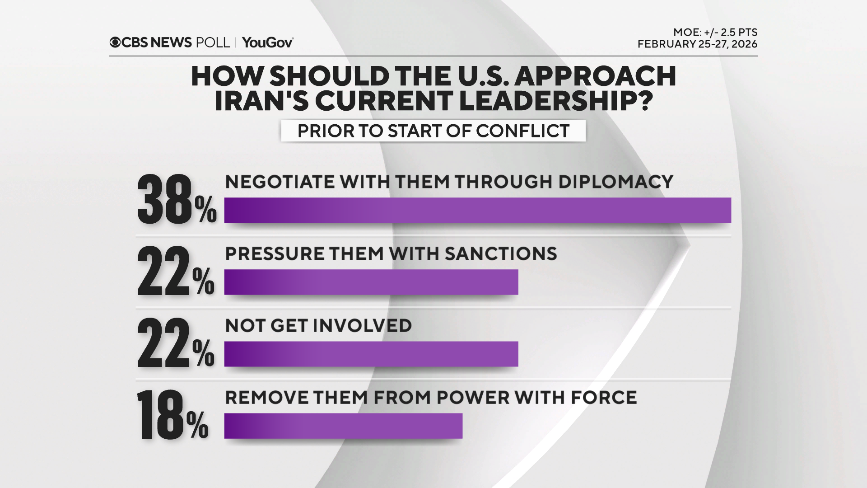
In polling completed just before news of the U.S. airstrikes on Iran, most Americans thought the U.S. should be at least pressuring or engaging the Iranian leadership in some form.
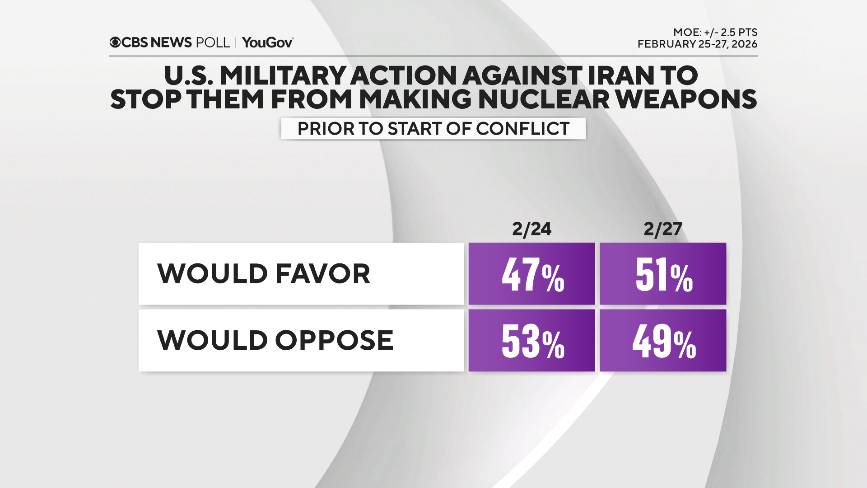
And in the days before the strikes began, there was movement toward approval of a U.S. military action specifically to stop them from making nuclear weapons; that change came after President Trump’s State of the Union address earlier this week, on Feb. 24.
The effect of that was that the nation went into the start of the conflict split about it.
The public had voiced a collective uncertainty about how long a conflict with Iran would last. More thought it would last months or even years, rather than just days or weeks. Supporters tended to think it would be short.
That sets some context as it now unfolds.
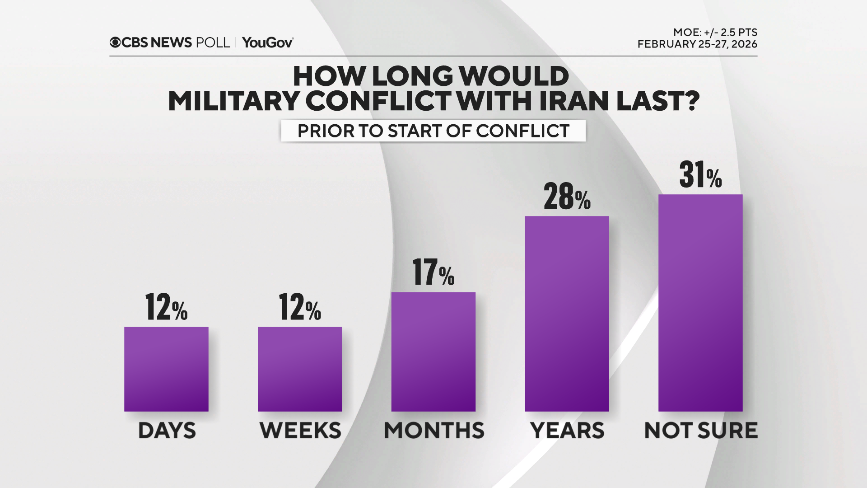
Views on the duration of a potential conflict were tied closely to whether Americans said they would back military action or not: Those who thought the conflict would be quick tended to favor military action (prior to the start), but those who thought it would take a long time were opposed.
With regard to the Iranian ruling regime, more favored U.S. economic or diplomatic pressure, rather than military force to remove them. Either way, a substantial majority of Americans thought the U.S. ought to be engaging in some form.
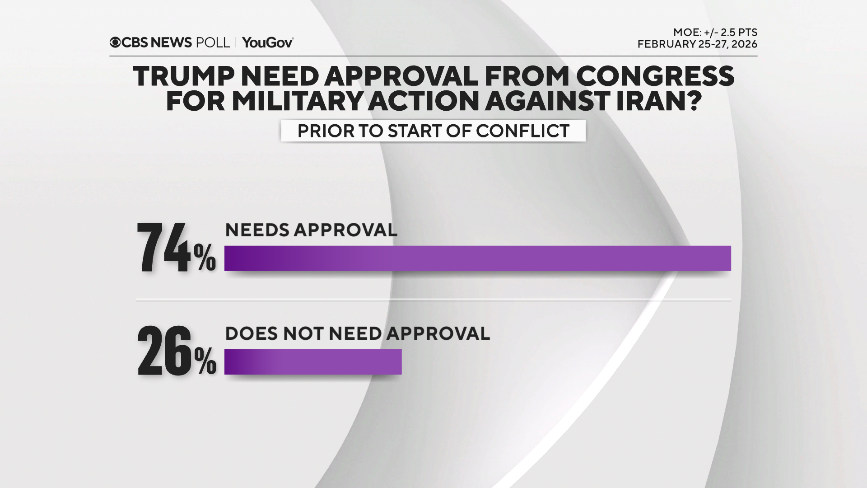
People overwhelmingly did think that Congress would need to approve military action.
The number of Americans who felt the president had explained the U.S. position ticked up a bit following the State of the Union, but as of the start of the action, he still hadn’t satisfied a large majority of Americans.
Before the strikes, the president’s approval for his handling of Iran was a bit higher than his overall approval, though still net negative.
For context, in CBS News polling going back decades, Iran or its potential nuclear capability has in some form been seen as a threat in the public mind, though often one that many felt could be contained or addressed diplomatically. Last summer, when the U.S. conducted airstrikes against Iranian nuclear facilities, views were partisan, with most Republicans approving.
The U.S. economy
The optimism about the economy that the president expressed in the State of the Union isn’t shared by most Americans.
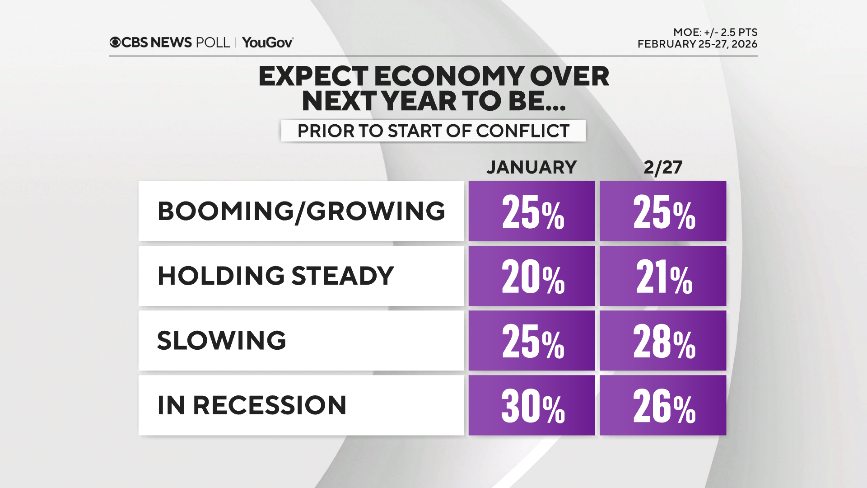
Expectations for the next year are for a slowing economy, or even recession, and that has been the case for a while. Overall ratings of the U.S. economy continue to be net-negative.
In fact, a sizable majority continue to think the president describes things with inflation as better than they actually are.
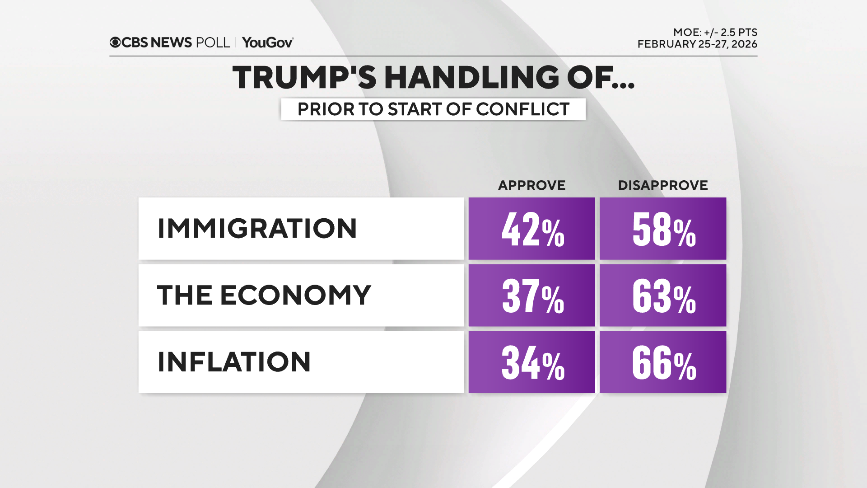
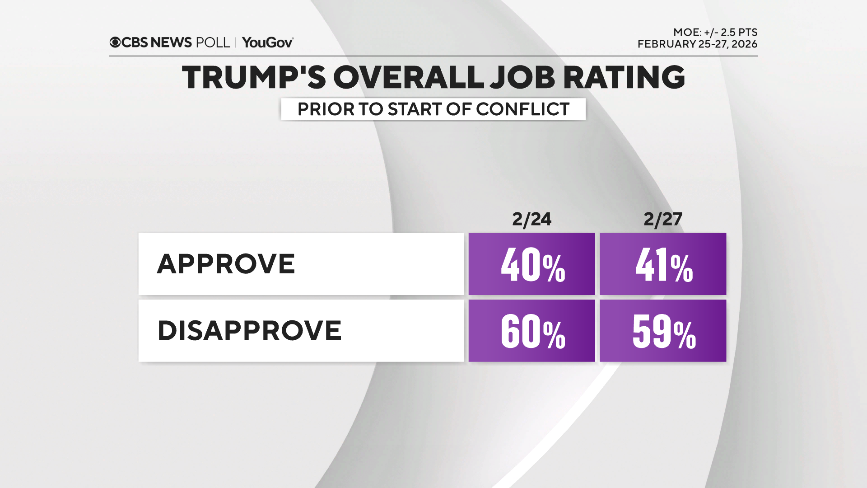
Before the strikes on Iran, Mr. Trump’s issue approval ratings were in line with what they were just prior to his State of the Union address. His overall approval had been fairly stable in recent weeks, and a point up from just before the State of the Union.
This CBS News/YouGov survey was conducted with a nationally representative sample of 2,264 U.S. adults interviewed between February 25-27, 2026. The sample was weighted to be representative of adults nationwide according to gender, age, race, and education, based on the U.S. Census American Community Survey and Current Population Survey, as well as 2024 presidential vote. The margin of error is ±2.5 points.
Toplines