
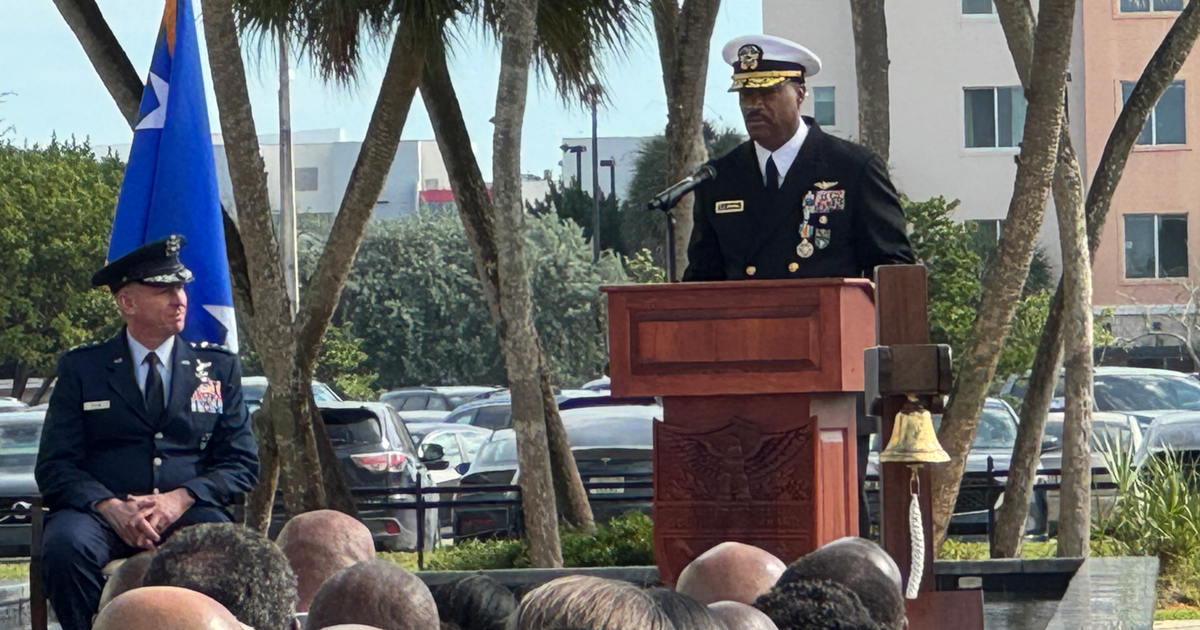
Doral, Florida — The admiral overseeing U.S. military forces in South America relinquished command Friday, as the U.S. continues its buildup of ships and military assets off Venezuela and carries out strikes against alleged drug boats.
“We have worked hard and tirelessly to build relationships and understand requirements across the region,” Adm. Alvin Holsey said during a relinquishment of command ceremony at U.S. Southern Command Headquarters on Friday. “That work must continue across the whole government to deliver at the point of need to respond to shared threats in our neighborhood — the time is now.”
Holsey, who has served in the Navy for 37 years, stepped down as the head of U.S. Southern Command after announcing in October he’d retire early, just one year into what is typically a three-year term leading a combatant command. He gave no reason, but at the time, CBS News reported there had been tensions between Holsey and Defense Secretary Pete Hegseth over deployment decisions in the Caribbean.
During Friday’s ceremony, the Chairman of the Joint Chiefs of Staff Gen. Dan Caine awarded Holsey the Defense Distinguished Service Medal with a citation signed by Secretary Hegseth.
In remarks, Caine thanked Holsey and his whole family, saying, “know how deeply, deeply grateful we are as a nation and as a joint force for all you’ve done for us.”
Holsey transferred his duties to Air Force Lt. Gen. Evan Lamar Pettus in the ceremony. Pettus will serve as acting commander of U.S. Southern Command until the Pentagon sends a nomination to the Senate to be confirmed.
U.S. Southern Command has been leading the ongoing strike campaign named “Operation Southern Spear” that has destroyed 23 alleged drug boats with military strikes, killing 87 people.
The campaign has come under increased scrutiny from lawmakers because of a controversial “double tap” strike on Sept. 2 that killed two survivors. The commander who ordered the second strike, Admiral Mitch Bradley of U.S. Special Operations Command, has conducted several briefings in the past two weeks with small groups of lawmakers to walk through his decision. He briefed House Speaker Mike Johnson Thursday, and the House speaker said after the briefing and a review of the strike video said the operation was conducted in a way that was “entirely appropriate.”
Earlier this week, Holsey gave a virtual briefing to the chair and ranking member of the U.S. Senate Armed Services Committee before officially transferring his duties on Friday. Ranking Member Sen. Jack Reed of Rhode Island told CBS News Holsey said it was a personal decision to retire early, and even after the briefing, Reed said that “we have still, I think, many more questions.”
It’s not just the boat strikes that have piqued Congress’ interest. Lawmakers also have questions about why there is an expanding military buildup in the region. The U.S. now has about 15,000 forces in the Caribbean between warships, including the world’s largest aircraft carrier the USS Gerald R. Ford, and on bases in Puerto Rico. It’s the largest U.S. military presence there in decades.
The buildup appears to be part of the Trump administration’s ongoing pressure campaign against Venezuela’s President Nicolas Maduro. Earlier this week with the support of the military, the U.S. Coast Guard seized a sanctioned oil tanker off the coast of Venezuela. President Trump has intimated that strikes inside Venezuela could be next.
Holsey assumed leadership of U.S. Southern Command in November 2024. During his tenure, the command expanded from roughly 3,500 personnel to nearly 15,000 personnel in direct support of operations in the region, according to a release from U.S. Southern Command that honors Holsey’s career.
In the last fiscal year, which ended in September, the command disrupted or seized more than a million pounds of cocaine, worth more than $11.34 billion. The release makes no specific mention of Operation Southern Spear.
Holsey is the latest of over a dozen senior military officers who have either been fired by Hegseth or who retired early since the beginning of the Trump administration.