
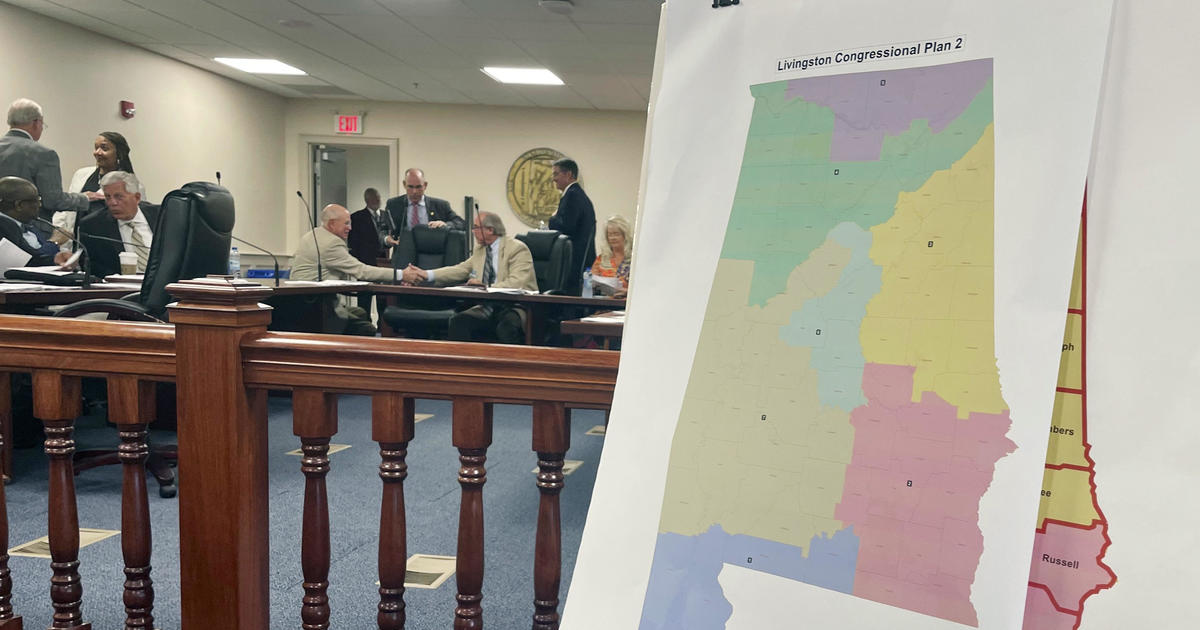
Washington — A federal district court on Tuesday temporarily blocked Alabama from using a congressional map adopted by state lawmakers in 2023 for the upcoming midterm elections, finding that the plan, which includes one majority-Black district, is racially discriminatory.
The panel of three judges instead ordered Alabama to continue using a court-selected map that includes two majority-Black districts. Those congressional district lines were used in the 2024 elections.
In their decision, the judges found that the redistricting plan adopted by Alabama’s GOP-led legislature in 2023, which state officials sought to reimplement for this year’s House contests, intentionally discriminated on the basis of race, in violation of the Constitution’s 14th Amendment.
“Ultimately, we cannot see our way clear to requiring Alabamians to cast their votes in the 2026 elections under a districting plan tainted by intentional race-based discrimination,” Circuit Judge Stanley Marcus and District Judges Anna Manasco and Terry Moorer found.
State officials said they are appealing the decision to the Supreme Court.
Alabama Gov. Kay Ivey, a Republican, has already set a special primary for Aug. 11 for four House districts that would be reconfigured under the new map. Primaries for the state’s remaining House seats unaffected by the redistricting scramble were held last week.
The court rejected the state’s argument that mapmakers were driven by party politics when they redrew the House district lines in 2023 and instead found that state lawmakers enacted that map to “distribute Black voters across districts to dilute their votes, at least in part because they were Black.”
Still, the district court gave state lawmakers the chance to enact another congressional districting plan for the upcoming House elections, writing that its order requiring Alabama’s congressional elections be administered under the court-drawn map expires if the state adopts new voting lines.
“We acknowledge that our holding is a rare one in the modern era, and we are painfully aware of the gravity of our ruling, but in this unusual posture and on this extensive record, we do not find the issue particularly complex or close,” the judge said.
The decision is the latest twist in the long-running legal fight over Alabama’s congressional map. The case landed back before the district court after the Supreme Court’s landmark decision last month that weakened a key provision of the Voting Rights Act.
That ruling, which came in a case involving Louisiana’s congressional map, set off a rush in some Southern states to reconfigure their congressional districts to give Republicans an edge and help the GOP hold onto its House majority.
On the heels of its decision in the Louisiana voting rights case, the high court set aside lower court rulings that had blocked Alabama from using the 2023 map and ordered additional proceedings. State officials then acted swiftly to implement the House lines drawn by state lawmakers three years ago.
Alabama’s congressional delegation is currently composed of five Republicans and two Democrats. But state GOP officials had hoped that under the new map, they could flip the seat currently held by Rep. Shomari Figures, a Democrat.
Figures said he is “pleased” with the district court’s decision blocking the state from using the 2023 House plan, but acknowledged that the state will likely appeal to the Supreme Court.
“This is a significant step in the right direction, but there is still a long way to go before this fight is settled,” he said.
House Democratic Leader Hakeem Jeffries accused Republicans and President Trump of engaging in a “desperate power grab” by redrawing congressional maps in order to bolster their attempts to hold onto the House majority in November.
“There will be a free and fair election in November,” he said in a statement. “The Supreme Court must now do the right thing, if the state of Alabama seeks judicial sanction to violate the 14th Amendment of the Constitution. The American people must be permitted to decide who gets to represent them in Congress, not Donald Trump.”
Alabama’s GOP-controlled legislature crafted new district lines in 2023 after their original map, crafted after the 2020 Census, was found to likely violate Section 2 of the Voting Rights Act.
The 2023 map included a single majority-Black district, but the district court blocked the state from using those congressional districts in the 2024 elections. Instead, those contests were held under a remedial map adopted by the court.