
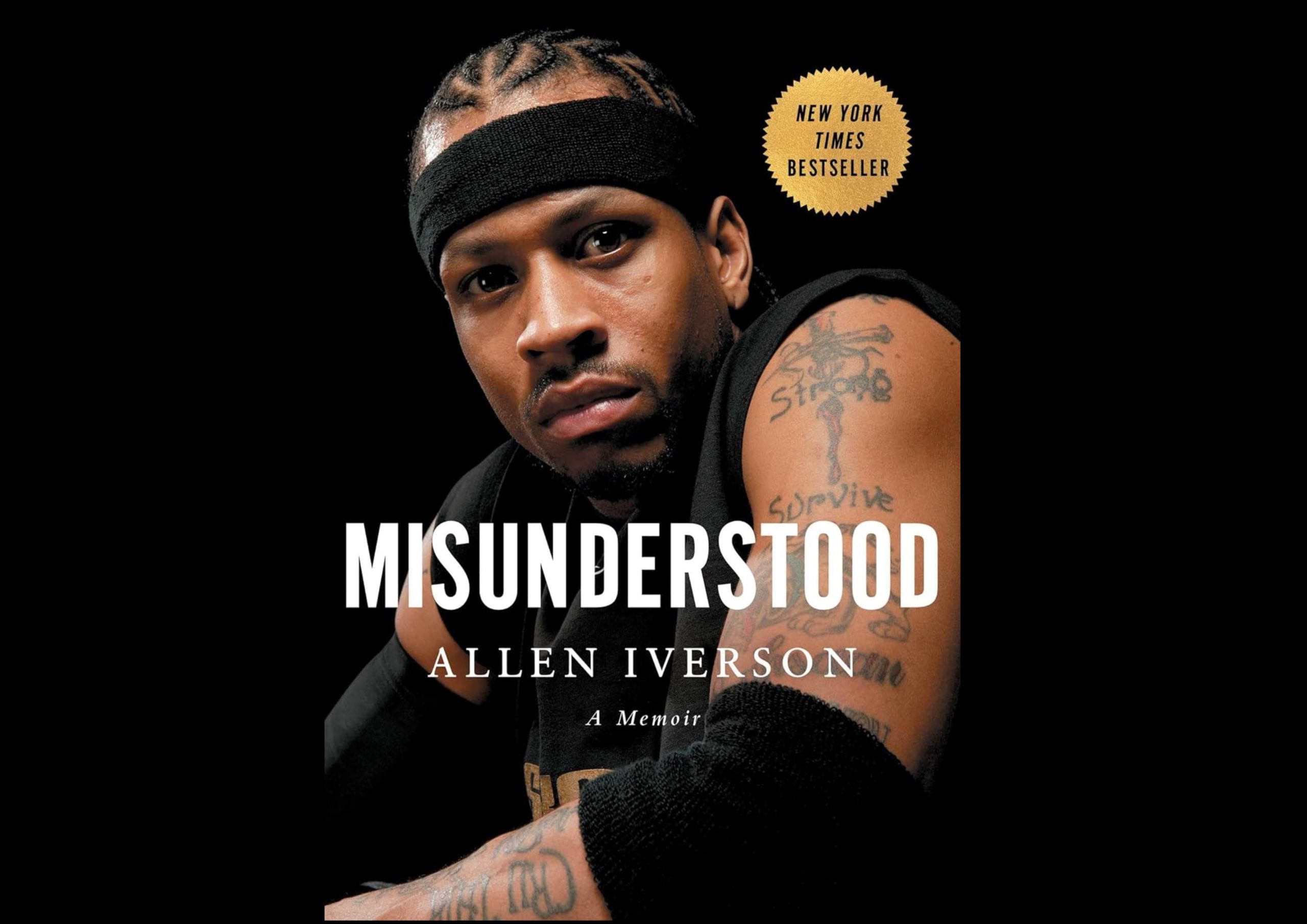
Allen Iverson finally wants to talk about practice.
“The Answer” opens Misunderstood: A Memoir recounting a question that would spawn one of the most legendary postgame press conference monologues in the history of professional sports: “So what about the situation with the practices?”
Iverson was off to the races
I’m supposed to be the franchise player, and we’re in here talking about practice. I mean, listen, we’re talking about practice. Not a game! Not a game! Not a game! We’re talking about practice. Not a game. Not the game that I go out there and die for and play every game like it’s my last. Not the game. We’re talking about practice, man. I mean, how silly is that?
The six-foot lightning bolt of a shooting guard didn’t think one press conference answer would outlive his highlights, though he does acknowledge that he “said the word practice a lot, as everyone in the whole damn world knows.” Iverson writes that it was his “moves on the basketball court that went viral—before going viral was a thing,” at least up to that point: “After that press conference, ‘practice’ became as recognizably me as any crossover, any jump shot, any championship, or any heartbreak.”
What Iverson gets at—the combination of on-court prowess and off-court virality, as he puts it—is familiar to all of us who devote an inordinate amount of time to following professional sports. The athletes who rise above simple greatness to become legends, who capture both award trophies and the hearts and memories of fans long beyond the final buzzers of their careers, mean more than just their places on statistical leaderboards. Joe DiMaggio’s grace in center field, for instance, made him the Yankee Clipper, but it was the aspirational vision of America he represented (and his marriage to Marilyn Monroe, natch) that prompted Paul Simon to ask where he’d gone. Mike Tyson may have been the greatest boxer in the world, but his personality, the size of his biceps, pixelated bouts on the NES, and scene-stealing appearances in the Hangover movies allowed him to take an ear-sized bite out of American culture. And Lance Armstrong, however short-lived his status may have been, inspired a generation of kids to wear yellow silicone bracelets out of the sheer power of his personal story.
Iverson’s persona is his person; as he writes in Misunderstood, he has never attempted to be anything other than what he is. His upbringing—darting back and forth between his mom’s house in Hampton, Va., and the projects where the stand-in for his father lived, committing petty crimes with friends, and being (unjustly, as he convincingly argues in his memoir) convicted over a melee at a bowling alley—informed who he became as a public figure. Who else’s bout with elbow bursitis could have brought in the shooting sleeve as a staple accessory on the NBA hardwood?
It is fitting, then, that Iverson’s explanation of what actually prompted the “practice” soliloquy combines the world he came from with the one he entered. Iverson’s best friend, Rahsaan Langford, was killed in a Hampton nightclub after looking at the wrong guy the wrong way while Iverson was in Philadelphia for 76ers training camp, seven months before the press conference.
“‘I lost my best friend,’ I said. And between that and a disappointing season, I told them I was feeling ‘that everything is going downhill for me as far as my life. I’m human. I am just like you. You bleed just like I bleed, you cry just like I cry, you hurt just like I hurt,’” he tells the reader. “I said that, yet the reporters kept asking me about practice.”
That story, right at the beginning of Iverson’s memoir, is representative of the rest of the book. A person with the odds stacked against him, having experienced enough for multiple lifetimes, succeeds through sheer force of will and God-given athletic ability. And it is impossible to discount the athletic ability: Iverson was a generational talent in football as well as basketball, playing in a Pee Wee league at the age of 8 alongside kids as old as 12 and outshining everyone else on the field.
Iverson never won a title, though he did deliver the 2000-01 Los Angeles Lakers their only loss of that year’s playoffs during Game 1 of the NBA Finals, stepping over opposing guard Tyronn Lue in an image that surely hung on college dorm room walls. And while he won an MVP that year and led the league in scoring four times over his career, the apex of his athletic prowess and the climax of the book came in a regular-season matchup against the Chicago Bulls during his rookie year, explained to the reader like it happened yesterday.
And there I was. Directly facing the basket, outside the three-point line, with Michael Jordan staring at me from his defensive crouch. I paused, then backed up for a second. I always knew that if he was guarding me, I would try my move. I told my friends, my family. So when he got on me, I was like, Here we go. That’s why I backed up.
As I retreated, you could hear the crowd respond. Like this is what they came for. Then the volume rose. The anticipation. I gave him a little left-to-right cross first to see if he would bite on it. He did. The crowd reacted. I let him set his feet as I dribbled the ball back to my left had. Then I hit him with the real one. This time his body went all the way to my left as I crossed over to the right. With space and him almost on the ground (his Jordans saving his ankles), I pulled up just inside the three-point line.
The jumper was cash. The crowd fucking erupted.
Iverson wrote, “Even now little kids don’t say, You’re Allen Iverson. They say, You’re the guy who crossed over Michael Jordan.” And what made that moment legendary, in addition to getting one over on the GOAT, is just how cool AI looked doing it. That’s truly what set him apart and what made him a cultural icon in the way better players could never dream of.
For so many contemporary NBA stars, the experience of playing AAU basketball has left them bland, faceless automatons no different from their competitions. For others, like LeBron James, political activism has taken the place of personality. Not so for Iverson, who recounts drawing controversy for stating, “All Lives Matter” during the initial wave of Black Lives Matter protests. In this, he shares a quality with the man he crossed up, Michael Jordan, he of “Republicans buy sneakers, too” fame. Iverson is bigger than politics in the same way he is bigger than basketball. And now that he’s finally talking about practice, NBA enthusiasts and sports fans of all stripes would do well to listen.
Misunderstood: A Memoir
by Allen Iverson
Gallery/13A, 352 pp., $30