
Harvard University’s anti-Semitism task force described how the university’s divinity school program on Religion and Public Life (RPL) presented a perspective “widely perceived as consistently anti-Israeli,” noting that its head, Diane Moore, said her goal was to “dezionize the Jewish consciousness.” Moore and her former deputy, Hussein Rashid, abruptly resigned in January 2025, but they weren’t unemployed for long. The Columbia University-affiliated Union Theological Seminary (UTS) announced last month that they will lead a program about how religion “can be instrumental in just peacemaking.”
Moore and Rashid, the former leaders of Harvard’s RPL program, will run a newly formed center at UTS—also called Religion and Public Life—starting in the fall, according to the February 26 announcement, which said the school’s “goal is to have students be intentional in their service of a just world at peace.” UTS president Serene Jones said it will equip “students with the intellectual rigor, moral imagination, and practical skills necessary to engage the most pressing issues of our time.”
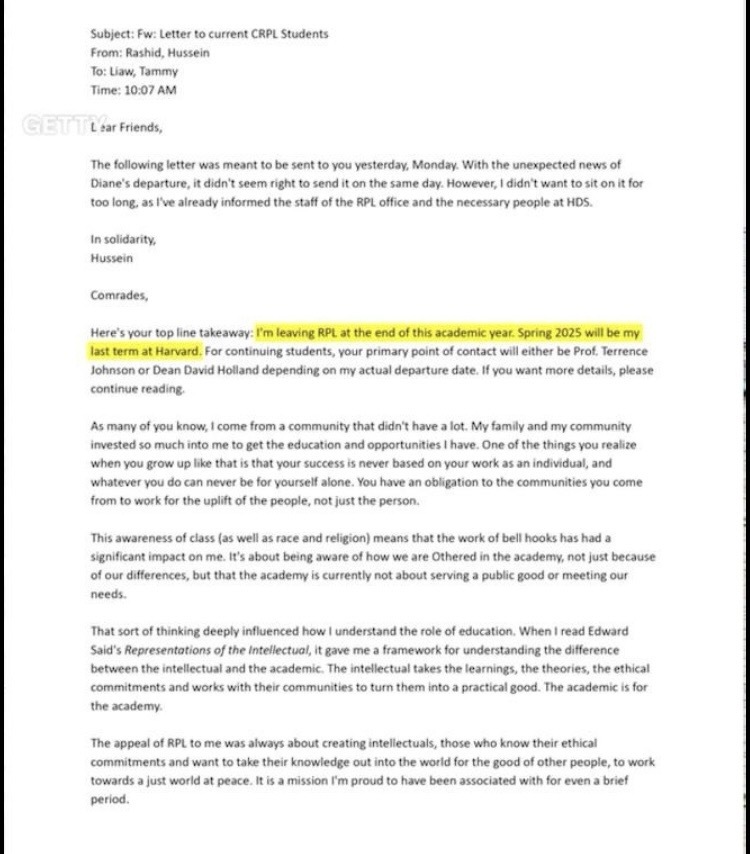
Rashid announced his departure from Harvard a day after Moore, accusing the university in his resignation letter, published by CNN, of “anti-Muslim bias (amongst other racisms and discriminatory attitudes that exist here).” Rashid also wrote that Harvard is “an institution of white supremacy that actively seeks to harm me and mine.” In an interview with the left-wing network, he called the school “a primarily white-serving institution.”

The pair’s hiring by a Columbia affiliate cements a pattern in which academics ousted by Harvard find refuge in Morningside Heights. Rosie Bsheer, who was removed from her leadership post at Harvard after bringing a litany of anti-Israel speakers and few, if any, dissenting voices, is finalist for Columbia’s Edward Said chair in Arab Studies, the Washington Free Beacon first reported. Cornel West, who claimed he was denied tenure at Harvard in 2021 because of the opposition from pro-Israel donors, also has fetched up as a professor at the Union Theological Seminary.
A Columbia spokesman said the university is independent from UTS and “has no authority or input over its personnel matters.” The schools, however, are close partners. UTS students have access to Columbia’s campus, which is about a five-minute walk away, as well as to facilities such as libraries. The schools also offer dual degree programs.
Harvard’s anti-Semitism task force detailed several examples of Harvard Religion and Public Life program pushing a one-sided, anti-Israel view under Moore and Rashid’s stewardship. The task force’s report describes an August 2024 paper Moore coauthored with Harvard RPL associate director Hilary Rantisi, explaining that the goal of the program’s annual trip to Israel and the West Bank was to teach a “decolonial approach” to the “Jewish settler colonial project in Palestine” and to “dezionize Jewish consciousness.”
Moore saw at least some success: One student said the excursion helped her “realize the way that Israeli apartheid intends to destroy everything—from after-school art programs to independent film festivals.”
The task force wrote in its report that using “an instructional program to ‘dezionize’ the ‘consciousness’ of Jewish students is to craft instruction to target students based on their religious identity. To suggest that the Jewish tradition is properly understood as reducing to ‘a settler colonial nation-state project’ is also to denigrate both a religion and an identity.”
Just four days after Hamas’s Oct. 7, 2023, terror attack, Moore and Rashid coauthored a statement urging students to “challenge single story narratives that justify vengeance and retaliation.”
“Start with the rockets fired into Israel by Hamas on October 7, 2023 and not with the illegal occupation of Palestinian land by Israel and the blockade of Gaza since 2007, and you have an entirely different story,” the statement read.
Harvard Divinity School interim dean David Holland distanced himself from the statement after it was published, clarifying that the authors “speak solely for themselves” and not the divinity school or “its wider community,” the Harvard Crimson reported.
The timing of Moore’s and Rashid’s abrupt departures is also noteworthy. Roughly a week prior, Harvard promised greater protections for Jewish and Israeli students in order to settle a lawsuit that accused the university of failing to address “severe and pervasive” anti-Semitism on campus. In their complaint, six Jewish students pointed to RPL’s statement as well as the program’s promotion of a student’s photo of graffiti near Bethlehem showing “a Jewish individual with a stereotypical elongated nose … hoarding water from three faucets simultaneously, while an individual wearing Palestinian garb stands nearby.” The photographer said it showed how “religion is weaponized through Zionism, and violently denies Palestinians daily of their livelihood and humanity by taking their natural resources.”

Soon after the settlement, the university faced mounting pressure from the Trump administration, which eventually moved to freeze more than $2 billion in federal funding, citing in part the school’s failure to address anti-Semitism. Harvard fired Bsheer in March 2025 and a few days later suspended its research partnership with Birzeit University, a West Bank school that has hosted military parades in honor of Hamas.
RPL’s posture was clear from the outset. Moore founded the program in 2020 to study peace and conflict and to improve the public’s understanding of religion, according to the Crimson. Yet its inaugural webinar included a speaker who praised “Jewish pro-Palestinian activists for grappling with ‘a specific Jewish sinfulness against the Palestinians,'” according to the anti-Semitism task force’s report.
While UTS praised Moore and Rashid’s experience, it makes no mention of their time at Harvard.
Harvard’s RPL program had received significant funding from a single anonymous donor, who left along with Moore, the Crimson reported. In the months following, the university has almost entirely gutted the program.
A UTS spokeswoman did not respond to inquiries about the program’s funding. She said the seminary has long been guided by its commitment “to interreligious engagement, and the pursuit of justice, peace, and dignity for every person.”
“These commitments are embodied in the scholars who have recently joined our community,” the spokeswoman said: “Diane Moore, a leading national voice on how understanding religious diversity strengthens democratic life; and Hussein Rashid, a globally recognized scholar of Islamic studies, the Muslim experience in America, and interreligious dialogue.”
Harvard did not respond to a request for comment.