
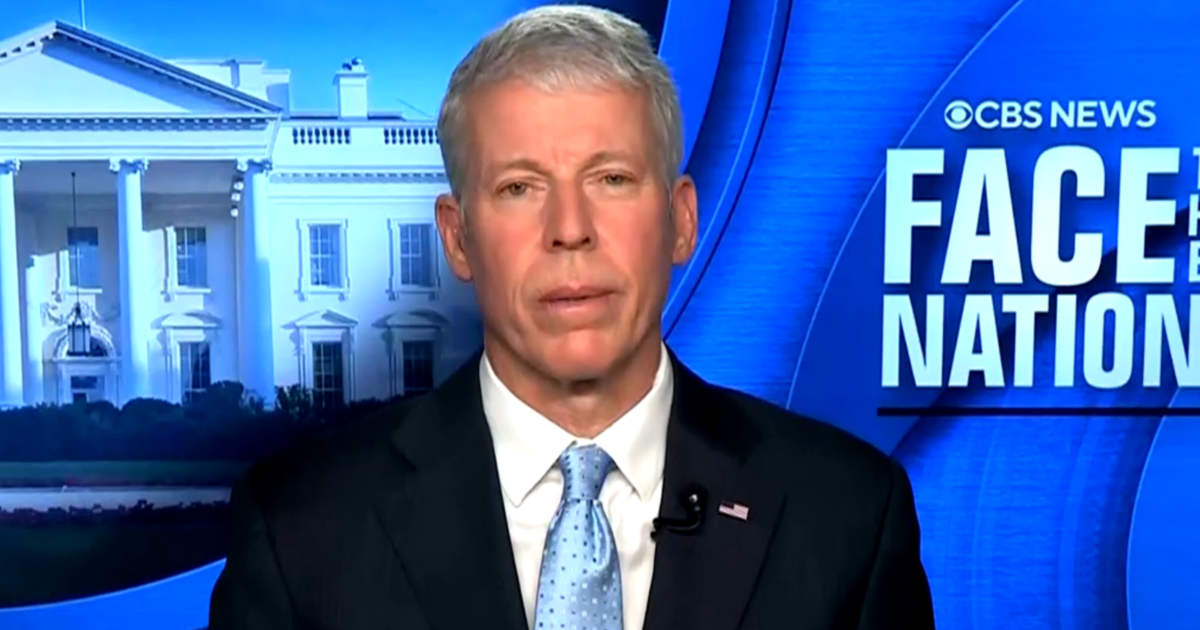
Washington — Energy Secretary Chris Wright said Sunday that elevated energy prices amid the escalating war with Iran will be “temporary,” stressing he believes gas prices “shouldn’t go much higher.”
“We have a temporary period of elevated energy prices, but it will not be long,” Wright said on “Face the Nation with Margaret Brennan.”
Concerns about a global energy crisis have grown as the war with Iran enters a second week. But Wright claimed “in the worst case, this is weeks — this is not months, and it leads to a much better place.”
“It leads to an Iran that’s defanged, that can’t threaten its neighbors, can’t threaten American soldiers, and can’t continue to drive up energy prices by making a mess of the Middle East,” Wright said. “They can move to commerce, not conflict.”
The comments come as the war has continued to push up prices at the pump, with gas prices up 14% in the past week, according to AAA data. The national average rose to $3.45 per gallon Sunday, after dipping below $3 in December. But Wright said gas prices “shouldn’t go much higher than they are here, because the world is very well supplied with oil.”
“There’s no energy shortage at all in the Western Hemisphere, the United States is a net exporter of oil, a large net exporter of natural gas,” he said. “But refineries in Asia and Europe are seeing an interruption from the normal crude flows.”
Wright cited “massive energy stores around the world,” noting that “what you’re seeing is emotional reactions and fear that this is a long-term war.” He stressed that “this is not a long-term war.”
The energy secretary said while previous administrations have “begged, bartered and bribed the Iranian government to stop its nefarious activity,” it “simply hasn’t worked.”
“Now is the time to end their risk to America and the world,” Wright said.
Meanwhile, the war has dramatically reduced shipments of oil and liquefied natural gas through the Strait of Hormuz, a waterway through which about 20% of global oil shipments normally travel. Asked by Margaret Brennan about when the strait could see a return to the typical 20 million barrels of oil transported per day, Wright said he expects things will return to that level “relatively soon,” though he noted that protection by the U.S. military may be necessary.
“All of our military assets right now are focused on ending Iran’s ability to kill their neighbors, threaten American soldiers and threaten ship traffic in the Strait of Hormuz, but that’s going swimmingly well,” he said. “I think in the relatively near term, you’re going to see their capacity so low that we’ll see more normal ship traffic return to the Strait of Hormuz.”
Wright argued that the operation in Iran will “bring in an era of even lower energy prices, because a major energy producing region of the world, the Middle East, will no longer have a strong, powerful Iran that can threaten their neighbors, that can threaten the United States of America, and was not far away from a nuclear bomb.” He called that scenario “unacceptable,” while noting that the real risk to energy prices “was not doing anything.”
“The president’s going to continue to stay focused on ending a 47-year conflict, stay focused on growing the global energy supply,” Wright said. “This is actually part of that effort. It does involve a temporary impediment to energy production, but on the other side, it will allow much more energy production and much lower energy prices.”
The Trump administration has resisted calls to tap into the Strategic Petroleum Reserve, but Wright said Sunday that “we’re more than happy to use that if it’s needed.” Still, Wright said that oil was needed at refineries in Europe and Asia, and there is more than 100 million barrels of untapped Russian oil that could be used. The U.S. Treasury Department said last week that India can buy crude oil and petroleum products from Russia until April 4, calling the sanctions waiver a “stop-gap measure” to “alleviate pressure” on the market.
“We’re not helping Russia by just accelerating the sale of their oil to stop the rise of energy prices and keep European and Asian refineries in oil,” Wright said Sunday. “We’re just doing pragmatic things to get through a short period.”