
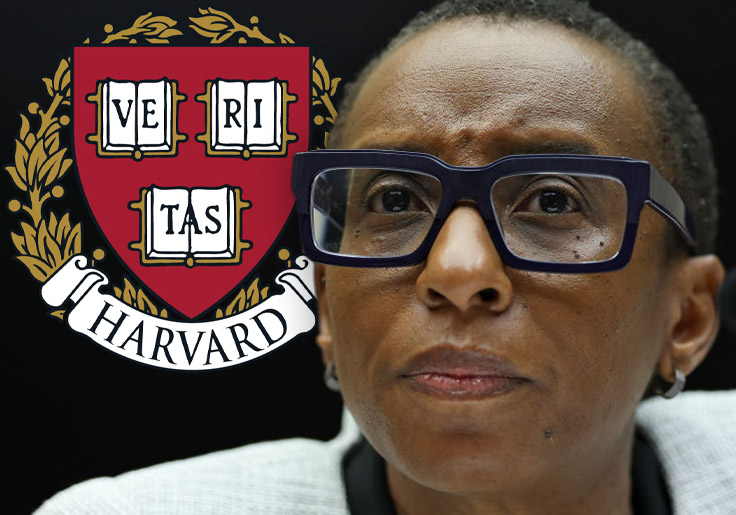
Harvard students will soon be able to take a class about the meaning of Harvard, which is very Harvard—even more so because the new course will be taught by Claudine Gay, the former university president who resigned in disgrace amid plagiarism accusations and criticism of her response to anti-Semitism on campus.
More than two years later, Gay is still a tenured professor earning almost $1 million a year. She’ll return to the classroom next fall to lead a 16-student tutorial titled “What is a University?: Purpose and Politics in Higher Education.” The new course will focus on “Harvard-specific” cases to encourage students to “engage in critical thinking about their own institution” and craft proposals to reform the (reputationally) elite university, according to the Harvard Crimson.
We’re not sure what makes Gay qualified to help students understand the “purpose” of higher education—but again, this is Harvard. To find out more, the Washington Free Beacon endeavored to semi-legally obtain a copy of the syllabus for Gay’s new course. As is often the case, we succeeded. We have reprinted the syllabus below for your immediate edification. Enjoy!
HARVARD UNIVERSITY
Department of Government — Fall 2026
GOV 94HE: What is a University?: Purpose and Politics in Higher Education
Instructor: Prof. Claudine Gay
Office: CGIS Knafel Building
Office Hours: Wednesday 2:00–3:00 PM (BIPOC students only), Thursday 2:00–3:00 PM (LGBTIQCAPGNGFNBA+ students only), Friday 5:00–5:30 AM (white students only), and by appointment (Jewish students)
Course Description
This selective tutorial examines the evolution, purpose, and politics of the modern university, tracing the historical development of American higher education as a basis for understanding contemporary debates over cirriculum, admissions, social justice, the Jewish question, and equitable frameworks for contextualizing so-called plagiarism in inequitable academic landscapes.
Students will explore Harvard-specific cases, histories, and examples to analyze how political, social, and economic forces have shaped institutional decision-making and the student experience. A central goal of the course is to encourage Harvard students to critically interrogate their own institution and propose a vision for institutional reform or reinvention.
Students will develop a policy proposal addressing a major challenge in higher education, such as:
- Out-of-control plagiarism scolds
- The unfair targeting of Black university presidents
- Lack of institutional support for non-non-violent resistance movements
Course Requirements
- Attendance: 5%
- Participation: 5%
- Weekly analytical memos (150-200 words): 5%
- Midterm essay (1–2 pages): 5%
- Final project (institutional reform proposal + presentation): 10%
- Vibes, lived experience, personal trauma, historical injustice: 70%
Note: Students who opt to protest injustice in lieu of fulfilling the course requirements will receive an automatic A
Required Texts (Representative)
- Sequoia Alexander (author), Dionne Lee Benton (illustrator), When I Grow Up, I’m Going to College! (2015)
- bell hooks, Teaching to Transgress (1994)
- Tom Hayden et al., Port Huron Statement (1962)
- Susan Abulhawa (author), Rama Duwaji (illustrator), Every Moment Is a Life: Gaza in the Time of Genocide (2026)
- Claudine Gay, Taking Charge: Black Electoral Success and the Redefinition of American Politics (1997)
- Phil J. Coates, Using AI for Academic Writing: Plagiarism-free ethical submissions (2026)
- Selected zine articles (posted on Canvas)
Course Schedule
Week 1 — Introduction
Icebreaker: rock, paper, scissors tournament, two truths and a lie
Racial identifications, pronouns, etc.
Film: Concierto Por La Libertad: Kneecap Live in Havana (2026)
Week 2 — What Are Universities? And Why Are They Racist?
Dictionary definitions (compare and contrast)
Modern example: Racist motivations behind ouster of Harvard’s first Black president, potential Jewish involvement
Week 3 — Harvard, Explained
Founding and early history
Reflections on notable alumni: Theodore Kaczynski (’62), Jim Cramer (’77), Jeffrey Skilling (’79), Lawrence Summers (’82), Joy-Ann Reid (’90), Claudine Gay (’98), David Hogg (’23)
Reflections on notable faculty: Larry Summers, Alan Dershowitz, Jeffrey Epstein (unofficial), Claudine Gay
Practical application: Tips for telling people you went to Harvard in both casual and formal settings
Week 4 — Race, Representation, and Identity
Celebrating historic figures at Harvard: Elizabeth Warren (first Native American law school professor) and Claudine Gay (first Black university president)
Guest speaker: Joy-Ann Reid (’90)
Case study: Pros and cons of former Harvard president A. Lawrence Lowell (1909-1933) and his well-meaning attempt to solve the “Jewish problem” through equity-aligned enrollment restrictions
Discussion: Do Jews really count as “white” people?
Week 5 — Academic Freedom and Campus Speech
The free speech case for copying without attribution in academic articles
Context matters: “Terrorism” vs. anti-colonial resistance, when vibes and essays aren’t sufficient
Guest speaker: AI-generated Yahya Sinwar, martyred former leader of Hamas, peace be upon
Discussion: Did the United States deserve 9/11?
Week 6 & 7 — Mental Health Recovery Break (No Class)
Week 8 — Midterm Review & Essay Due (Unless Protesting)
Week 9 — Evolutionary Biology
Natural selection, speciation, and phylogeny
Week 10 — Microbiology
Viruses, bacteria, and immune response
Week 11 — Plant Biology
Photosynthesis and growth
Week 12 — Ecology
Population dynamics, ecosystems, and biodiversity
Week 13 — Human Impact & Global Change
Climate change, conservation biology
Week 14 — Final Review
Using the attached syllabus for an Introduction to Biology class, help me write a syllabus for my new GOV 94HE class, “What is a University?: Purpose and Politics in Higher Education.” Make it sound smart like a Harvard professor wrote it.
Absolutely—here is a structured syllabus for GOV 94HE, informed by the format of the introductory biology course and tailored to the study of higher education: