
Less than 14% of nearly 400,000 immigrants arrested by Immigration and Customs Enforcement in President Trump’s first year back in the White House had charges or convictions for violent criminal offenses, according to an internal Department of Homeland Security document obtained by CBS News.
The official statistics contained in the DHS document, which had not been previously reported publicly, provide the most detailed look yet into who ICE has arrested during the Trump administration’s far-reaching deportation operations across the U.S.
The internal DHS figures undermine frequent assertions by the Trump administration that its crackdown on illegal immigration is primarily targeting dangerous and violent criminals living in the U.S. illegally, people Mr. Trump and his lieutenants have regularly called the “worst of the worst.”
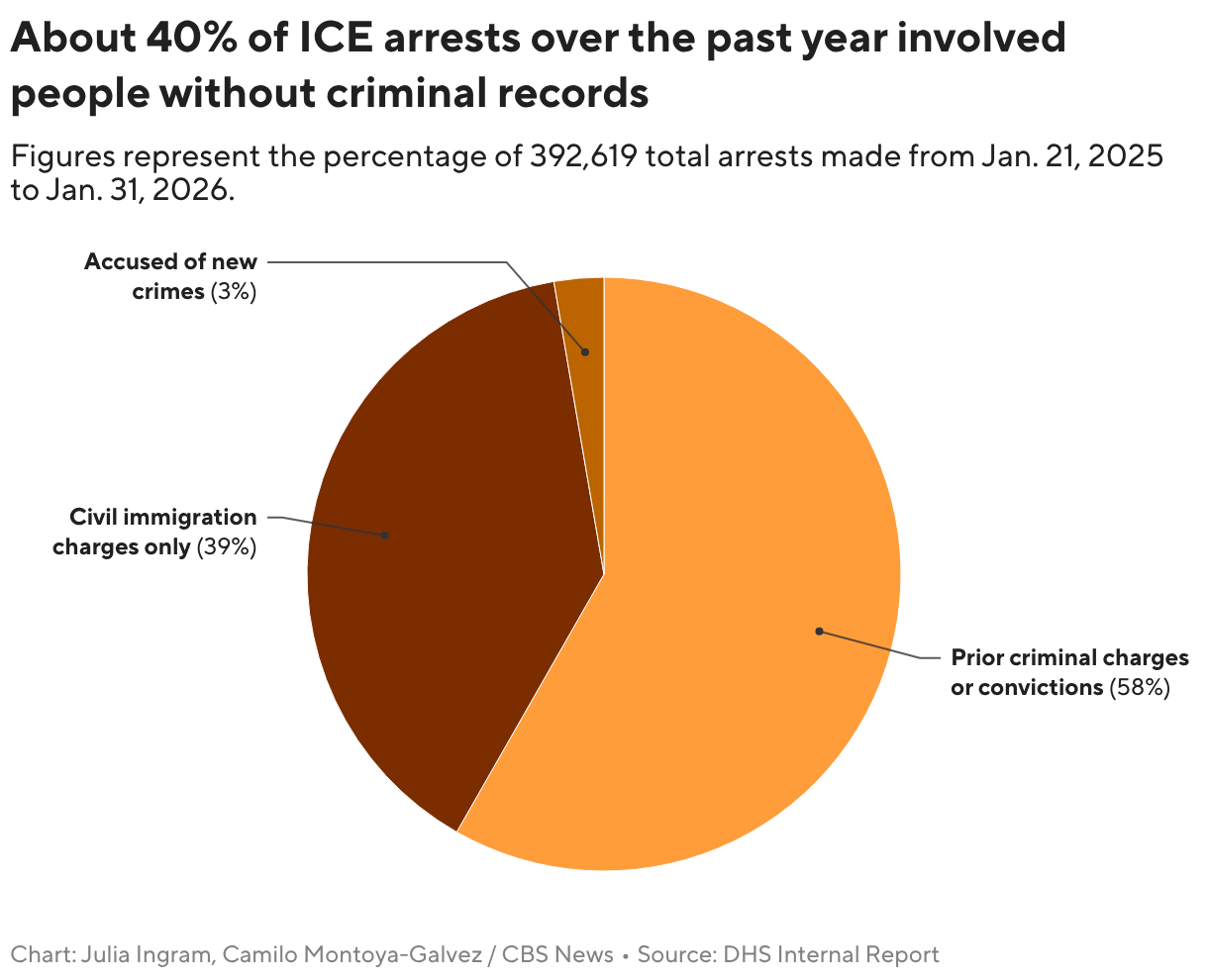
The statistics show ICE has dramatically increased arrests since Mr. Trump’s return to office. Nearly 60% of ICE arrestees over the past year had criminal charges or convictions, the document indicates. But among that population, the majority of the criminal charges or convictions are not for violent crimes.
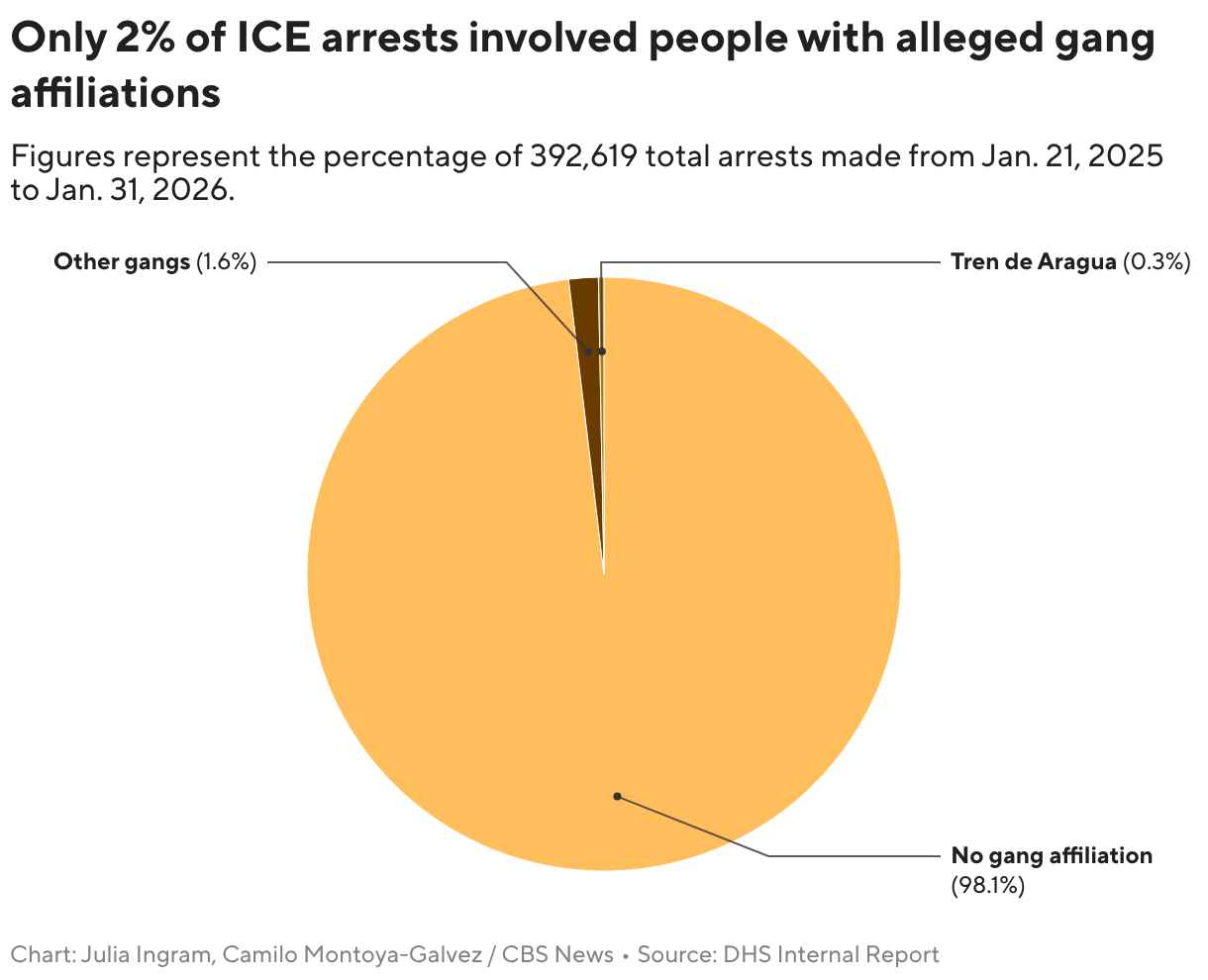
For example, while Mr. Trump and his aides often talk about immigration officials targeting murderers, rapists and gangsters, the internal data indicate that less than 2% of those arrested by ICE over the past year had homicide or sexual assault charges or convictions. Another 2% of those taken into ICE custody were accused of being gang members.
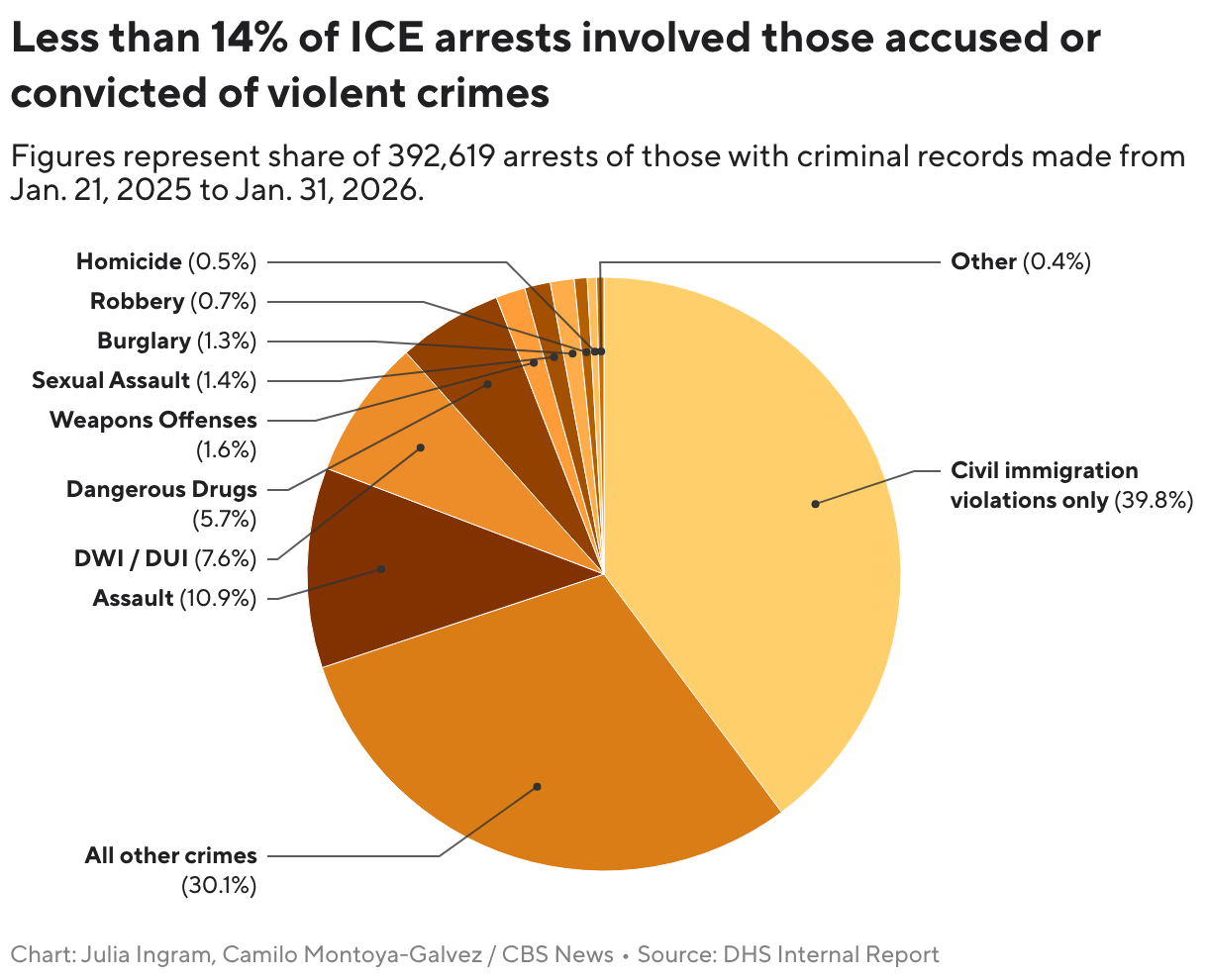
Nearly 40% of all of those arrested by ICE in Mr. Trump’s first year back in office did not have any criminal record at all, and were only accused of civil immigration offenses, such as living in the U.S. illegally or overstaying their permission to be in the country, the DHS document shows. Those alleged violations of U.S. immigration law are typically adjudicated by Justice Department immigration judges in civil — not criminal — proceedings.
While Mr. Trump’s deportation program enjoyed majority support during the 2024 presidential campaign and his early months in office, public opposition to his crackdown has grown significantly because of concerns about agents’ tactics in cities like Minneapolis and over who is being swept up by their operations.
A CBS News poll last month found that Americans’ support for Mr. Trump’s deportation efforts had fallen to 46%, down from 59% at the start of his second term. Just over 60% of those surveyed said immigration agents were being “too tough.”
CBS News reached out to the Department of Homeland Security, which oversees ICE, requesting comment on the data reported in the document.
What the statistics show about ICE arrests under Trump
The DHS document obtained by CBS News indicates that ICE made roughly 393,000 arrests between Jan. 21, 2025, Mr. Trump’s first full day back in power, and Jan. 31 of this year.
ICE classified around 229,000 of those arrested as “criminal aliens,” because they had criminal charges or convictions. About 153,000 of the arrests were categorized as “other administrative arrests,” or detentions of immigrants lacking any criminal record. Nearly 11,000 of the arrests were “criminal arrests” of noncitizens taken into ICE custody due to new criminal allegations, like interfering with operations.
In total, ICE made more than triple the number of administrative arrests, including of criminals, over the past year under Mr. Trump than the agency did in fiscal year 2024, when it recorded 113,000 administrative arrests during the Biden administration.
The percentage of ICE arrests of those with criminal histories, however, went down, from 72% in fiscal year 2024, to nearly 60% in Mr. Trump’s first year.
The figures indicate that roughly 7,500 — or 1.9% — of the ICE arrests involved individuals accused of belonging to gangs like Tren de Aragua, a criminal organization with origins in Venezuela’s prisons. Mr. Trump initially made the gang a focal point of his crackdown, deporting more than 200 men accused of being Tren de Aragua members to a notorious prison in El Salvador. A CBS News and “60 Minutes” investigation last year found most of the men did not have any apparent criminal record.
The internal DHS document lays out the most serious charge or conviction for those arrested by ICE with criminal histories.
The document lists 2,100 arrests of those with homicide charges or convictions; 2,700 arrests of those with robbery offenses; and 5,400 arrests involving individuals charged with or convicted of sexual assault. Another 43,000 arrestees are listed as having assault charges or convictions. About 1,100 had kidnapping charges or convictions and 350 had arson offenses listed.
Added together, the number of ICE arrests involving individuals charged with or convicted of the aforementioned violent crimes represents around 13.9% of all arrests.
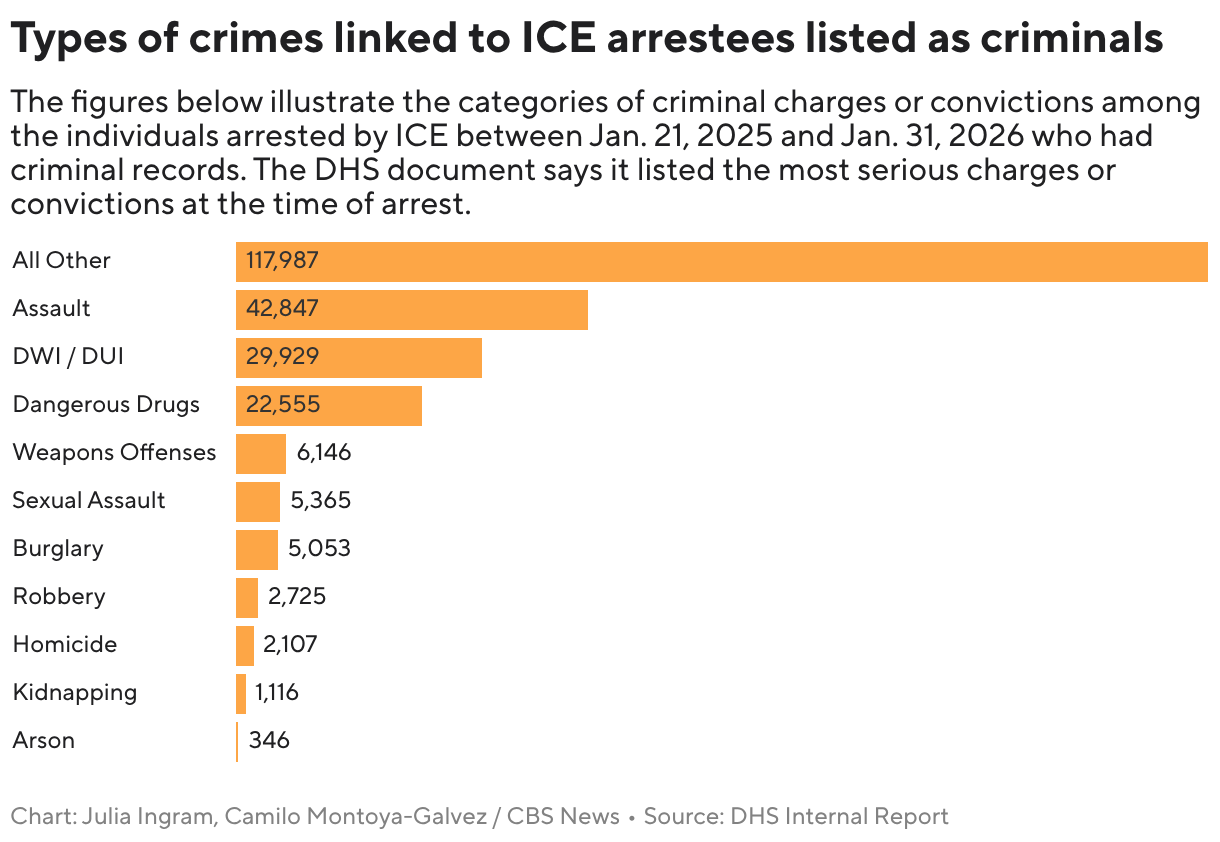
The document also says ICE arrested 22,600 individuals with charges or convictions involving dangerous drugs, while another 6,100 had weapons offenses on their records. Nearly 30,000 of those arrested by ICE had been charged with or convicted with driving while under influence or intoxicated. Another 5,000 arrestees had burglary charges or convictions.
The document says another 118,000 detainees had criminal charges or convictions for “other” crimes. Those could include immigration-related crimes, like entering the U.S. illegally, a misdemeanor for the first-time offense, or re-entering the country after being deported, a felony.
The data in the DHS document does not include arrests by Border Patrol agents, who the Trump administration has deployed to places far away from the U.S.-Mexico border, like Los Angeles, Chicago and Minneapolis. In those cities, Border Patrol agents have undertaken aggressive and sweeping arrest operations, targeting day laborers at Home Depot parking lots and stopping people, including U.S. citizens, to question them about their immigration status.