
Attorneys for Fulton County, Georgia, argued in federal court Friday that an FBI agent who filed an affidavit in support of a search warrant of the county clerk’s office for 2020 election ballots omitted information about the election and how it was conducted in the county.
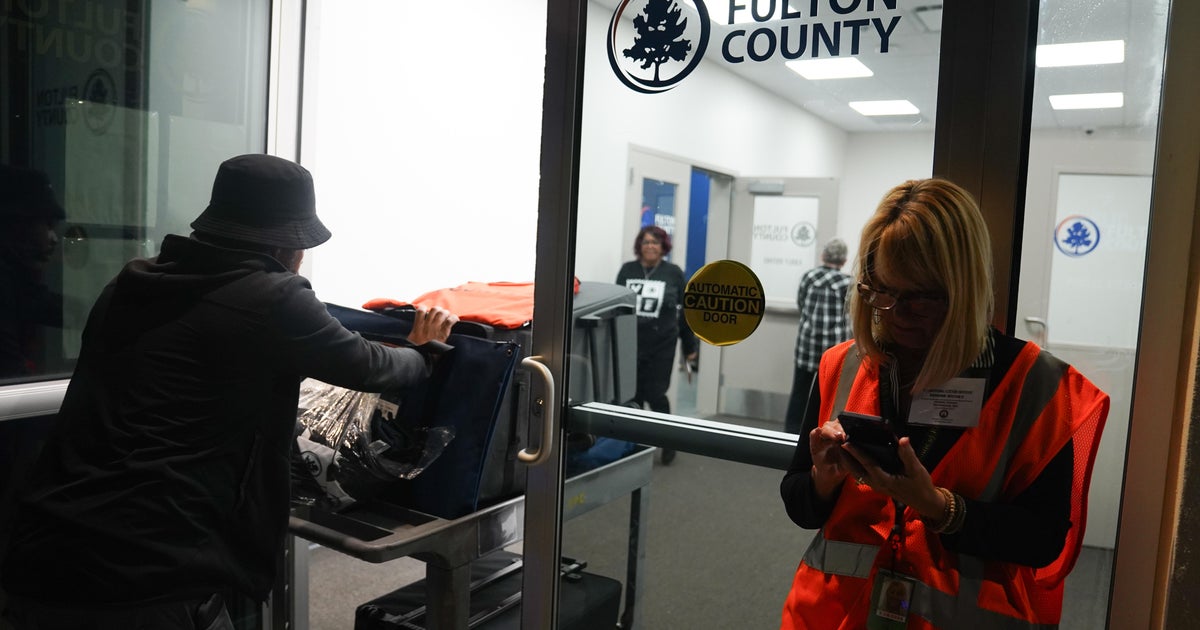
Last month, the FBI executed a search warrant at a Fulton County elections office, seeking to take “all physical ballots” from the 2020 vote, as well as tapes from vote-tabulating machines, ballot images and voter rolls.
The affidavit, written by an FBI agent and unsealed in February, detailed the legal basis for the search, and also said the FBI investigation was initiated after it received a referral from an attorney who worked to overturn the election results in 2020.
In court Friday, Abbe Lowell, arguing for Fulton County, said “a number of things were omitted” from the affidavit at the heart of the search regarding the election and alleged misconduct by the county, and a government witness, Ryan Macias, testified that “information in the affidavit does not make sense.”
Macias said there was “incoherent terminology” in the affidavit, and testified the agent and FBI “conflate certain things.” He told the court that the election “has already been looked at and investigated,” and the affidavit had just recycled debunked rumors from over six years ago.
U.S. District Judge Jean-Paul Boulee said of the Justice Department’s defense of the seizure of more than 630 boxes of election material “that piece bothers me” a “rather considerable” amount.
“How far does that affidavit have to go?” Boulee asked Justice Department attorney Tysen Duva, who led arguments for the government today.
Duva dismissed Lowell’s arguments “woefully inadequate” and responded to Boulee’s questioning about flaws in the affidavit by saying “this isn’t grading a paper.”
“Are there places in the affidavit where the agent could have done better? Sure,” Duva said, adding he “may have missed a thing or two.”
Duva also conceded the FBI’s seizure of the ballots may not lead to any charges.
“If there is an indictment, that remains to be seen,” he said. “What may happen later? Maybe nothing.”
After the FBI conducted its search, Fulton County filed a lawsuit to compel the return of the boxes. The county has asked for the seized materials to be returned and asked the judge for an order instructing the government “to maintain, but not review, any copies of the seized materials until this matter is resolved.”
Fulton County said in court filings that the Justice Department’s search and seizure of documents “callously disregards multiple Fourth Amendment rights,” of the county and was a “gross intrusion” of the state’s role in elections. The county asked Boulee, a Trump nominee, to order the return of all of the documents.
The Justice Department said it was “scrupulously careful” to comply with any Fourth Amendment concerns raised by the county, and said it searched the county’s election offices “only after obtaining a warrant based on a magistrate judge’s probable-cause determination.”
On Thursday, Boulee ruled that he would not force the FBI agent who had submitted the affidavit to testify at the hearing, after the county had tried to force him to speak about the affidavit in court.
Last month, Boulee directed Fulton County and the Justice Department to mediate the dispute instead of going to court, but that mediation failed, Boulee said, resulting in Friday’s hearing.
Lowell also argued Friday that the statute of limitations of both criminal statutes cited by the FBI agent in the affidavit have expired, and said “there’s nothing” in the affidavit “to support that there’s an ongoing investigation that matters” in Fulton County. He did warn, however, that the ballots may be used “for some future crime that may not exist.”
In court filings ahead of Friday’s evidentiary hearing, the Justice Department argued that Fulton County was trying to “disrupt an ongoing federal investigation” with its filings, and asked Boulee to deny the county’s motion.
In court filings, the Justice Department said it is investigating “irregularities that occurred during the 2020 presidential election in the County,” and is centered on if election records were properly maintained, and whether there was “procurement, casting, or tabulation” of fraudulent ballots in 2020.
Fulton County argued that the affidavit “does not identify facts that establish probable cause that anyone committed a crime” and said that the FBI agent “all but admits that the seizure will yield evidence of a crime only if certain hypotheticals are true.”
Lowell also argued that the statute of limitations of both criminal statutes cited by the FBI agent in the affidavit have expired, and said “there’s nothing” in the affidavit “to support that there’s an ongoing investigation that matters” in Fulton County. And he warned that the ballots may be used “for some future crime that may not exist.”
State officials in Georgia, including the Republican governor and secretary of state, have defended the integrity of the 2020 election for years, noting that three separate counts confirmed that Joe Biden defeated President Trump in the state. The results in Georgia were at the center of Mr. Trump’s efforts to overturn the election, and Fulton County, which includes Atlanta, is a key Democratic stronghold.
The affidavit said the current investigation originated from a referral sent by Kurt Olsen, who the FBI describes as a “Presidentially appointed Director of Election Security and Integrity.” In 2020, Olsen was an attorney who worked with Texas Attorney General Ken Paxton to urge the Supreme Court to overturn the election results.
Lowell said Friday that one of the witnesses cited by the government in the affidavit has a criminal record. He also brought up two incidents of court sanctions against Olsen and said about half of the witnesses would be categorized as “election deniers.”
In 2022, Olsen was subpoenaed by the House Jan. 6 Committee, which was investigating the aftermath of the 2020 election and the Jan. 6, 2021, attack on the U.S. Capitol. The subpoena alleged that Olsen “contacted various high-level officials at the Department of Justice” at the president’s direction to discuss filing challenges to the election results. The committee said Olsen spoke multiple times with Mr. Trump on Jan. 6, 2021.