
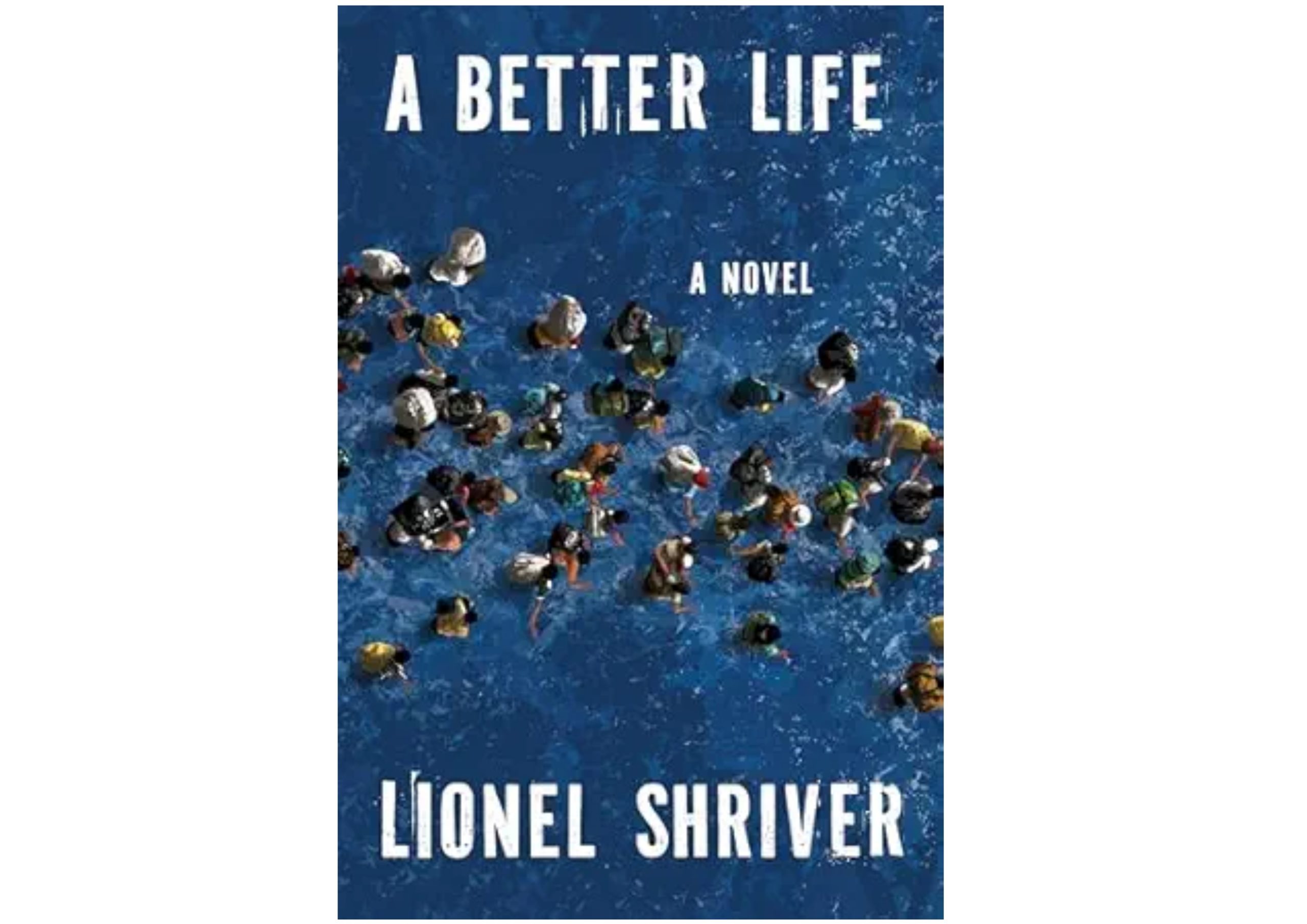
For evidence of a so-called cultural vibe shift, the pendulum swing away from the extreme sensitivity and irrational wokeness of the preceding decade, look no further than Lionel Shriver’s new novel, A Better Life, a blunt but layered—and entertaining—depiction of America’s once-lax immigration policies.
First, cast your memory back to the dawn of this decade, when the most talked-about novel was Jeanine Cummins’s American Dirt (2020). A first-person account of a Mexican woman’s harrowing flight with her son from a vicious drug cartel and across the U.S. border, the work had publishing houses falling over themselves to give Cummins a seven-figure advance. The novel “humanized [the] migration process in a way that nothing else I’d ever felt or seen had,” raved Oprah.
But in a preview of the cancel culture that would hit its nadir in that annus horribilis, a phalanx of writers, critics, and activists griped that Cummins—born in Spain, of Irish and Puerto Rican descent—was not sufficiently Latinx to write the novel. Writing from the perspective of a character unlike herself was a glaring case of cultural appropriation. In a 2023 retrospective about the episode, Pamela Paul explained, “American Dirt was essentially held responsible for every instance in which another Latino writer’s book got passed over, poorly reviewed or remaindered. … [If] the proposal for American Dirt landed on desks today, it wouldn’t get published.”
By the time of the great American Dirt dust-up, Shriver had already been warning writers that concerns over cultural appropriation could hurt fiction. In 2016, responding to a controversy at Bowdoin College—students were punished for attending a tequila party where revelers wore mini-sombreros—Shriver donned the Mexican headgear (no mini-sombrero for her; she went full-sized) during a speech at a writer’s festival. “The moral of the sombrero scandals is clear,” she declared, “you’re not supposed to try on other people’s hats.” It is perversely appropriate, then, that her new novel considers the influx of immigrants across our Southern border.
And no publisher would have picked it up just a few years ago. The story of a family exploited by unsavory immigrants, A Better Life is based on a plan floated—but never pursued—by New York City mayor Eric Adams, in which the city would pay residents to house asylum seekers. In Shriver’s alternative history, the city implements the plan (it’s called Big Apple, Big Heart) and Gloria Bonaventura is eager to open her Brooklyn home to a deserving immigrant. The 60-something divorced mother of three grown children has already been active in helping immigrants. There’s more than enough room in the charming five-bedroom early-20th-century home she won in her divorce: The only other resident is her son Nico, who’s spent the past four years since graduating from Fordham holed up in the basement bedroom, playing video games and watching YouTube. Technically speaking, he’s not unemployed because he’s not even looking for a job. He has no friends. He has no dates. His only regular appointment is a nightly rendezvous with Miss Michigan. (At least he’s not gooning.) He considers this aimlessness a noble kind of neutrality.
Nico is the only Bonaventura child who thinks his mother’s charity is a terrible idea, and not just because it means he must move into his childhood bedroom upstairs. Walking through the city, he sees that it “was being transformed over a mere eighteen months into an unrecognizable third-world hellscape. … A cascade of strangers had thrown themselves on the mercy of people like his parents who had no rational motivation to assume such a burden and who were therefore being taken for chumps.”
His older sisters have lives of their own but frequently drop by to support their mother’s altruism and chastise Nico for his cynicism. They adore the new arrival, Martine. Seeking asylum because of an abusive husband in Honduras (or so she claims), Martine cooks and cleans and contributes much more to the family than Nico does. But he spots holes in Martine’s stories and sees everything she does as part of a larger plan to manipulate his mother.
Increasingly suspect events push the reader toward seeing Nico’s side of things. When Martine’s brother Domingo arrives, Gloria lets him live in the basement with his sister, even though she’s not compensated by the city for him—and despite the strange nature of their supposedly sibling relationship. When Martine’s children in Honduras (whom she had never mentioned before) are kidnapped, Gloria dips into her retirement account to pay the hefty ransom. A second uninvited guest makes himself at home, a charming business partner of Domingo’s named Alonso who has the virtue of being honest about how some immigrants game America’s naive policies—as he proceeds to do with the Bonaventuras.
Before long, a slew of more tattooed bad hombres make themselves at home. They mooch, they steal, they make a mess, they don’t say thank you, and they turn the Bonaventura home into the headquarters for their criminal enterprise. Gloria’s charity may be admirable at first, but it seems to devolve into a combination of plain old gullibility and a stubbornness to concede that her son was right. By the time she does, it’s too late.
Reactions to this novel so far have followed party lines, but they shouldn’t. “There is cringing amusement in seeing how far its author is willing to go to pierce leftist pieties under the protective tent of fiction,” Alexandra Jacobs writes for the Times, “but it’s more playground taunt than brave truth.” That predictable reaction misses an important element that elevates this novel above political propaganda. As strongly as Shriver expresses conservative concerns about lax immigration policies, she consistently undermines or compromises the characters who hold those opinions.
This approach applies to Nico especially. Because the third-person narrator stays close to his perspective throughout, he is the most fully realized character in the novel, and his general skepticism is vindicated in a finale that is at once tragic and ironic. Yet his theories about Martine’s duplicity remain unproven. Most importantly, Nico is a loser. He’s an embodiment of the shiftless, aimless, conspiracy-minded Gen-Z male. He’s nearly as much a target of Shriver’s satire as the immigration policies he loathes, and his laziness undermines his complaints about immigrants gaming the system. Even if you agree with his disdain for the Biden administration’s immigration policies, you won’t find him admirable. This creates a tension that makes the novel compellingly ambiguous.
Funnily enough, some of the novel’s least convincing moments are the result of Shriver’s own distance from the United States. (The author was born and educated stateside but has been an expatriate since the mid-1980s.) Her language occasionally veers away from American English and into distinctively British idioms, such as “Good show!” and “losing her rag.” Those shortcomings in Shriver’s attempt to tell the story through the perspective of a young American man don’t mean it’s wrong for her to try on his sombrero.
More significantly, Shriver occasionally drives home the point that the Bonaventura residence is a microcosm for the United States, teeming with unwanted visitors who will never leave. These are the weakest, because the most didactic, moments of this otherwise surprisingly complex and compelling novel. A Better Life is worth reading for its own sake, and worth welcoming as another sign the Woke fever has broken.
A Better Life: A Novel
by Lionel Shriver
Harper, 304 pp., $30
Christopher J. Scalia is a senior fellow at the American Enterprise Institute and the author of 13 Novels Conservatives Will Love (but Probably Haven’t Read) (Regnery, 2025).