
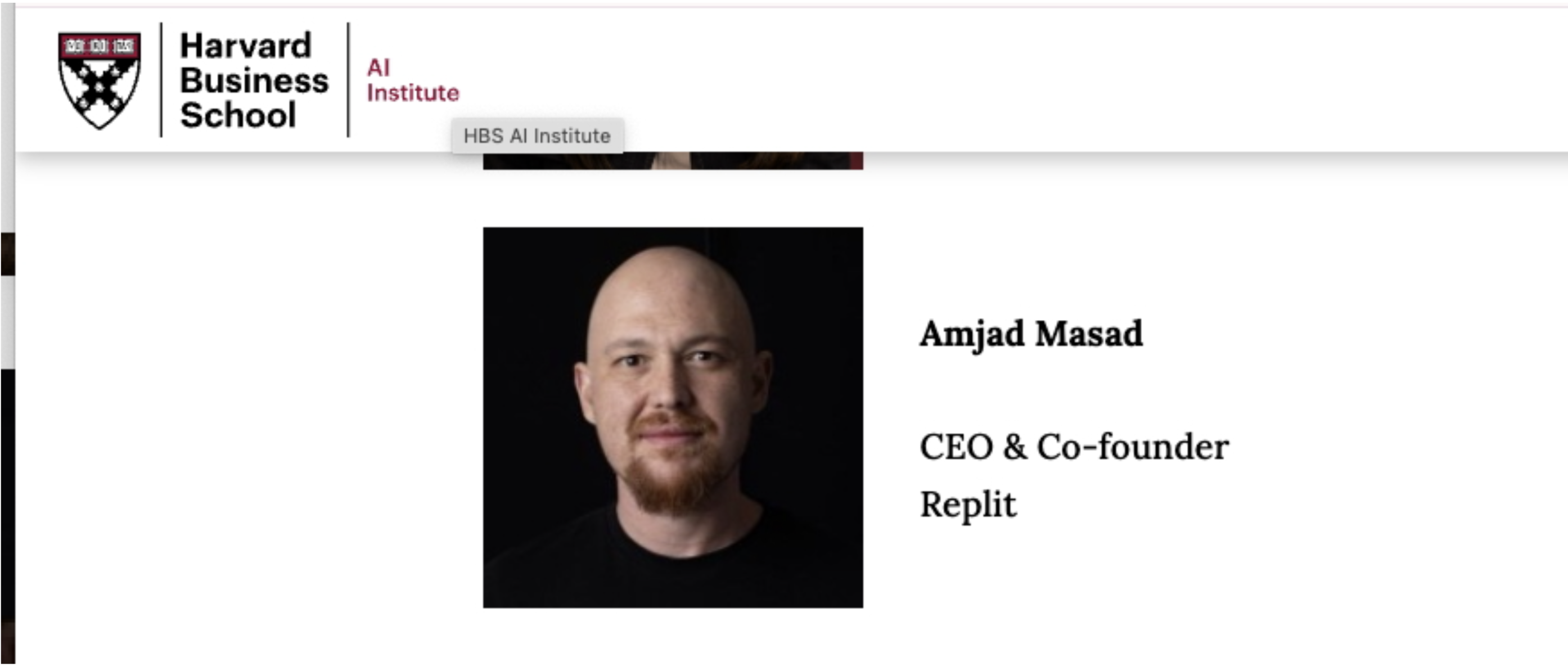
A businessman who was ostracized in Silicon Valley for social media posts that demonized Israel is being touted by Harvard as a star speaker at an upcoming conference on artificial intelligence.
Amjad Masad, the CEO of a Foster City, California-based artificial intelligence company called Replit, posted in June 2025 that “Israel is the most destabilizing force in the world.” When people pushed back that Iran is the real threat, he accused them of spreading “retarded propaganda.”
He’s also likened Israelis to Nazis, posting, also in June 2025, “We are at the ‘I was just following orders’ stage of the genocide.”
The extreme rhetoric has attracted press attention. A January 2026 profile of Masad in the San Francisco Standard described him as wearing a keffiyeh while shooting an AR-22. “Masad’s ultimate objective was to leverage his success in tech to help the Palestinian cause,” that article reported. It says he made a deal to make Replit “the exclusive AI coding software for Saudi governmental agencies.” The article says he’d never work with Israel: “it’s an illegitimate and criminal government … Netanyahu is a war criminal.” The article said “Masad became a frequent topic in pro-Israel tech groupchats, a source said, where some investors accused him of being antisemitic.” It also says “investors called him a ‘terrorist sympathizer.’”
Masad has complained publicly about being ostracized in Silicon Valley: “When I first spoke out about the genocide, I was one of the few voices in tech, and it came at a cost. I faced sabotage especially from the VC class: lies, leaks, threats, and blocked investments.”
One place where there is no cost, and where there may even be rewards, for demonizing the Jewish state? Harvard University, which is breathlessly welcoming Masad as a star speaker at a faculty-organized conference on artificial intelligence.
“We’re thrilled to welcome Amjad Masad, Founder & CEO of Replit, to the Leading with AI 2026 conference at Harvard Business School, May 14-15,” an email invitation from HBS Alumni Relations, obtained by the Washington Free Beacon, says. “Amhad just raised $400M in a Series D and unveiled Agent 4; an AI that can vibe code an entire company from scratch. He’s not just building a product. He’s redefining what it means to be a ‘developer’—and what it means to run a business.” That sort of endorsement from Harvard in the competitive AI field used to be worth something but is worth less than it used to be as Harvard’s reputation has declined amid a series of scandals about research fraud, left-wing bias, grade inflation, and antisemitism.
The conference was also promoted from a Harvard Business School Alumni Facebook account with a large picture of Masad. “Amjad Masad — Founder & CEO of Replit — is joining us at Leading with AI 2026 on the Harvard Business School campus, May 14–15,” the post says. “Replit has grown revenue five-fold in six months. Its AI agent can write, debug, and deploy working software from a plain-language prompt. And Amjad has been at the forefront of one of the most disruptive shifts in how businesses are built. Whether you’re a founder, executive, or just trying to understand where AI is taking us — this is the room you want to be in. Open to Alumni. Check your email for information on how to register.”
Masad also has a track record of repeatedly using terminology that, in cases involving others, developmentally disabled people and their advocates have denounced as offensive. In March 2026, he wrote, “Imagine how retarded you have to be to believe that top 10 podcaster in the world sells paid tweets.” In February 2025 he wrote, “no retard that’s genocide.” Also that month he wrote, “I’m Palestinian you utter retard.” At least as of four years ago, Harvard told incoming freshmen the use of such a term constituted “verbal abuse.”
The Harvard Business School news office and the Harvard professor organizing the event, Karim Lakhani, who is Dorothy & Michael Hintze Professor of Business Administration at Harvard Business School and Founding Chair of the HBS AI Institute, did not respond to an email seeking comment. A press release from 2016, when Lakhani was appointed to the Mozilla Corporation Board of Directors, describes him as “Born in Pakistan and raised in Canada.” As is frequently the case with Harvard Business School, people have one foot in the university and another foot in business. Lakhani is listed simultaneously as a Harvard professor and as an “expert” at Keystone, a consultancy that “provides transformative solutions for leading companies.” Another Harvard AI Institute affiliate, Jen Stave, is also listed simultaneously at Harvard Business School and at Keystone, and her LinkedIn profile describes her as simultaneously serving as “inaugural director HBS AI Institute” and as “partner and practice leader, global strategic advisory” at Keystone. Stave and Lakhani announced an advisory board for the Harvard institute that included Mary Callahan Erdoes, a banker to Jeffrey Epstein who was also named to the board of the Harvard Management Company, which manages Harvard’s endowment. The advisory board also included Lewis Chan, who is based in China and is affiliated with the Our Hong Kong Foundation, a China-aligned think tank, and who is also a member of the MIT Sloan School “Asian Executive Board.”
I suppose one can argue from a free speech perspective that an invitation to speak at a Harvard conference should be independent of political speech, however silly or crude, on topics unrelated to the conference. I’m actually somewhat sympathetic to that “no political litmus tests for academic visitors” point of view. In Masad’s case, though, his willingness to enter into business deals for his company with Saudi Arabia but not with Israel makes his views directly related to the company that he’s invited to come speak about, and that Harvard is cheerleading for in the conference invitation material. If anyone thinks that an AI company that openly refused to serve black people or gay people would be welcome on the Harvard campus, forget about it. Yet shunning Israel seems to be no obstacle when Harvard is concerned. The federal government says such double standards are evidence of Harvard’s discrimination.
At least two federal judges have faulted Harvard for its treatment of Jewish students. “Harvard failed its Jewish students,” Judge Richard Stearns found in August 2024. And Judge Allison Burroughs has ruled, “It is clear, even based solely on Harvard’s own admissions, that Harvard has been plagued by antisemitism in recent years and could (and should) have done a better job of dealing with the issue … Harvard was wrong to tolerate hateful behavior for as long as it did.” The issue remains before federal courts at both the district and appellate levels, and it is also the subject of continuing executive branch and congressional scrutiny, with billions of federal research funding for Harvard at risk.
Harvard has argued that it has taken steps to improve the situation and also that the focus on antisemitism is a pretext by the Trump administration to attack research universities. Yet the claim that it is all a Trump pretext ignores that the problems erupted during the Biden administration. And the claims that it has somehow been fixed ignores many recent events.
The Harvard Business School has been a particular focus of concern by alumni. In October 2023, five business school alumni—Joanna Jacobson, Seth Klarman, Mitt Romney, Bill Hellman, and Mark Nunelly—wrote to Harvard administrators, including Business School Dean Srikant Datar, about what they called the “violent assault of an Israeli student on the Harvard Business School campus.” Masad’s appearance and the AI conference are scheduled for Klarman Hall, an auditorium on the Harvard Business School campus named for Klarman.
Last month, a Harvard Business School professor who participated in a library protest in favor of student anti-Israel protesters was scheduled to teach a slanted “case” on divestment from Israel, a class that was only delayed and revised after objections by Jewish students and alumni. The Business School convened an antisemitism working group that drafted a report with findings including that Jewish business school faculty “were shocked by the hatred.”
“Several said they used to feel pride to work at Harvard, but now felt embarrassed,” the draft report said.
Among the “themes” that the report said emerged from interviews with Jewish students, staff, and faculty at Harvard Business School were “a palpable experience of feeling unwelcomed, abandoned, fearful, and silenced,” “a surprising level of ignorance, insensitivity, and arrogance,” and “a School culture of silence and anti-intellectual tendencies.” Dean Datar did not release the report publicly; it only surfaced in an appendix to a report from Republicans on the House Committee on Education and the Workforce.