
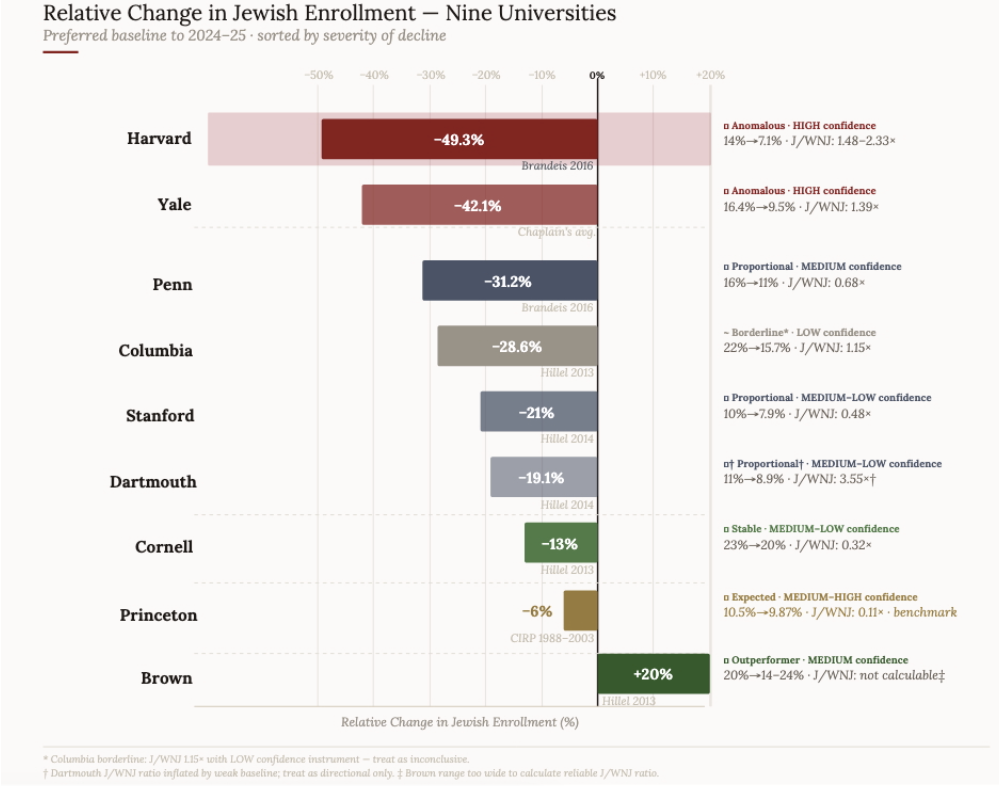
Harvard College’s dean of admissions and financial aid, William Fitzsimmons, says Harvard is following Brown University’s lead in admissions outreach targeting Jewish day schools, and that results so far this year have been encouraging.
The dean’s remarks, made February 20 at a Harvard Chabad shabbat dinner at Harvard Business School where a former Brown chancellor was the honored guest speaker, are being reported here for the first time. Fitzsimmons also joined Harvard president Alan Garber and Harvard Chabad in December in publicly lighting the Harvard Chabad chanukah menorah in Harvard Yard.
The news comes as the Harvard Jewish Alumni Alliance, the university’s official Jewish alumni group, released a 64-page report, A Narrowing Gate: Jewish Enrollment at Harvard and Its Peers, 1967-2025.
“Harvard’s Jewish undergraduate enrollment stands at 7 percent today, the lowest level recorded since before World War II and the lowest of any Ivy League institution with reliable data. That is roughly half what it was a decade ago, and less than a third of the 25 percent share Jewish students held for much of the latter twentieth century,” the report says. “Among well-documented peer institutions, no school has seen a steeper recent-decade decline.”
The report calls on Harvard to count Jewish applicants, admits, and enrollment, to “commission an independent, third-party investigation” and correct any disparities.
“Our Jewish community share at Harvard is at lows we haven’t seen in 100 years. Other institutions subject to similar pressures have not seen such severe drops,” the president of the Harvard Jewish Alumni Alliance and an author of the report, Adrian Ashkenazy, told the Washington Free Beacon in an interview. “Why is Brown succeeding where Harvard failed?”
The level of Jewish enrollment has been an issue of long-running concern for the Harvard community. I wrote about it in December 2022 when I was working at Education Next, a Harvard-based education policy journal. Rep. Elise Stefanik (R., N.Y.) questioned the then-Harvard president, Claudine Gay, about it in a December 2023 congressional hearing: “According to the Hillel college guide, the Crimson freshman survey, and even Harvard’s own Education Next journal, the population of Jewish undergrads at Harvard has plummeted from roughly 25 percent in the 1980s to between five and 10 percent. Now, why is that?”
Gay, who resigned in January 2024 under pressure over a plagiarism scandal and a botched response to anti-Semitism on campus, replied, “that is not data that we collect as part of the admissions process. So I can’t speak to those numbers or to the trajectory.”
Interest in the issue extends far beyond Harvard or the Jewish community.
President Donald Trump had a Jewish Harvard student, Alexander “Shabbos” Kestenbaum, speak at the 2024 Republican National Convention. Kestenbaum sued Harvard alleging discrimination and won an early ruling from a federal judge that “Harvard failed its Jewish students.” As president, Trump froze hundreds of millions of dollars in federal grants to Harvard and also tried to block foreigners from entering the U.S. to attend the school. The funding fight is now before the U.S. Court of Appeals for the First Circuit.
Harvard College admissions were also the subject of a decade-long, multimillion-dollar legal battle that culminated in the 2023 Supreme Court opinion Students for Fair Admissions, Inc. v. President and Fellows of Harvard College, in which the court held that the racial preferences Harvard had been using in its admissions violated the Equal Protection clause of the 14th Amendment to the Constitution. Fitzsimmons testified in that trial. Harvard defended its practice up to and even after the Supreme Court called them unconstitutionally discriminatory.
Brown’s July 2025 settlement agreement with the federal government included, among “significant, proactive, effective steps to combat antisemitism and ensure a campus environment free from harassment and discrimination,” “outreach to Jewish Day School students to provide information about applying to Brown.” Brown’s president, Christina Paxson, spoke March 17 at the American Enterprise Institute about using admissions as a way to increase diversity of perspectives on campus. “We’re doing recruiting in religious day schools,” Paxson said.
Harvard may wish its fight with the government over anti-Semitism to be in the rearview mirror, but, unlike Brown, it has no settlement agreement. Instead it faces yet more litigation and public scrutiny. Stefanik has a book, Poisoned Ivies: The Inside Account of the Academic and Moral Rot at America’s Elite Universities, coming April 14. She posted to social media about the Harvard Jewish Alumni Alliance report: “The antisemitism does not just impact students on campus at Harvard. It shapes admissions.”
The House Education and Workforce Committee, whose hearings led to the resignations of Gay and of Presidents Liz Magill of Penn, Michael Schill of Northwestern, and Baroness Minouche Shafik of Columbia, is pressing ahead on the issue. The committee on March 17 released a majority staff report, “How Campuses Became Hotbeds: The Rise of Radical Antisemitism on College Campuses.” It highlights how some of Harvard’s problematic staff and faculty—including the executive director of Harvard’s Francois-Xavier Bagnoud Center for Health and Human Rights, Jehane Sedky—remain in place at the university. Sedky did not respond by deadline to a request for comment on the report. According to the House report, she responded to the report of Harvard’s Presidential Task Force on Combating Antisemitism and Anti-Israeli Bias by claiming that the report “exhibits all six elements of anti-Palestinian racism,” and citing the use of the word “terrorism” as a symptom of such racism.
“Let the release of this report serve as an important reminder: if university leaders forget their legal responsibility to address discrimination of any form on campus, my colleagues and I will remind them,” the chairman of the committee, Rep. Tim Walberg, Republican of Michigan, said.
Since Fitzsimmons himself is not hostile and was in place both at Harvard’s Jewish peak and at its recent low ebb, it’s worth considering what or who else may be driving the decision making. There’s a pincer of anti-Israel students and faculty that are involved. Harvard’s anti-Israel student activists have infiltrated the admissions office and at one point even were posting pictures of themselves in keffiyehs from the main Harvard College admissions Instagram account. And there is a faculty standing committee on Admissions and Financial Aid in Harvard College. Its members include Ali Asani, who signed a statement demanding “an end to US support for Israel’s apartheid regime,” condemning Israel’s “state aggression,” and expressing “support for the Palestinian liberation struggle.” Another member is Maya Jasanoff, who said she brought oranges and bananas to the anti-Israel protesters who erected an encampment in Harvard Yard in violation of university policies. Asani and Jasanoff are both on leave this academic year. President Trump recently posted a link to a Washington Free Beacon article about Jasanoff, who was expected to take over as the next chair of Harvard’s history department, proclaiming, “Harvard should not hire this misfit!”
In addition to the influence of individuals, there are market forces at play. College rankings and internal discussions related to admissions put a premium on “yield,” that is, the percent of students admitted to a college who choose to attend. Harvard, unlike many of its competitors, doesn’t have a binding early decision option that allows an admissions office to goose its yield by offering admission only to candidates who are committed in advance to accept. To compensate, Harvard has resorted, essentially, to paying students to attend—offering not only free tuition but extra cash in the form of $2,000 “startup grants,” $2,000 “launch grants” and “coat money” for students whose families are poor enough to qualify for “need-based” financial aid. A 2023 article in the university-published Harvard Gazette featured one such student, Innocent Munai, who called such grants “a lifeline.”
“Coming from Tanzania, East Africa, and being on full financial aid here, every opportunity like this represents more than just financial support; it embodies hope, validation, and a reminder that my dreams and aspirations are recognized, valued, and supported, and it ignites an even stronger desire to excel and give back to the community,” Munai said in the Gazette article.
Munai was recently featured in the Crimson as pleading not guilty to two counts of indecent exposure after prosecutors said he repeatedly walked through dorm halls “undressed from the waist down.” Munai’s lawyer did not respond by a deadline to a request for comment.
Some prospective Jewish applicants to Harvard, seeing what a circus it is, may decide not to even apply. Or, if they do apply and get in, they may choose to go somewhere else instead. It’s that second risk that might drive even a nondiscriminatory admissions officer to go with a more sure-bet-to-attend applicant instead of a Jewish student who might decide that there’s less hostility at Vanderbilt, the University of Florida, Yeshiva University, Brown, Yale, the University of Chicago, West Point or Annapolis, or Washington University in St. Louis. The University of Florida and the University of Texas at Austin are both offering four-year, full-tuition scholarships via the Rosenthal-Levy Scholars Program for “exceptional undergraduates interested in the great ideas of Jewish and Western civilization and the responsibilities of American civic leadership.”
As I observed in 2018 about Stephen Schwarzman, a Jewish student rejected when he applied to Harvard College in the pre-Fitzsimmons era who later became a significant donor to Yale and MIT, the genuinely scarce resources aren’t the slots at Harvard College but the future Stephen Schwarzmans. For all of the constructive interventions by Stefanik, Trump, and others, and for all the ways that endowments and federal financing make it less than a purely free market, the most powerful forces for quality and improvement in higher education are competition and choice. That’s part of why Harvard’s Fitzsimmons and Ashkenazy are both suddenly talking about Brown.