
Washington — The House is on track Thursday to approve a three-year extension of health care tax credits that Congress let expire at the end of last year, with a growing number of Republicans poised to join Democrats to back the measure.
GOP members who revolted against GOP leadership to join Democrats in forcing a vote on the issue are expected to propel the measure to passage in the lower chamber. The legislation is unlikely to pass the Senate in its current form, but some lawmakers have said it could serve as the starting point for a broader compromise.
“We’ll get this off of the House floor, if the Republicans stay true to their word, and we look forward to passing that in a bipartisan way,” Rep. Pete Aguilar of California, the chairman of the House Democratic Caucus, said Wednesday.
During a procedural vote on Wednesday, nine Republicans voted with all Democrats to advance the measure — more than the four who crossed the aisle last month.
The Affordable Care Act tax credits subsidized premiums for millions of Americans who have coverage in state-run exchanges. One analysis found that premiums were set to double without the enhanced credits.
Their extension was at the center of the government shutdown, which stretched through October and into November to become the longest in history. After a handful of Senate Democrats broke with their party to end the shutdown without securing an extension for the enhanced tax credits, House Democrats pushed ahead on an effort of their own — but needed GOP support to make it successful.
House Minority Leader Hakeem Jeffries, a New York Democrat, led the effort to force the vote with a discharge petition in the final weeks of the year. Moderate Republicans have generally criticized a straight extension of the tax credits without reforms. But four GOP members signed onto the petition, arguing that an extension of the tax credits without reforms was more favorable than letting them expire.
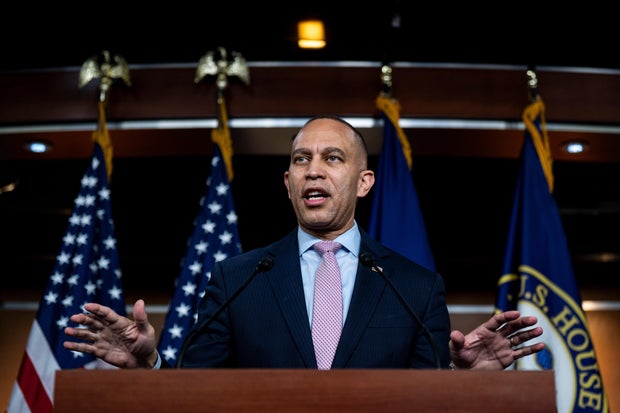
Rep. Mike Lawler of New York was one of the four Republicans who signed onto the petition last month, along with Reps. Brian Fitzpatrick, Ryan Mackenzie and Rob Bresnahan of Pennsylvania.
“We endeavored in a bipartisan negotiation after the shutdown to come up with a compromise bill that would extend the subsidies, but put in place necessary reforms,” Lawler told reporters Tuesday. “Unfortunately, we couldn’t get a vote on that before Christmas, and so the only alternative was to sign the three-year discharge.”
The moderate Republicans are banking on the measure being a vehicle for a compromise bill in the Senate.
“I’m hopeful that when we pass the discharge through the House, the Senate will be able to use that vehicle and garner enough support to get a bipartisan compromise across the finish line,” Lawler said.
The search for a Senate compromise
A number of moderate Democrats and Republicans in both chambers have been seeking a solution on health care costs. And the discharge petition added momentum to a bipartisan effort to reach a health care compromise before lawmakers broke for recess in December. Now, lawmakers are looking to the Senate to come to a long-sought agreement to extend the credits, with some reforms.
The Senate rejected a Democrat-led effort to pass a three-year extension of the enhanced tax credits last month. Republicans offered an alternative plan to send funds directly to consumers through health savings accounts that also fell short. But a number of Senate Republicans expressed willingness to reach a compromise.
GOP Sen. Susan Collins of Maine, who’s been involved in the discussions, told reporters on Tuesday that “we’re continuing to work hard” on a compromise measure. She said parts of the measure would be similar to what she and Sen. Bernie Moreno, an Ohio Republican, originally proposed last month. That plan would extend the tax credits for two years, with some reforms in the first year and then “more substantial reforms” in the second.
Senate Majority Leader John Thune, asked about the timeline for addressing the tax credits in the upper chamber, told reporters Wednesday that the conversations among the bipartisan group of lawmakers have been productive and “we’ll see where the discussions are going.”

“There’s some thorny issues they have to resolve,” Thune said. “You got to deal with reforms, you got to deal with a bridge to an HSA, and then obviously, Hyde is a big, big challenge.”
President Trump encouraged Republicans in Congress to be “flexible” on the Hyde amendment, which restricts federal funding for abortions, in order to find a solution on health care costs. But conservatives in Congress haven’t expressed willingness to move on the issue, seeking additional Hyde amendment language within the health care bill to ensure it applies to coverage in state-run exchanges.
“There’s no flexibility. You’re either using public funds to pay for abortion or you’re not. We’re not sure there’s a compromise available on that,” Republican Rep. Andy Harris of Maryland, who leads the House Freedom Caucus, told reporters Wednesday.
Thune said while Collins and Moreno are trying to address the challenging issues, there isn’t “a landing spot just yet.”
“The conversations are constructive,” he added. “But at this point, there’s nothing that I’m aware of that we’ll be voting on soon.”