
At CIA headquarters in Langley, Virginia, an imposing spy aircraft stands outside the main entrance — a relic from a pivotal era of Cold War intelligence gathering that, in its time, pushed aerospace technology to its limits.
But its stationary, terrestrial home amid birds and bugs, instead of at Mach 3 speeds and altitudes of 80,000 feet, meant it risked falling apart.
“The A-12 is prime real estate here at CIA headquarters,” Robert Byer, CIA’s museum director, told CBS News in an interview, noting employees pass by it daily. But, he added, “this plane was not built with the idea of being outside 24/7.”
The A-12, a top-secret reconnaissance plane developed in the late 1950s and operational in the early 1960s, is more than a piece of aviation history. It is a “macro artifact,” according to Byer, who described the unique conservation challenges that the agency has been working to address through an extensive restoration project.
Since arriving at CIA headquarters in 2007 — when its 39,000-pound frame was hauled on five wide-load trucks and mounted on pylons sunk 40 feet into the ground — the aircraft, known at CIA as Article 128, has been the focus of painstaking preservation work. The goal is to honor what the agency describes as the “golden age of overhead reconnaissance,” Byer said.
The aircraft is the eighth of 15 A-12s built and one of nine known to survive today. It also serves as a memorial to CIA pilots Walt Ray and Jack Weeks, who died in the line of duty in the late 1960s. Because it sits on the agency’s main campus, however, it remains inaccessible to the public.
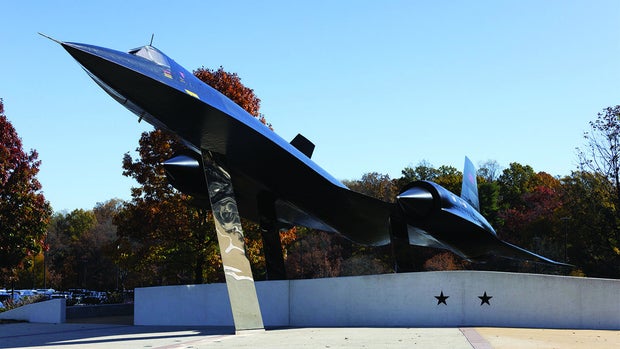
Constructed largely from titanium composites, the A-12 was developed in direct response to the 1960 shootdown of a U-2 spy plane, which exposed the vulnerability of existing surveillance methods. U.S. intelligence officials urgently needed an aircraft that could fly higher and faster than Soviet air defenses at a time when, as Byer put it, “there really was an Iron Curtain.”
Operating the A-12 was demanding and costly. It required specialized fuel, intensive maintenance and pilots trained to fly in full pressure suits.
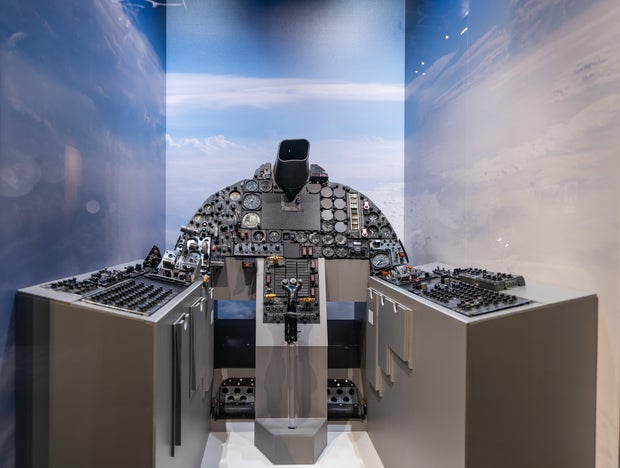
Its design also created long-term preservation challenges. The aircraft was built with seams and gaps that allowed the metal to expand at extreme speeds and altitudes — an advantage in flight, but a liability on the ground. Over time, insects, moss and mold infiltrated the cockpit, while the plane’s exterior paint suffered repeated adhesion failures.
In 2018, the agency completed one major cleaning and recoating, but additional wear soon appeared. That prompted further research and collaboration with other institutions that display A-12 aircraft.
In the summer of 2025, CIA experts visited the Intrepid Museum in New York City and the U.S. Space & Rocket Center in Huntsville, Alabama, consulting curators on how they protect their A-12s from harsh outdoor conditions. Unlike the Langley aircraft, those planes are accessible to the public.
“It’s a small, small, very small niche subgroup of museums that have an A-12. And it’s definitely a nice little club that we belong to,” Byer said. “And everyone in that club is very friendly [with] sharing information because we all want to keep our A-12s in the best possible shape.”
Drawing on those insights, the CIA opted to recoat the aircraft using automotive paint, chosen for its durability, flexibility and resistance to UV damage and weather extremes. The latest restoration, completed just ahead of the 60th anniversary of the A-12’s operational readiness in November 1965, also included stripping failing paint, repairing water damage and inspecting the cockpit.
Despite its relatively short operational life — the A-12 was soon eclipsed by satellite reconnaissance and its Air Force successor, the SR-71 Blackbird — Byer emphasized its enduring significance.
“The A-12 was not built for technology’s sake; it was built to get us information on the Soviet Union that we couldn’t get anywhere else,” Byer said, adding, “It’s a huge artifact of CIA history, and we’re committed to keeping it in the best possible shape for the future.”
The aircraft flew primarily over Asia, including missions photographing missile sites during the Vietnam War. By the mid-1960s, however, satellites were rapidly taking over the intelligence role once filled by high-speed, high-altitude aircraft.
One notable detail in the restoration was returning the aircraft’s tail number color to red, reflecting its operational appearance. Historical research and consultation with a former engineer at Area 51, the highly classified U.S. military base in Nevada, confirmed that red tail numbers were used during active flights and changed regularly to confuse observers.
Historically, “whenever people were talking about aliens over Area 51, if you look at alien sightings, over 50% of them line up with A-12 flights,” Byer said. “Back then people were so sure that there were aliens out there and the truth is it was just technology that they didn’t know about yet.”
He declined to say whether comparable stealth technologies are available to the CIA — and perplexing the public — today, but said the agency’s culture of innovation remains driven by intelligence needs.
“How does it get us the information we need in order to be able to brief the president, to give our policy makers the information,” he said, “that they can’t get anywhere else?”