
Washington — The 15 comments came across a series of eight days in July, posted under pseudonyms alluding to the perpetrators of some of the most infamous mass shootings in U.S. history, including Sandy Hook Elementary School and Aurora, Colorado.
“That POS Judge … MUST have her life ENDED Immediately! Get it done, Patriots!!” read one post, referring to a federal judge in California.
Another named members of Congress: “This is GREAT! Now I can use a, high-powered firearm to take care of [four members of Congress], and the Squad members … for starters! Wish me Luck.”
The posts targeted a Supreme Court justice, seven federal judges and 11 lawmakers, and included what prosecutors said were “thinly veiled racial epithets.”
The comments, posted in response to news articles, were traced back to a Minnesota man, Jeffrey Petersen, who admitted to the FBI that he was behind some of the postings and acknowledged they “got out of hand,” according to prosecutors’ filings. Petersen was first indicted last October on 20 counts and pleaded not guilty.
His lawyer is seeking to have the charges dismissed, arguing that Petersen was engaging in speech protected by the First Amendment. While the comments may have expressed wishes of death, they didn’t indicate Petersen had any plans to kill the officials, his defense lawyer said.
Petersen is one of 126 people charged last year for making threats to federal and top state officials, according to a CBS News analysis of court records from all 94 federal judicial districts. CBS News examined cases brought under federal statutes that make it a crime to threaten to kill or harm the president and successors to the presidency, and to transmit threatening communications.
The National Counterterrorism Innovation, Technology, and Education Center at the University of Nebraska at Omaha and the Prosecution Project also contributed data.
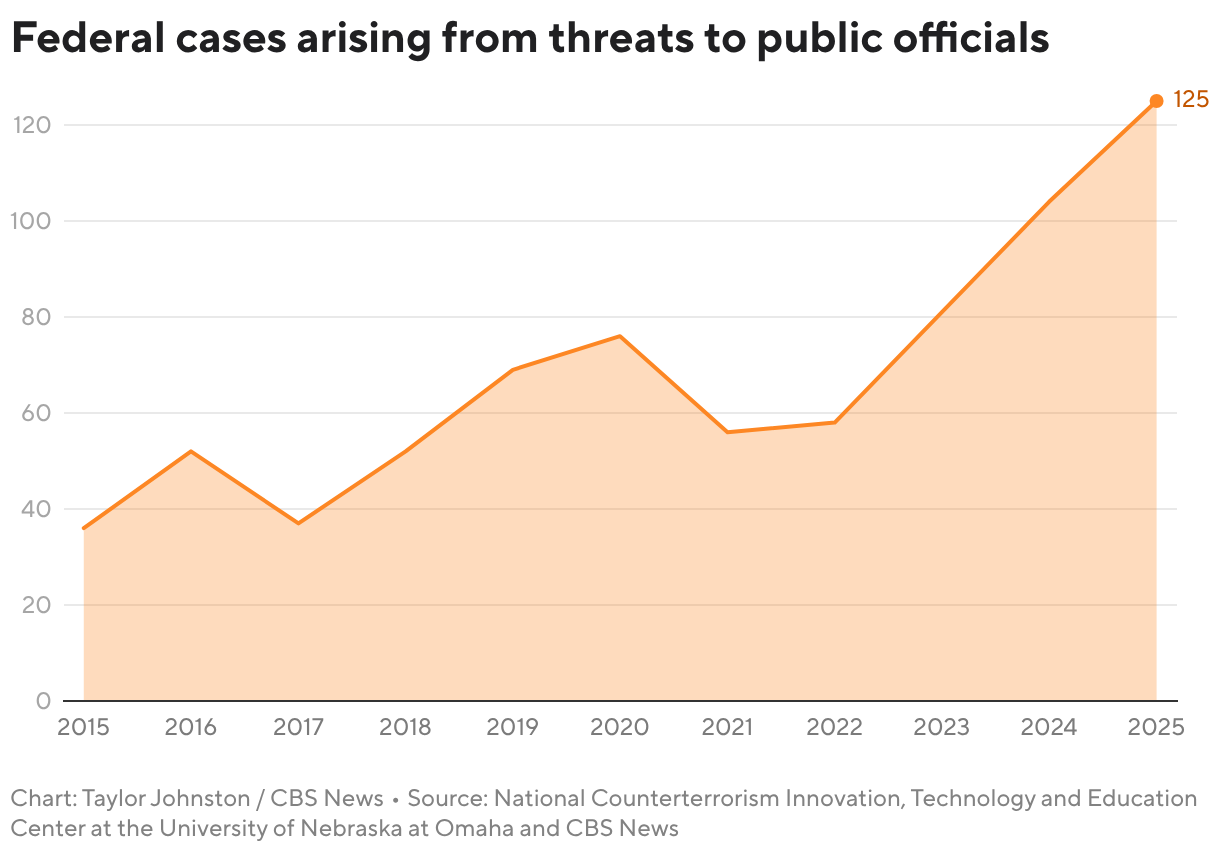
The threats that have resulted in charges do not discriminate in their targets. They were leveled against officials working in all three branches of government — from judges to members of Congress to law enforcement officers to President Trump and former President Joe Biden — and directed at those in the highest levels of state government.
The volume of cases marks a more than three-fold increase in the number of federal prosecutions arising out of threats to public officials over the past decade. 2025 surpassed 2024 in threats-related cases, according to NCITE.
The rise underscores the current landscape for federal officials who were elected to office, appointed to their roles or hired to enforce the law. In today’s environment, they face a barrage of threats on social media and in voicemails and emails, and have been swatted or doxxed.
“If I were in my 30s or 40s with young children at home and thinking about going on the federal bench, one of the factors [to consider] is that we may be exposing ourselves to possible violence,” U.S. District Judge John Coughenour, who sits on the court in Seattle, told CBS News.
Coughenour was appointed to the bench by President Ronald Reagan in 1981 and has had security details in response to threats a handful of times in his 45 years as a judge, he said, including when he presided over the trial of leaders of an anti-government group in the late 1990s.
But Coughenour said the threats he has received in recent months are more explicit and more frequent than what he’s experienced before.
The judge said he was swatted, an illegal scheme in which people make fake emergency calls to draw SWAT teams to the homes of public figures. The FBI also told him there was a bomb in his house, Coughenour recalled. He said he’s also received hundreds of threatening voicemails and other communications.
Last year, Coughenour blocked an executive order from Mr. Trump that sought to end birthright citizenship, saying it was “blatantly unconstitutional.” Mr. Trump had referenced Coughenour’s decision in the Oval Office, saying “there’s no surprises with that judge.” Coughenour’s image also appeared on a “wanted” poster displayed outside the office of Rep. Andy Ogles, a Tennessee Republican, which described him and other judges as “known get-Trump judicial activists.”
“The prior 40 years that I’ve spent on the bench, from time to time, people would be critical of decisions we make, and that’s to be expected,” Coughenour said. “Half the people that come before us for trial are going to be unhappy with the result. But it had never before reached the level where the president and the attorney general and the president’s staff were making hypercritical comments and calling judges monsters and referring to a judicial coup. Things like that, that’s all new. I’ve never experienced that before.”
A “marked decline in civility”
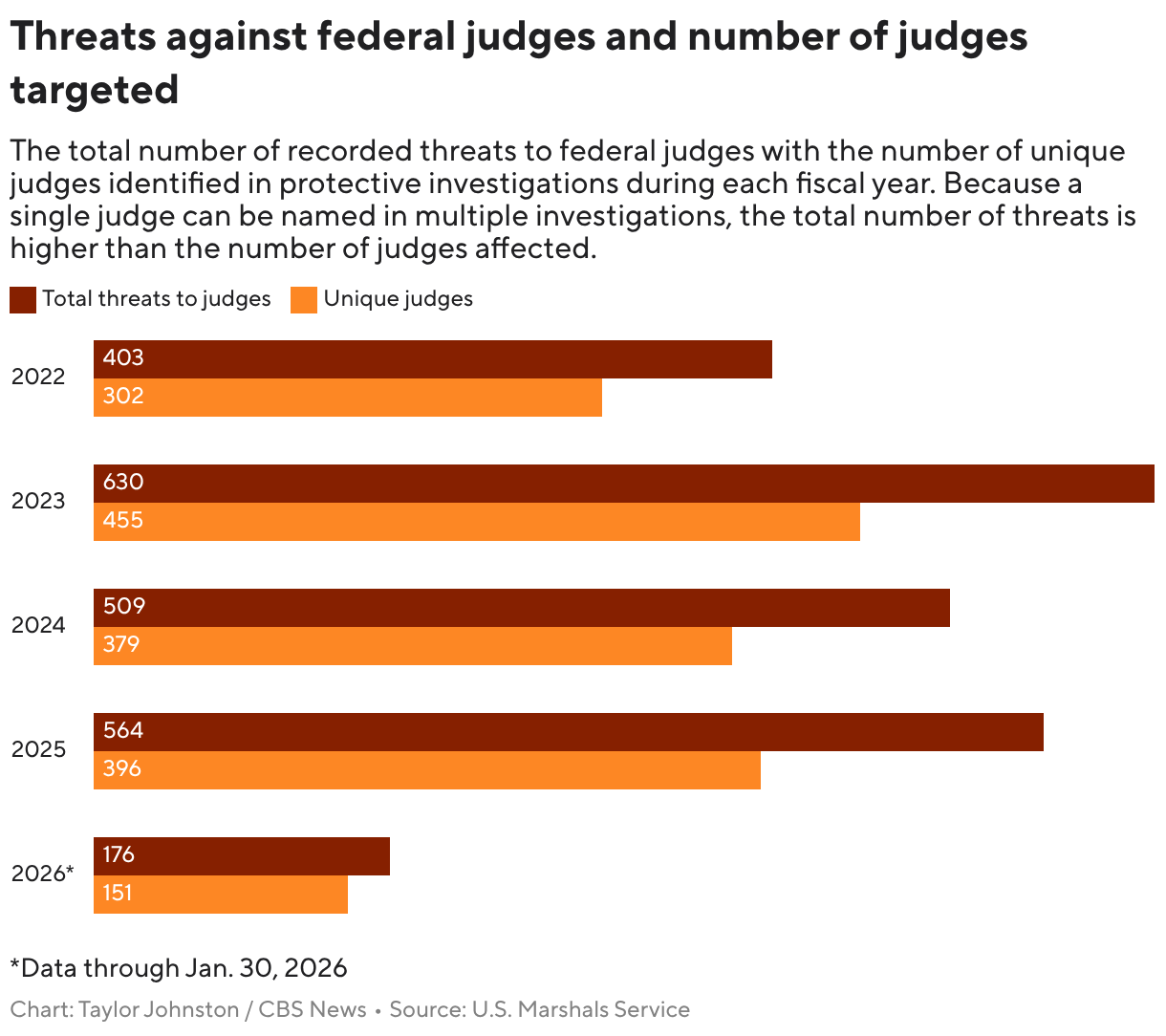
In the last fiscal year, there were 564 threats against judges, up from 509 in fiscal year 2024, according to data from the U.S. Marshals Service, which is responsible for providing protection to members of the federal judiciary. From the beginning of October to the end of January, the agency said there were 176 threats to judges.
Chief Justice John Roberts said in his 2024 year-end report on the federal judiciary that the number of threats and communications targeting judges had tripled over the prior decade.
“There has been a very marked decline in civility and the respect for the rule of law in our society over the last number of years,” one Trump-appointed federal judge, who asked not to be identified, told CBS News. “When an individual or a group of individuals disagrees with a decision — in this case, a decision by a court — they then begin to attack the institution of the court through the individuals who may be making the decision. That tendency didn’t exist when I started.”
The judge said that over the last year, there have been emailed death threats directed against his spouse and social media posts that accused him of being corrupt.
“When you call a decisionmaker corrupt for no legitimate reason, when you attack them personally, that then causes the public to, at a minimum, question whether their institutions are in fact strong and honest and serving the Constitution and the people as they’re designed to do,” the judge said.
CBS News found that of the 126 prosecutions from last year, 12 included threats against judges. Forty-one involved threats made against Mr. Trump and former Presidents Joe Biden and Barack Obama; and 29 of the prosecutions involved defendants accused of targeting federal law enforcement, including agents with Immigration and Customs Enforcement. Threatening messages directed at members of Congress were cited in 21 cases.
Other government officials — including Cabinet members, senior Trump administration officials, federal employees and unnamed political figures — were cited in 50 cases.
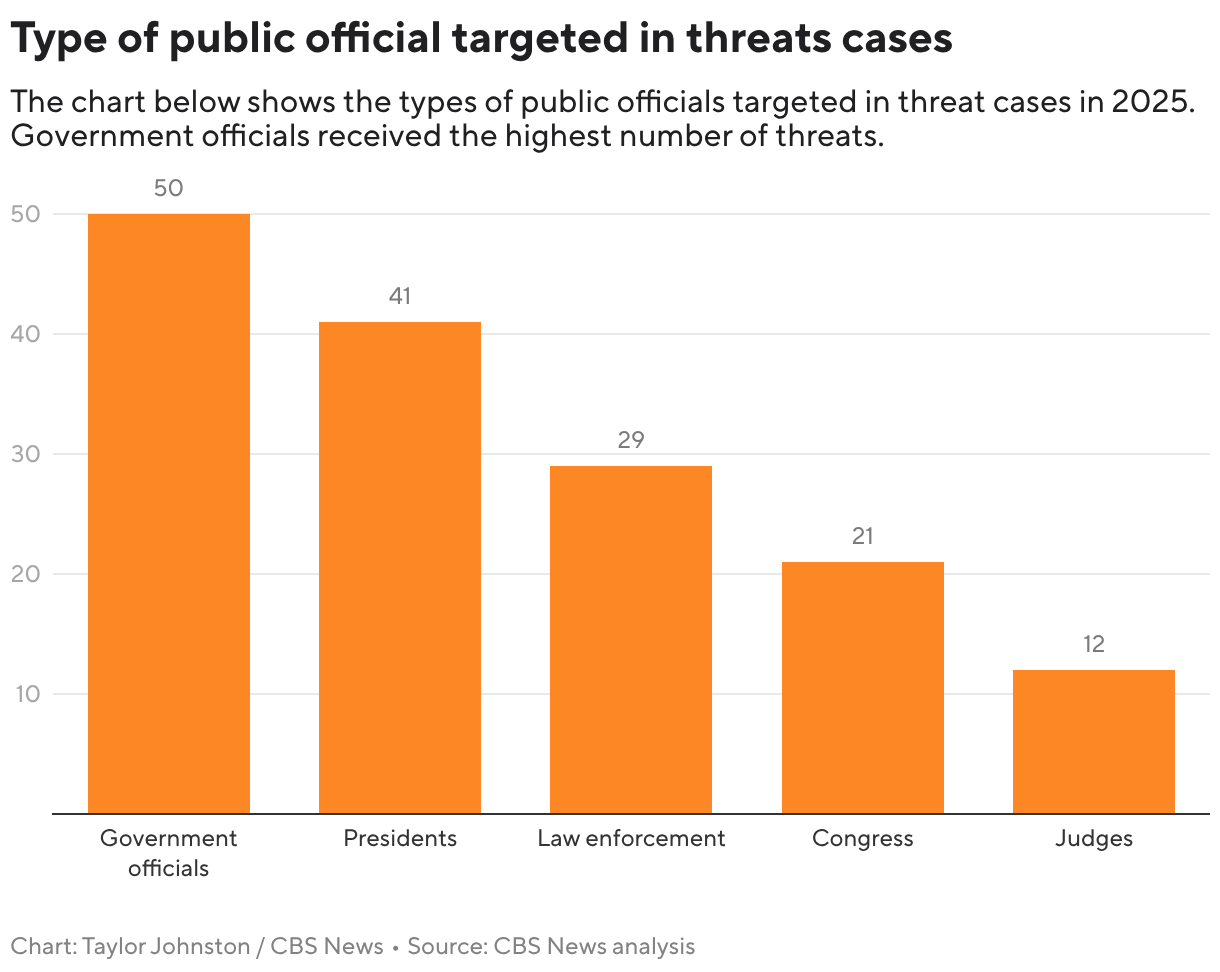
Seamus Hughes, an expert on counterterrorism and extremism at NCITE, said over the last year, there has been a dramatic shift in the volume of threats to law enforcement agents, who have increasingly become a target for people with grievances against the government. The number of prosecutions stemming from threats to those agents likely reflects increased news coverage of Mr. Trump’s mass deportation campaign and the administration prioritizing protecting officers, he said.
“The federal prosecutions tell you, ‘This is where we have skin in the game, where we’re actually going to put our finger on the scale and try to tamp down on this,'” Hughes said.
At the height of the COVID-19 pandemic, for example, there were more prosecutions involving threats to education and public-health officials. In 2020, cases were brought against those who sought to intimidate election officials, Hughes said.
While the number of threats-related prosecutions marked a new high, the universe of concerning statements directed at people in public service — many of them vile, disturbing and violent — is far broader.
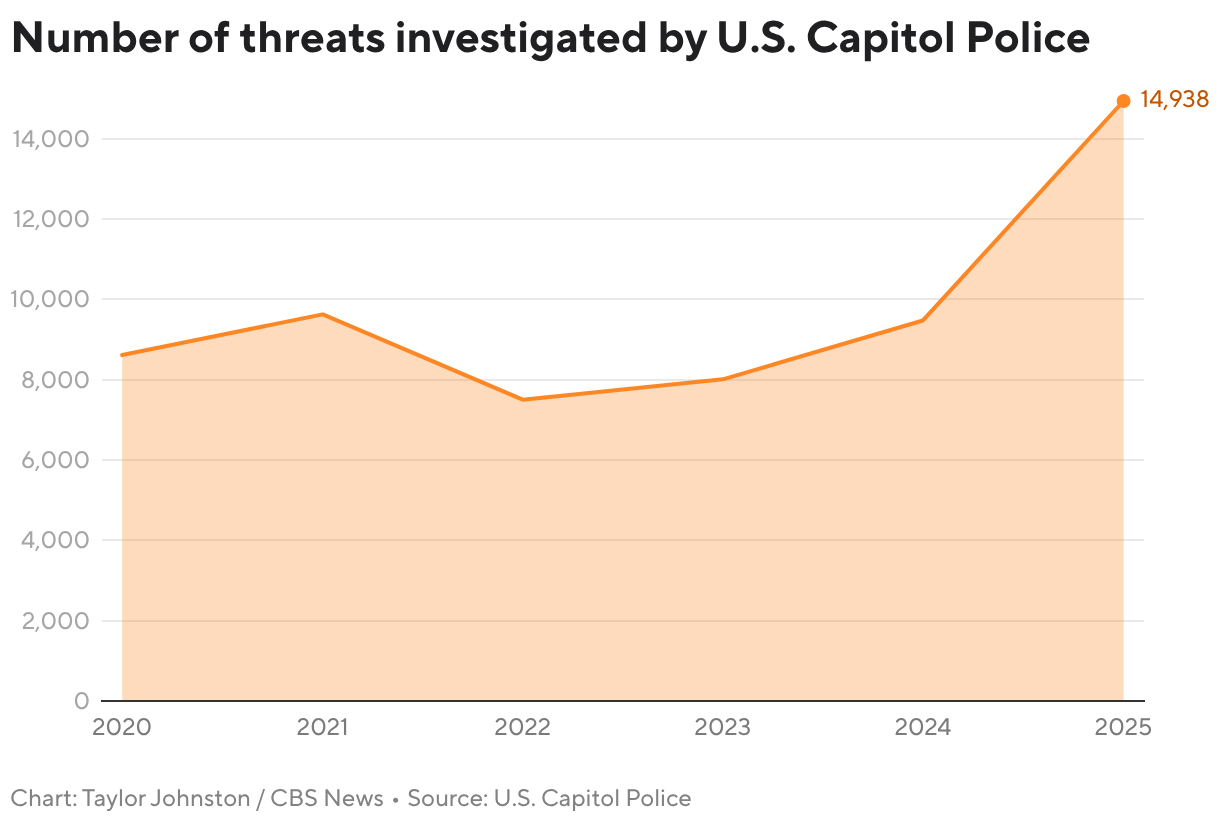
The U.S. Capitol Police reported last month that it investigated 14,923 “concerning statements, behaviors and communications” directed against lawmakers, their families, staff and the Capitol complex itself last year. That figure was up from 9,474 in 2024 and just over 8,000 in 2023.
During a recent hearing from the House Judiciary Committee, Democratic Rep. Eric Swalwell of California appealed to Attorney General Pam Bondi to ensure people menacing lawmakers are held accountable. He recalled several instances of obscene and violent messages directed at him last year, and lamented that prosecutors declined to bring charges. On one occasion, a caller left 11 voicemails with Swalwell’s district office, including one in which he said, “I’m going to hunt him down, that motherf***er, and toss his ass over the Golden Gate Bridge by my f***ing self,” according to Swalwell.
“The president can come after me, it’s fine. I’m in the arena. So are these folks,” he said, referring to his fellow lawmakers. “But we never expected that the Department of Justice would not seek to prosecute and investigate those who are making threats against us, and that would include those on that side of the aisle. I’m asking for your help to protect life because life is at risk with the environment we’re in right now.”
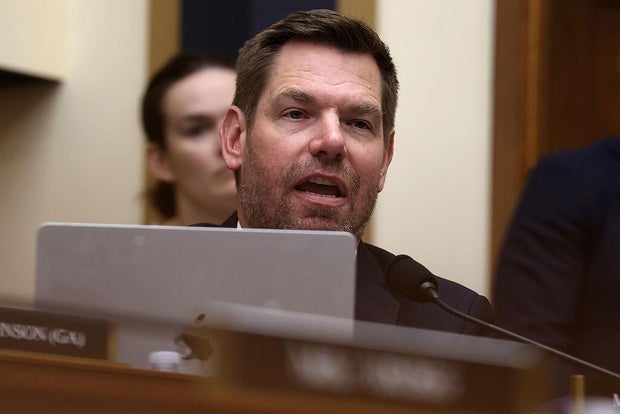
Bondi agreed that “none of you should be threatened” and said the Justice Department is engaged in ongoing investigations.
“We have a responsibility to prosecute these cases and to protect victims who are the unfortunate recipient of these threats,” Gregory Kehoe, the U.S. attorney for the Middle District of Florida, told CBS News. “When the person communicating it does it recklessly, and he does it in such a way that he recklessly believes that what he does will be viewed as a threat, then that’s a crime. Then we have to take that quite seriously. So let’s separate the exercise of free speech from threats over the wires or over the mails, etc., because we get both of them, and threats to injure another human being over the wires or in the mails.”
The region Kehoe oversees stretches from Jacksonville, in Florida’s northeast corner, down to Orlando, west to Ocala and Tampa, and south to Fort Myers. CBS News identified at least 17 cases involving threats to government officials and law enforcement that were prosecuted by his office last year, the most from any of the 94 judicial districts.
Kehoe, who served as a prosecutor for more than 20 years and was tapped as U.S. attorney last March, said threats and the criminal cases arising from them have increased dramatically.
“It’s our job to elevate the awareness and say, this is not going to be tolerated, and people that do this are going to be prosecuted,” he said. “If people do this and they’re not prosecuted, people are going to come be of the belief that it’s OK, and it’s not.”
Former Rep. Marjorie Taylor Greene, a Republican from Georgia, said members of Congress and their families are facing increasing levels of toxicity and violent rhetoric.
In an interview with CBS News, she rattled off defendants who had been convicted for threatening her. One man from New York pleaded guilty in 2023 and was sentenced to three months in prison for making threatening calls to her office. Another man from Georgia claimed he would shoot her in the head. Greene also recalled one incident where a syringe was placed in her mailbox with a death threat.
“It’s too much,” she said. “This isn’t what people run for office for. And no matter whether you agree with a member of Congress or disagree with a member of Congress, they’re representing their district, and their district voted for them. So to some Americans, their views may be extreme, but to that district, they keep getting reelected over and over again. To that district, that’s not extreme.”
In July, a Maryland man who made eight phone calls to Greene’s district office between October 2023 and January 2025 was charged with threatening to assault and murder Greene and her family. The threats escalated over that 15-month span, according to prosecutors, and culminated with a voicemail that warned she and her staff “were as good as dead.”
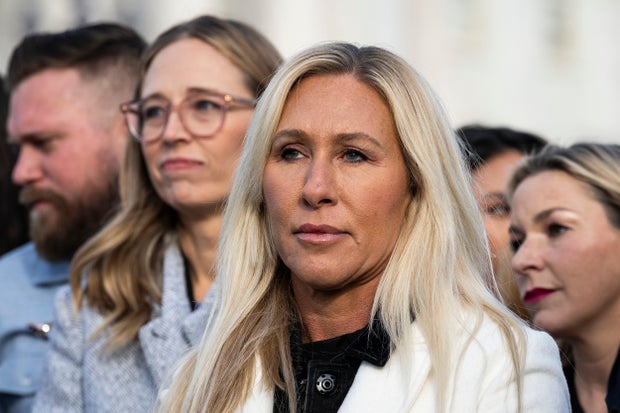
The caller, Seth Jason, told Greene to “make your last will ready, because we are coming after you, and the only thing you’re going to hear is bang … I’m yearning to hear you cry for your last breath.” He pleaded guilty in December and will be sentenced in June.
Greene said the time between a guilty plea or conviction to when a defendant ultimately reports to prison to begin serving a sentence can be frightening and frustrating.
“Not only the threat is scary, it’s the fact that this person admits guilt, pleads guilty and then is sent home before they’re ever sent to prison. You wonder, well, they’ve already pleaded guilty to it, are they willing to follow through on it before they go to prison?” she said. “That’s shocking to me. So you can’t let your guard down. You can’t feel safe even though that person has been convicted.”
Members of Congress have taken steps to protect themselves, such as by installing security systems at their homes, arming themselves or hiring personal security. Last November, Congress approved legislation that provided $203.5 million to boost security for lawmakers. Each senators’ office received an additional $750,000 to pay for enhanced security measures, including at their residences. About $100 million went toward bolstering security for House members and their families.
Greene, who served five years in the House and resigned Jan. 5, said she carries a gun and practices shooting.
From threats to action
Shannon Hiller, executive director of the Bridging Divides Initiative at Princeton University, attributed the current threat environment to the rise of social media and lockdowns during the COVID-19 pandemic. During the pandemic, local officials reported changes in the tone and volume of vitriolic messages, and that hasn’t subsided in the years since, she said.
Additionally, there has been a climate of dehumanizing rhetoric by the nation’s leaders, as well as a normalization of the use of threats and harassment against those on the other side of an issue, Hiller said.
“You have threats and harassment being used and normalized in politics and you have leaders all the way at the top and down being willing to use it,” she told CBS News. “So even for officials who may want to speak up against it, they’re worried about threats themselves. That creates this continual negative feedback. If there’s no sanction from within either party, within community members, to say, ‘This is unacceptable in our politics,’ then that behavior will continue.”
Hiller warned that a consequence of today’s landscape is fewer people willing to serve in public office and, for those who are serving, a fear that engaging with constituencies in public settings could put them in danger.
“When we see all of these dynamics year after year and continue to worsen, that’s what gets us closer to some incident or escalation creating broader conflict and risk of violence,” she said. “Part of what this climate of hostility in our politics does is create the tinder for more conflict rather than having our civic spaces be a place where we can feel confident, we can peacefully and constructively resolve our differences.”
That risk became reality late last month, when a man assaulted Minnesota Rep. Ilhan Omar, a Democrat, during a town hall in Minneapolis. The alleged perpetrator, 55-year-old Anthony Kazmierczak, charged at Omar with a syringe in his hand and sprayed her with a liquid. Police later determined it to be apple cider vinegar and water.
Kazmierczak faces a federal assault charge as well as state charges. He has not yet entered a plea.
Omar said after the attack that she sees death threats against her “skyrocket” after Mr. Trump uses “hateful rhetoric” to talk about her.
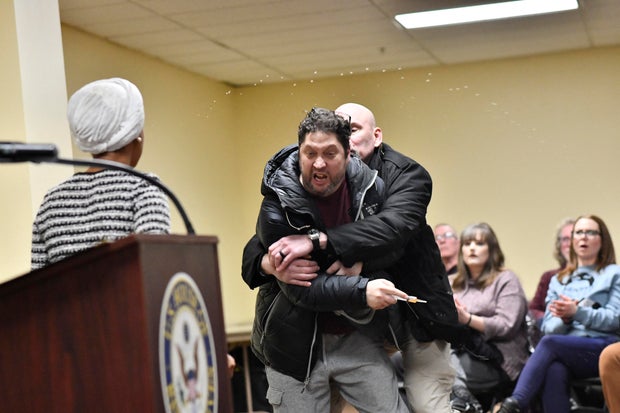
The president has repeatedly demonized Omar in the seven years since she began serving in the House. Mr. Trump has called her a “fake sleazebag” and “garbage,” and suggested on numerous occasions that she should “go back” to her home country, Somalia.
“It could be anybody in Congress,” Greene said about the Omar attack. “I think most Americans are really getting fed up with just the constant fueling of toxic politics that come from both sides. And I just think it’s unfortunate that it’s fear and anger that is used by political campaigns and politics to drive people to vote and donate.”
Threats targeted at jurists and the president have also materialized into political violence.
Mr. Trump was the victim of two attempted assassinations in 2024, including the shooting at a campaign rally in Butler, Pennsylvania, that left one dead and the president and two others injured.
Two years prior, after the leak of a draft Supreme Court opinion overturning Roe v. Wade in 2022, an individual from California was detained outside Justice Brett Kavanaugh’s Maryland home armed with a handgun, knife and myriad tools. The defendant, who was arrested and charged as Nicholas Roske but now goes by Sophie Roske, pleaded guilty last April to attempting to kill or kidnap a Supreme Court justice.
Prosecutors said Roske aimed to kill three members of the high court and researched their home addresses. Roske was sentenced to 97 months in prison last October.
Two years earlier, Daniel Anderl, the 20-year-old son of U.S. District Judge Esther Salas was shot and killed at their New Jersey home. Her husband, Mark, was shot three times. The gunman, a disgruntled lawyer, had been stalking the family and had information on their daily movements, including the routes Salas took to work and where they attended church, according to the FBI.
“I think of threats like the mood music,” Hughes said. “They always play in the background, they cause a level of concern. And there will be a subset of people from that who see these images and announcements and say it’s time to take action.”
The name of Salas’ son has been invoked by perpetrators of hoaxes known as “pizza doxxing,” which involves sending pizza to a target’s home in an attempt to scare them. Roughly two dozen federal judges have reported receiving unsolicited deliveries for Anderl.
In an interview with CBS News last year, Salas called the attempted pizza deliveries “psychological warfare” against judges.
To combat the rise in political violence, Hiller said there are short-term steps that can be taken, like improving security at public meetings and ensuring there are adequate personal data protections, as well as long-term solutions, such as countering a normalization of hostility and holding perpetrators accountable.
“It sounds basic, but people really have to accept it doesn’t have to be this way,” she said.
Coughenour, the judge from Washington, too, said things must change.
“We can’t go on the way that we are today,” he said. “I’ve often said that I worry that this country is closer to civil war than it’s ever been in my lifetime, but surely this, too, will pass.”