
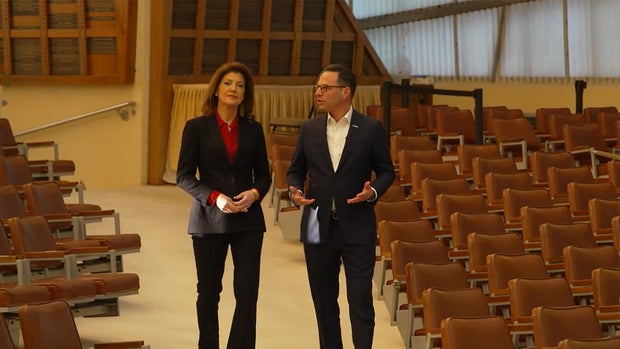
Pennsylvania Governor Josh Shapiro says it’s special to visit his longtime congregation, Beth Sholom Synagogue, in the Philadelphia suburb of Elkins Park, which he’s attended since he was young. He grew up coming here with his parents. His father, a pediatrician, and his mother, a teacher and activist, inspired him into a life of service.
But we learned it was also his mom’s struggles with mental health that may have had the most impact on Shapiro. “There were moments where a switch could be flipped, and there’d be a lot of yelling and a lot of chaos and a lot of tumult in the house,” he said. “And you would just want to retreat to your room and try and escape it all.”
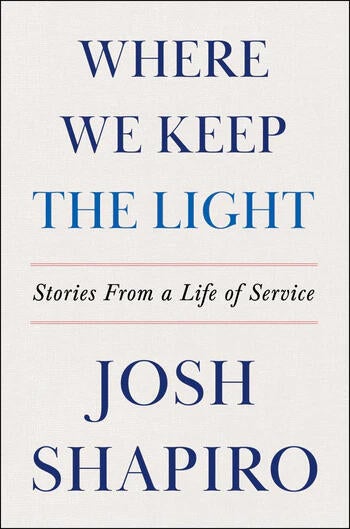
In his new memoir, “Where We Keep the Light: Stories from a Life of Service” (to be published Tuesday by HarperCollins), the 52-year-old governor details his childhood and his decades-long career.
Shapiro writes that he had a happy childhood, and at points an unhappy childhood home – something he’s never spoken about publicly. “I wanted to share that, in part, because I know there’s a lot of other families out there that go through this kind of stuff,” he said. “But in part, I want my mom to know that for as difficult as our childhood was at times, for as difficult as I imagine hers was, you know, she really set me on this path of service in a way that, you know, I hope she sees some of herself in, and I hope she takes pride in.”
Hard conversations
The memoir begins with a deeply personal recounting of the arson attack on the governor’s official residence in April 2025, while Shapiro and his family slept upstairs, hours after conducting a Passover seder.
His son, Ruben, asked if someone tried to kill their family because they were Jewish.
Shapiro said that conversation was really hard: “We had to have some honest, tough conversations with our kids about what political violence is all about, and how it’s designed to maybe target one person, but affect a broader swath of people based on a particular characteristic, perhaps in this case, our faith. And look, it’s a hard thing for a parent to have that kind of conversation with their kids when they know in this business, they can’t necessarily guarantee that level of safety.
“What I really hope for every day is that kids stop having to worry about that — not just my kids, but all people have to stop worrying that violence is gonna come to their community because of something they believe, or who they voted for, how they pray, who they love,” he said.
The arson attack occurred less than a year after Donald Trump, campaigning for president in Shapiro’s state, had nearly been assassinated. I asked if political violence has changed how he carries out his work.
“I think political violence has gotten worse in this country since Butler,” Shapiro replied. “And I think it is only gonna get better when all politicians, all people condemn it universally, no matter who’s the target of it, and no matter who carries it out. I don’t care if you’re a left-wing ideology, right-wing ideology; it should not be hard for us to say that it is all wrong.”
A new generation of the Democratic Party
This year, Shapiro is in the middle of a re-election campaign, but he’s also considered a top contender to represent the Democratic Party in 2028.
We asked if the Democratic Party today has a clear set of ideals. “I think the Democratic Party has a lot of clear ideals and wonderful values,” Shapiro said. “Otherwise I wouldn’t be a member of this party.”
“Are they articulating in a way, in a national message, that will win elections?” I asked.
“Yeah. I think folks are hoping that there will be one person every day, who’s gonna go out and be the alternative to Donald Trump, or be the voice of the Democratic Party. And that one person certainly does not exist right now,” Shapiro said. “And that’s okay, because there are wonderful Democrats who are governors, who are mayors, who are members of Congress, who are doing really good work every single day. And that work they’re doing, I think, is helping shape and define the new generation of the Democratic Party.”
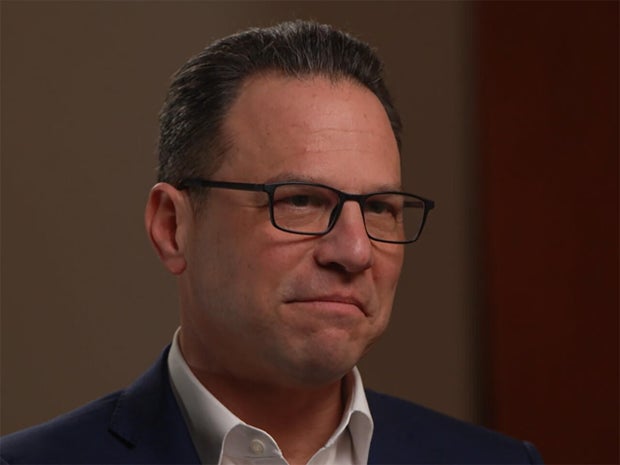
Right now, Shapiro is watching closely what’s happening in Minneapolis with the president’s immigration crackdown.
“The President claims it’s all about safety,” Shapiro said, adding, “I think what the president’s trying to do is show that he can be the dominant figure, that he can dictate behavior. Whether we’re talking about Minneapolis or Greenland or Venezuela, this president wants to try and show what he believes to be strength that I think is a facade of strength and ultimately a veneer of strength. And ultimately what he’s doing is making people worse off, less safe.”
What Governor Shapiro won’t say is whether he will ultimately run for president himself. “Here’s what I can tell you with absolute certainty: I want to be a part of the dialog that helps shape us going forward into a party that can be one that helps people get a great education, that creates safer communities. I want to help build a Democratic Party that sees us as part of a world order, not going it alone. So yeah, I wanna be a part of shaping that dialog. And then ultimately from that dialogue that we have, there will be people who emerge, who ultimately want to lead that party. And that’s a conversation for another day down the road.”
WEB EXCLUSIVE: Watch an extended interview with Gov. Josh Shapiro (Video)
For more info:
Story produced by Julie Morse. Editor: Remington Korper.