
The Justice Department has a playbook ready for responding to emergencies like the one unfolding in Minneapolis, including containing unrest and defusing community anger or distrust in law enforcement.
In the civil rights era, the agency formed its Community Relations Service, a group of dozens of federal specialists who were informally referred to as “America’s peacemaker.”
For the type of crisis emerging in Minneapolis, the Community Relations Service had a long-time, fulltime staffer based in Minnesota, and would also immediately deploy its specialists from Chicago, St. Louis, Detroit, Indianapolis and Madison to get on the ground promptly to assist.
At a time when relations between federal agents and the Minneapolis community, Portland and other U.S. cities have been deteriorating, the Justice Department is being criticized for scrapping its playbook, and turning away its “peacemakers.”
Several sources, including current and former Justice Department employees, said the Trump administration has shuttered the office and has begun pushing out many of the approximately 60 employees who served in the Community Relations Service.
In a June 2025 report, the Trump administration said, “The (community relations service) mission does not comport with Attorney General and Administration law enforcement and litigating priorities.”
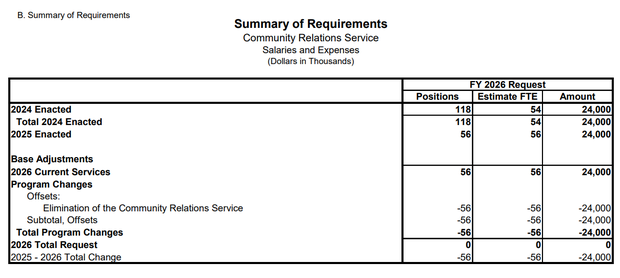
An agency budget request for 2026 showed the Justice Department planned to reduce the office’s staffing from 56 to zero. The Justice Department estimates the cuts would save $24 million this year.
Julius Nam, a former Justice Department prosecutor and Community Relations Service specialist told CBS News the office”has had a neutral, impartial role. That is so important in these situations, in which there is deep distrust of law enforcement by protesters and community groups.”
The Community Relations Service, whose specialists are referred to as “conciliators,” convenes forums, meetings and dialogues to ease tensions and help head off unrest, protests and hate crimes.
In a span from 2021 through 2024, the office conducted more than a dozen formal mediation sessions and more than 100 training programs.
In Minneapolis, the office had some recent successes, in its response to the killing of George Floyd in 2020. An agency report reviewed by CBS News said the Community Relations Service’s deployment to Minneapolis during the trial of Floyd’s killer was the largest by the office in 2021.
“The Community Relations Service deployed twice to Minneapolis during the trial and sentencing of Derek Chauvin,” the report said. “Despite the challenges of social distancing, CRS conciliators worked for months to build relationships with the community, facilitate dialogues, and lead trainings.”
Bert Brandenburg, who used to work in the Community Relations Service, told CBS News, “When we sideline peacemakers, we all pay the price.”
“Minnesota is not the first and not the last city where you’d want peacemakers on the streets.”
Brandenburg said that through its 60-year history, the office was effective in its work to ensure independence and trust among police, local government leaders and communities during conflicts. He said the Community Relations Service would help de-escalate tensions and build up sufficient trust to get both sides of a conflict into a room for discussion and reconciliation.
A Justice Department spokesperson told CBS News the portfolio and functions of the former Community Relations Service have been shifted into federal prosecutors’ offices nationwide. The spokesperson said, “This transition will save the Department over $11 million and further President Trump’s mission of having a federal government that’s more efficient and effective for the American people.”
CBS News has learned that approximately 30 laid off Justice Department employees have been called back to work for the agency. Those employees include some who worked for the Community Relations Service. According to one of the impacted employees, the workers have been reassigned to work for federal prosecutors.
Nearly a dozen civil rights organizations and charities filed a civil lawsuit in Massachusetts, seeking a court order to prevent the dismantling of the Community Relations Service. In the lawsuit, in which NAACP St. Louis County and the Haitian Community Help & Support Center are among the plaintiffs, the groups argue the Trump administration’s cuts to the office were unlawful and have stymied critical, ongoing work by the Community Relations Service.
The suit said the Trump administration’s decision disrupted ongoing de-escalation efforts, including “mediation among community groups and law enforcement over a race-related policing incident when CRS abruptly [withdrew] from the process, leaving them without a mediator or any final agreement among the parties.”
“The Community Relations Service was designed to help de-escalate tensions like those we see in Minneapolis and Portland, and for decades it succeeded in that mission,” said Stacey Young, executive director of the Washington, D.C.-based Justice Connection, a group organized in 2025 to help represent and serve ousted Justice Department employees.
Young said, “For no logical reason, the administration discarded the experts who were best positioned to keep budding conflicts from turning violent. We’re seeing the consequences of that fateful decision.”
A newly introduced federal funding bill aimed at averting a government shutdown next month would allocate $20 million in funding for the Community Relations Service, if approved .
Support for the funding appears highly likely among House and Senate Democrats.
Nearly 100 congressional Democrats have filed a court motion in support of the civil rights groups’ legal challenge to the Community Relations Service cuts. Their motion argued the Trump administration was closing the office by “executive fiat” and is “leaving local communities without the vital peacemaking support and services that the agency has long provided.”
The Community Relations Service was set up in the 1960’s, amid metastasizing unrest, including fractured relationships between communities and police departments. The office was credited with helping prevent another riot in 1993, as racial tensions re-emerged following the second trial of police who beat Rodney King in California.
It also helped ease rising racial tensions after the 1997 fatal police shooting of a Chinese-American man in Rohnert Park, California, and in Akron, Ohio in 2022, after the shooting of a Black man by police.
Nam, the former Community Relations Service specialist, told CBS News he expects the Trump administration will shift some of the office’s responsibility to its 93 U.S. attorneys’ offices nationwide. He said the mission risks failing – or falling short – if it operates out of prosecutors’ offices. And he added that the Community Relations Service was effective, in part, because it was not connected to law-enforcement agents, and was best positioned to build relationships with people in American communities.
Nam told CBS News, “Those people could have gone to Minneapolis immediately this week.”