
Issues like birthright citizenship could provoke rulings from the U.S. Supreme Court.
News Analysis
President Donald Trump’s administration has been hit with a wave of legal challenges responding to executive orders and other actions, teeing up potential Supreme Court decisions that could clarify the scope of executive power.
So far, states and other groups have filed more than 20 lawsuits alleging violations of the Constitution, the Administrative Procedure Act, and other laws. It’s unclear how many of them will succeed in the long-run but many have already attained initial successes in blocking the administration, with federal judges across the country issuing injunctions.
“He’s testing to see what works and what doesn’t,” former federal prosecutor Neama Rahmani told The Epoch Times.
Steven Engel, who served in the Department of Justice (DOJ) during Trump’s first term, disagreed.
“I think President Trump came in with a plan and a muscular view of executive authority,” he said. Engel added that he believes some of Trump’s “decisions will lead to cases that better articulate the scope of executive power.”
Related Stories
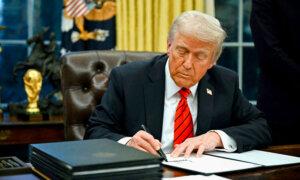
Perhaps Trump’s most ambitious orders were the ones attempting to freeze wide swaths of government spending and end birthright citizenship for children of illegal immigrants, a longstanding practice that the administration says is out of step with the 14th Amendment.
The amendment states in part: “All persons born or naturalized in the United States, and subject to the jurisdiction thereof, are citizens of the United States and of the State wherein they reside.”
Immigration
On Feb. 6, a federal judge in Washington accused Trump of trying to change the Constitution via executive order and said a new amendment would be needed to replace how birthright citizenship has typically been granted.
During that hearing, Deputy Assistant Attorney General Drew Ensign argued that the history of the 14th Amendment and the Supreme Court’s decision in United States v. Wong Kim Ark supported the idea that immigrants should have more permanent ties to the nation in order for their kids to receive citizenship. The implications of that 1898 decision have been debated but the court held that the 14th Amendment granted birthright citizenship to a Chinese man whose parents were legally present in the United States.
Trump’s order, signed on Jan. 20, argued that an individual who is born in the United States is not “subject to the jurisdiction thereof” if that person’s mother was unlawfully present in the country and the individual’s father was not a U.S. citizen or lawful permanent resident at the time of his or her birth.
It further stated that the privilege of U.S. citizenship does not apply to an individual whose mother’s presence was lawful but temporary and whose father was neither a citizen nor a lawful permanent resident at the time of that individual’s birth.
Rahmani speculated that “even the conservative justices on the Supreme Court will probably reject [the] argument“ that babies born illegally in the United States are not subject to its jurisdiction under the 14th Amendment. ”Maybe with the exception of [Justices Clarence] Thomas or [Samuel] Alito,” he assessed.
Immigration Reform Law Institute Director Chris Hajec told The Epoch Times that the issue offered the Supreme Court the opportunity to affirm what he saw as the true ruling of Wong Kim Ark.
“Under the 14th Amendment, [Wong Kim Ark] conditioned having birthright citizenship on residing here with the permission of the United States,” he said.
Federal Workers
Both Hajec and Rahmani indicated that Trump faces good prospects in lawsuits challenging his other immigration-related executive actions.
The firing could prompt the Supreme Court to reconsider a longstanding precedent in Humphrey’s Executor v. United States, a 1935 decision wherein the court said that presidents did not have the power to remove certain officials for reasons other than what Congress allowed.
The NLRB case is one that is “likely to end up at the Supreme Court and test the court’s willingness to overrule … Humphrey’s Executor,” Catholic University Law Professor Joel Alicea told The Epoch Times. “And if that precedent is overruled, it would be a sea change in American government—the way that the government operates.”
Earlier in the 2024-2025 term, the court declined to hear two challenges to Humphrey’s Executor but the NLRB decision might earn a hearing, Competitive Enterprise Institute attorney Devin Watkins told The Epoch Times.
Trump has also encountered legal backlash for attempting to create a separate category of federal workers whom he can more easily fire. Multiple lawsuits have been filed by unions alleging that Trump’s order establishing that category violated the Administrative Procedures Act and flouted Congress’ intention for civil service protections.
His order, signed on Jan. 20, frames the issue as part of his executive authority under Article II of the Constitution.
Trump’s order came amid his and others’ allegations that the Department of Justice had been weaponized for political purposes.
DOGE
Some lawsuits have also arisen in response to employees the administration sought to retain as part of efforts by the Department of Government Efficiency (DOGE), which Trump created by reorganizing and renaming the United States Digital Service.
Other lawsuits have raised concerns about the group, which is led by billionaire Elon Musk, accessing data at the Department of Labor and Treasury Department.
Spending
Part of DOGE’s plan for the administration is to enact steep spending cuts, raising questions about how much the executive can limit the disbursement of money appropriated by Congress.
The administration attempted to enact a spending freeze in January related to Trump’s executive orders, with wording clarifying that agencies should pause disbursement of funds “to the extent permissible under applicable law.” The administration quickly encountered legal pushback and a judge entered an administrative stay. The Office of Management and Budget (OMB) then rescinded the memo directing that freeze but the White House indicated that some kind of freeze was nonetheless still in place.
Watkins said the spending freeze could wind up at the Supreme Court and noted that the OMB memo directed agencies to pause funding as allowed under the law. “There’s a lot of discretion that’s given in [a] variety of grants,” he said. “Without examining each and every one of those grants … you can’t know whether the pause is lawful or not.”
Zachary Stieber and Bill Pan contributed to this report.
Original News Source Link – Epoch Times
Running For Office? Conservative Campaign Consulting – Election Day Strategies!