
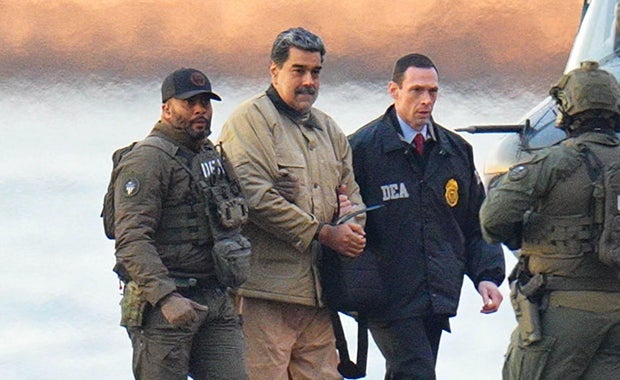
Nicolás Maduro, the deposed Venezuelan leader, and his wife are set to appear in federal court Thursday in Manhattan nearly three months after American forces invaded his country and brought him to the U.S. to face narco-terrorism and drug trafficking charges.
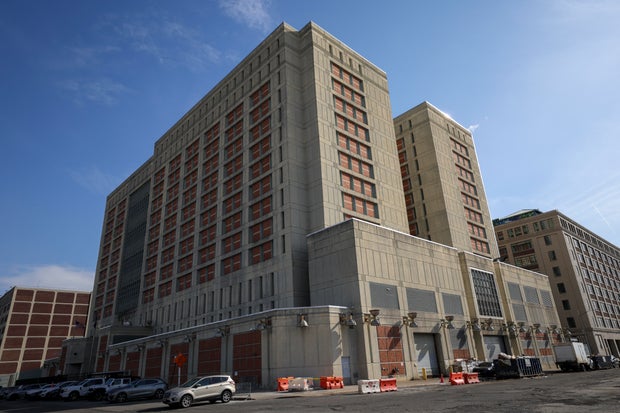
Since his January arrest, Maduro has been held in a secure unit described as a “jail inside of a jail” for the most high-risk detainees at the Metropolitan Detention Center in Brooklyn, law enforcement sources told CBS News. He is being kept under “special administrative measures” in what corrections officers dub the “SAMs unit.”
Special administrative measures are designed to restrict contact prisoners have with the outside world in cases where officials believe their communications could bring harm to others. The U.S. Department of Justice states that only the attorney general of the United States is authorized to direct the Bureau of Prisons to implement special administrative measures.
Juan Orlando Hernández, the former president of Honduras, was believed to be held in the same unit until his conviction on federal drug trafficking charges in June 2024. He was then sent to FCI Hazelton in West Virginia. Hernández was pardoned by President Trump in December 2025.
Maduro’s wife, Cilia Flores, is being held in a different unit in the same facility.
Special administrative measures
An existing unit was refurbished at the Brooklyn federal detention center to become the SAMs unit after the Metropolitan Correctional Center in Manhattan, where it was previously located, closed in the summer of 2021, law enforcement sources told CBS News. Among MCC’s notable inmates was Jeffrey Epstein, who died behind bars there in 2019.
A wall and secure door were added to create the new SAMs unit at the MDC, sources said.
The unit can hold up to 12 inmates. It is not clear if other inmates are currently being held in the unit under special administrative measures.
MDC is one of the few detention centers in the U.S. with the capacity for high-security defendants. It is known for housing other high-profile defendants like Luigi Mangione and, in the past, Sean “Diddy” Combs and Ghislaine Maxwell. Unlike Maduro, however, these high-profile inmates weren’t reported to be under special administrative measures.
The Office of Operations Enforcement, a division of the DOJ, provides legal advice to senior-level decision-makers on the use of special administrative measures.
CBS News has reached out to the Bureau of Prisons and the Justice Department for comment.
The measures are put in place for 120 days, but can be renewed indefinitely. Researchers from the Center on Constitutional Rights and a clinic at Yale Law School released a 2017 report on the government’s expanding use of SAMs, citing instances of some prisoners who remain under these severe restrictions for years or in some cases even decades.
For Maduro, the designation means that all of his activities take place within the SAMs unit, where he’ll stay until he is either acquitted or convicted and sentenced, said a law enforcement source.
Maduro only leaves his cell to shower, visit his lawyer or go for solo recreation for an hour a day. Those under special administrative measures are isolated from other inmate contact.
“They don’t leave the unit,” a law enforcement source said, noting that inmates under special administrative measures have access to a deck for recreation. There is a handball court on the deck at MDC where inmates under special administrative measures can go to “stretch their legs,” the source said. Each inmate goes outside alone accompanied by corrections staff.
Under 24-hour surveillance, Maduro is accompanied by two corrections officers and a higher-ranking lieutenant any time he moves within the unit. No one can come in from outside without approval, law enforcement sources said — everyone has to be signed in and signed out.
Maduro’s team moves to dismiss case
Maduro pleaded not guilty to all charges and proclaimed himself a “prisoner of war” at his arraignment on Jan. 5. “I am innocent. I am not guilty. I am a man, the president of my country,” he told Judge Alvin Hellerstein.
Lawyers for Maduro and his wife have moved to dismiss the case and argue that the Trump administration is blocking the Venezuelan government from paying their legal fees in violation of their constitutional rights.
Due to U.S. sanctions, a license from the Treasury Department’s Office of Foreign Assets Control (OFAC) is needed for Venezuela’s government to pay the couple’s attorneys. In court filings, Maduro’s lawyer Barry Pollack asserted that licenses were initially granted, then revoked, and that OFAC has refused to reinstate them.
“Mr. Maduro, who lacks the funds to retain counsel, is being deprived of his constitutional right to counsel of his choice,” wrote Pollack, who added that he cannot remain on the case “if OFAC’s interference with Mr. Maduro’s ability to fund his defense persists.”
Steve Vladeck, a Georgetown professor who specializes in constitutional law and federal courts, said a key question is whether it is possible for Maduro to receive effective representation.
“Here the law is a bit tricky because you don’t necessarily have a constitutional right to a specific lawyer, but you do have a right to the effective assistance of counsel,” said Vladeck. “I don’t see this as a fatal bar to this case going forward.”
“The Justice Department has, presumably, at least a fair amount of leverage here,” said Vladeck. “And the question is, what do they want? What do they want out of Maduro in return?”