
Cooper agreed to fast-track the release of 3,500 inmates as part of a settlement with the NAACP. Fifty-one rapists and murderers serving life sentences made the list.
Tony D. Hartsell strangled and beat the 84-year-old North Carolina woman who lived across the street from him before stabbing her 44 times, mutilating her body beyond recognition. A jury found Hartsell guilty of first-degree murder in 1995 and sentenced him to life in prison.
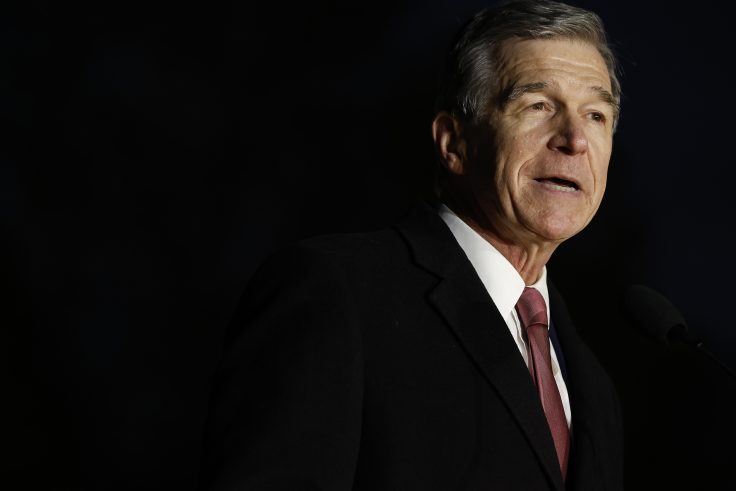
But in March 2021, Hartsell walked out of a North Carolina prison a free man, much to the dismay of his victim’s family. His release came a month after then-governor Roy Cooper (D.) and his administration agreed to fast-track the release of 3,500 inmates as part of a legal settlement with the NAACP—a deal that included Hartsell, according to a copy of the “early release” list obtained last week by WSOC-TV. Now, as Cooper’s campaign for North Carolina’s open Senate seat heats up, he insists he had nothing to do with Hartsell’s release. Cooper’s campaign told the Washington Free Beacon that the prisoner was eligible for parole before the governor signed the deal and that the state Department of Adult Correction, a cabinet-level agency that reports to the governor, had a say in granting Hartsell parole.
Being eligible for parole in itself is not a guaranteed ticket to freedom, however, and Hartsell’s inclusion on the “early release” list that stemmed from Cooper’s settlement raises questions about whether the deal played a factor in granting his liberation. In total, 51 North Carolina convicts serving life sentences for first-degree murder, second-degree murder, or first-degree rape are named in the Cooper “early-release” list, according to an analysis by North Carolina reporter Andrew Dunn.ᐧ
Their inclusion on the list flies in the face of a promise the Cooper administration gave to state lawmakers in February 2021 that nobody who had “committed a crime against a person” would be included as part of the deal.
The list also includes Lorenza D. Norwood, who was found guilty of first-degree murder in 1994 after he doused a man with gasoline, set him on fire, and watched him burn to death. Norwood was initially sentenced to death, but he received a reprieve in 2003, and his punishment was modified to life in prison. And in April 2021, he walked out of prison a free man.
Jervon K. Wilks was sentenced to life in prison in 1993 for sexually abusing a seven-year-old handicapped child. He, too, was included on the Cooper “early-release” list. Wilks walked free in 2021. Wilks wasn’t the only child rapist on the list. Louis E. Boyd committed first-degree rape against his 12-year-old stepdaughter and was sentenced to life in prison in 1986. Boyd walked free in April 2021.
Cooper’s settlement with the NAACP, which was signed by his chief of staff, quashed a lawsuit that a coalition of activist groups filed against the Democratic governor and his administration over health concerns at state prisons during the COVID-19 pandemic. Whitley Carpenter, an attorney for Forward Justice, a racial justice nonprofit that was involved in the litigation, hailed the deal at the time, saying the most effective way to protect prisoners from COVID-19 “is to reduce the number of people in prison.”
Cooper, who is now the leading Democrat in the race for the seat being vacated this year by Sen. Thom Tillis (R., N.C.), has come under fire for his record on crime during his two terms as North Carolina’s governor, from 2017 to 2025—criticism that only intensified after the senseless stabbing murder of Ukrainian refugee Iryna Zarutska on a Charlotte subway train in August.
Zarutska’s killer, career criminal Decarlos Brown, was among the 3,500 inmates on the Cooper “early release” list, Fox News reported. The Cooper campaign insisted that the NAACP early release settlement played no role in Brown’s release from prison. A campaign spokesman told the Free Beacon that Brown was retroactively added after being released from prison several months before the Cooper administration agreed to the deal on Feb. 25, 2021.
But the same can’t be said for nearly all of the 51 lifers included in the list, over 90 percent of whom secured their early release from prison after Cooper settled with the NAACP, the data show. Still, the Cooper campaign said that the governor cannot be held responsible for their release because he did not play a direct role in choosing which prisoners received adjusted sentences under the settlement and that all the lifers named in the “early release” list were eligible for parole before his administration signed the settlement.
North Carolina Department of Adult Correction spokesman Keith Acree said the 51 lifers “could be on the list per the terms of the settlement” but maintained they were not made eligible for parole “because of the COVID settlement.”
“The NC Post Release Supervision and Parole Commission had discretion to approve individuals’ placement onto parole,” Acree told the Free Beacon.
Original News Source – Washington Free Beacon
Running For Office? Conservative Campaign Management – Election Day Strategies!