
After 5 years of jurisdictional wrangling, the Canadian operator and state attorneys got their day in court in a 4-hour hearing that could have national impact.
It’s taken five years, but Michigan’s claim that states have a significant regulatory role in pipeline permitting is now in the hands of a judge whose ruling following a four-hour hearing on Jan. 27 could set the stage for similar challenges nationwide.
However, Michigan Attorney General Dana Nessel maintains that states have regulatory authority under “common law” public trust doctrines and public nuisance provisions to enforce environmental laws that protect residents and natural resources.
Enbridge ignored the order and petitioned to have the case heard in federal courts. The pipeline is still funneling 540,000 barrels per day (bpd) of light crude oil, light synthetic crude, and natural gas through the straits.
What followed was nearly five years of jurisdictional sparring as intricate as any pipeline network deadheaded by docket twists and turns and venue changes, with Canada intervening in October 2023 when it invoked a 1977 pipeline treaty with the United States.
Related Stories

In November 2023, a federal judge transferred the suit to federal courts, where it was dropped. Nessel then filed another state suit alleging the pipeline violates three Michigan laws.
For the first time since the 2019 complaint, state and Enbridge attorneys met in court on Jan. 27 and argued for nearly four hours before Ingham County Circuit Judge James Jamo in Mason, Michigan.
Nessel “seeks judicial relief never before sought or granted to any state official in the United States—the permanent shutdown of a federally regulated interstate pipeline,” DeRosier said. “And not just any pipeline, but a pipeline that has been operating in the straits safely for over 70 years, on which millions of people rely to fuel their cars and heat their homes, both in this country and in Canada, and on which thousands more rely for solid middle-class jobs.”
“These rights and the state’s duty to protect them are perpetual,” he said. “This duty can never be waived, and the state, including the courts, must always guard against it.”
Essentially, Bock said, Enbridge maintains “it has the right to pump millions of gallons of oil through an aging pipeline in the heart of the Great Lakes, regardless whether it has a valid easement to do so, regardless whether it has the owners’ permission—the people of the state—to do so; that it’s immune from Michigan law.”
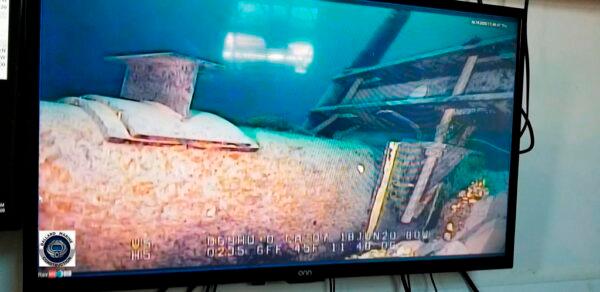
Damage to anchor support EP-17-1 on the east leg of the Enbridge Line 5 pipeline within the Straits of Mackinac in Michigan is seen in this June 2020 photo. The Canadian Press/HO-AP, Michigan Department of Environment, Great Lakes, and Energy
Question of Safety
DeRosier said the Pipeline Safety Act provides a “comprehensive scheme to regulate the safety of interstate pipelines, including protecting the environment,” that limits local and state jurisdiction.
“An interstate pipeline is not the time or place for 50 separate states to enforce their own environmental safety rules,” he said, noting Congress recently imposed protections to prevent anchor strikes near pipelines, citing a litany of policy and court precedents confirming federal preemption.
“Once a pipeline like Line 5 is built, only federal regulators can order a shutdown if there’s an imminent hazard and, before they can do that, [they] must consult with other federal and state regulators, and must consider the impact on the national economy.”
The act includes an “express preemption provision” prohibiting states from “adopting, or continuing to enforce, safety standards for interstate pipeline facilities or interstate pipeline transportation,” he said, quoting from the law.
While state and local regulators have land-use jurisdiction over siting pipelines, once built, they cannot impose retroactive safety restrictions, DeRosier said.
“The attorney general’s complaint is singularly focused on imposing one ultimate safety standard, which is that no pipeline, under any circumstances, can safely operate on the bottom of the Straits of Mackinac,” he said.
Untrue, Bock said.
Michigan “does not seek to enforce any pipeline safety standard,” he said. “Enbridge seeks to broaden the definition of the pipeline safety standard. Enbridge cannot prevail if the attorney general’s claims are not pipeline safety standards and, so, Enbridge seeks to stretch that definition.”
Bock said the people of Michigan hold title to Great Lakes submerged lands and have the right to use those waters and lands for fishing, swimming, navigation, and activities related to commerce.
He cited “ample case law” where state, local, and tribal regulators shut down pipelines or imposed restrictions.
“It’s absolutely permissible for governmental authorities, including state and local authorities, to bring actions against pipeline companies related to state laws, as long as the primary concern is not pipeline safety,” Bock said, adding that the public trust doctrine, public nuisance provisions, and Michigan Environmental Protection Act “are not pipeline safety standards.”
The act also “does not say anything at all about state property or contract law. It does not preempt state common law remedies, and indeed, it specifically reserves routing and locational decisions to the states,” he said.

Workers use suction hoses in an effort to clean up a crude oil spill in the Kalamazoo River in Battle Creek, Michigan, after an underground pipeline owned by Calgary-based Enbridge Energy Partners began leaking, spilling more than 800,000 gallons of crude into the Kalamazoo, in July 2010, Bill Pugliano/Getty Images
Treaties Versus Home Rule
DeRosier said the 1977 U.S.–Canada pipeline transit treaty also preempts Michigan from shutting down Line 5 because “in short, [it] requires the uninterrupted flow of hydrocarbons on Line 5,” which is why Canada invoked the treaty and is engaged with PHMSA in a “dispute resolution process” that should be resolved soon.
That could happen quickly under President Donald Trump’s energy policies, he said.
“We now have a new administration. There will be a new prime minister in Canada as well,” he said.
Bock cited “glaring problems” with Enbridge’s claim that the treaty and Federal Foreign Affairs doctrine preempt state regulation, especially when Michigan’s suit has nothing to do with either.
He said Enbridge has a key concept backward.
“We do not need to show an exception to preemption. The opposite is true. The presumption is Enbridge is subject to state law and it has to show a federal statute that preempts that state law. The Pipeline Safety Act says nothing about ever preempting routing and location decisions,” he said.
How this case is decided could influence pipeline development nationwide as demand for natural gas is increasing but the capacity to move it isn’t.
During the four-hour hearing, which paused midday for a half-hour, Jamo asked several questions related to jurisdictional arguments. He appeared dubious of Enbridge’s claim that states have little to no jurisdiction.
“I’m going to take this under advisement and issue a written opinion,” he said, without indicating when that decision would be issued.
Original News Source Link – Epoch Times
Running For Office? Conservative Campaign Consulting – Election Day Strategies!