
Spanberger claims rejoining the ‘Regional Greenhouse Gas Initiative’ will lower energy costs for low-income families. The numbers say otherwise.
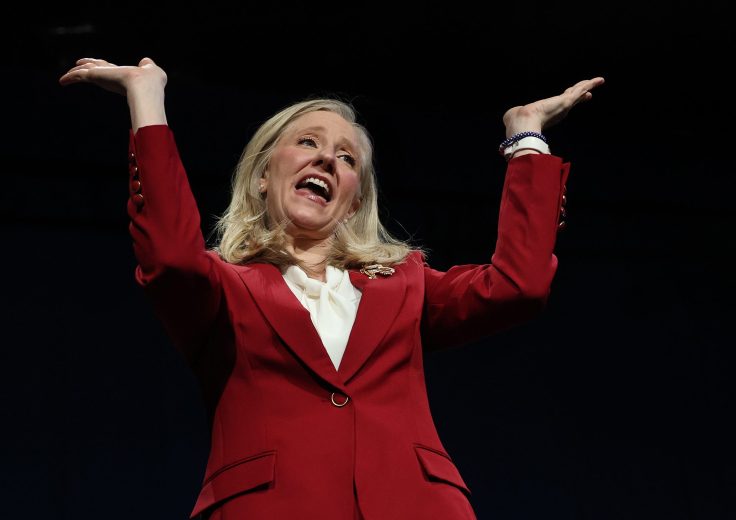
Democratic Virginia governor Abigail Spanberger’s decision to reenter her state into a controversial green energy program is projected to cost Virginians nearly $1.2 billion over the next two years, due to higher electric bills, despite Spanberger’s claim that the move was about “cost savings” and “lowering bills for families who need help most,” according to state filings.
Spanberger’s Republican predecessor, Glenn Youngkin, had pulled Virginia out of the Regional Greenhouse Gas Initiative in 2022, calling it a hidden and “regressive” tax that disproportionately impacted lower-income families.
The RGGI, which critics say functions like a carbon tax, forces utility companies in participating states—11 Northeastern and Mid-Atlantic states, all but one with a Democratic governor—to pay states for greenhouse gases they emit. The states are then supposed to reinvest that money into green energy programs, including so-called environmental justice programs that make the homes of lower-income families more energy efficient. That would, the theory goes, eventually lower these families’ electric bills.
Spanberger, who ran as a moderate Democrat in 2024 but since entering the governor’s mansion has pulled the state sharply to the left, quickly rejoined the RGGI.
“For me, this is about cost savings,” Spanberger claimed in January. “RGGI generated hundreds of millions of dollars for Virginia—dollars that went directly to flood mitigation, energy efficiency programs, and lowering bills for families who need help most.”
Spanberger’s sunny language, if properly parsed, clearly states the “equitable” or “environmental justice” component of the RGGI: The cost savings are designated for low-income Virginians, who will supposedly benefit from state-funded energy efficiency initiatives to bring down their power bills. But those rosy predictions have so far not just been off, they’ve been flat-out wrong.
Dominion Energy, the state’s main electricity provider, calculated RGGI’s shocking $1.2 billion price tag for Virginians based on the number of “allowances” it would be forced to buy to account for the carbon emissions from its power plants, according to the filings it submitted this month with state regulators.
Typically, power companies subject to the RGGI simply pass down the costs to their customers. Dominion said the $1.2 billion allowance cost would be applied to residential bills in the form of a surcharge, increasing the average Virginian household’s electric bill by roughly $13 per month, or 7.5 percent. Virginia’s State Corporation Commission must approve that surcharge before Dominion can implement it.
Dominion’s director of strategic planning, Lisa Crabtree, said in the filings that the surcharge was necessary to “recover projected and actual costs related to the purchase of allowances through the Regional Greenhouse Gas Initiative.” The company added in a separate document that it “recognizes that the … customer bill impact from these compliance costs is significant.”
The projected cost increase is a black eye for Spanberger, who made energy affordability a central pillar of her gubernatorial campaign last year. It also cuts against her promises that the RGGI would lower the amount that low-income Virginians pay. Based on Dominion’s projects, all Virginians will pay more.
Spanberger formally reentered Virginia into the RGGI in late February. Virginia first joined the initiative in 2021, but in early 2022, Youngkin withdrew the commonwealth from the program. “The benefits of RGGI have not materialized, while the costs have skyrocketed,” he said at the time.
In fact, since Youngkin withdrew Virginia, the average cost of residential electricity in states participating in the RGGI has increased by 39.1 percent while the average cost of residential electricity in Virginia has increased by 34.3 percent, according to federal data reviewed by the Washington Free Beacon. The three states with the largest electricity price hikes nationwide since then—Maryland, Maine, and New Jersey—are all RGGI participants.
Overall, nine Democrat-led states, including Virginia, and two Republican-led states (New Hampshire and Vermont) along the East Coast participate in the RGGI as part of their broad efforts to combat global warming and boost green energy. But the idea that the RGGI fees would incentivize utilities to adopt green energy sources has proven fanciful. Those states still rely heavily on natural gas for electricity, meaning their residents will continue to pay hefty fees under the RGGI.
As for Virginia, natural gas generates nearly 60 percent of Virginia’s total electricity while green sources like solar and wind generate less than 15 percent.
“Governor Spanberger ran on kitchen-table affordability, and Virginians are about to find out what that actually means—higher electric bills every single month,” American Energy Institute CEO Jason Isaac told the Free Beacon.
And what about the idea, put forth by RGGI’s advocates, that RGGI revenue coming into participating states is used to make lower-income families’ homes more energy-efficient, and thereby saving them down the road? “Don’t be fooled by the ‘cap-and-invest’ branding,” Isaac told the Free Beacon. “That money isn’t coming back to the families who paid it. … It gets extracted from ratepayers, laundered through the state government, and redirected to whatever green energy programs bureaucrats decide to fund. It’s a forced subsidy for the climate agenda dressed up as consumer benefit—and Virginians will be paying for it whether they like it or not.”
Spanberger’s office did not respond to a request for comment.