
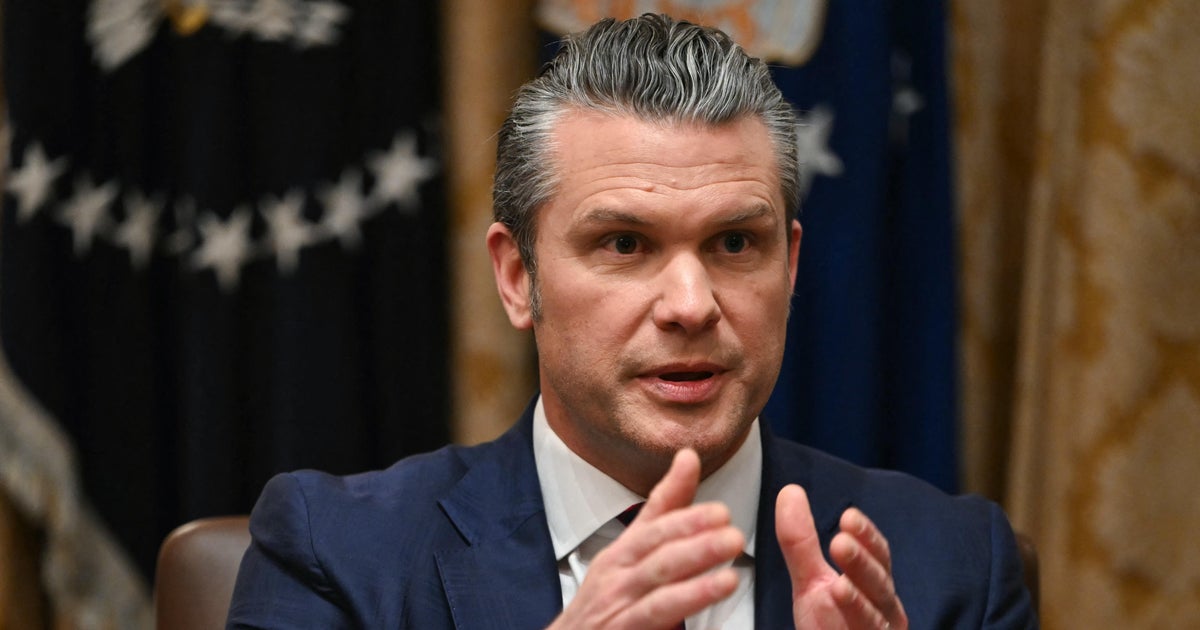
Washington — Defense Secretary Pete Hegseth jeopardized sensitive military information that could have endangered American service members when he shared certain details about U.S. military operations in Yemen in a private Signal group chat earlier this year, according to a report the Pentagon’s inspector general released Thursday morning.
The report found the former Fox News host-turned-defense secretary violated Defense Department policies when he used his personal device for official business to transmit sensitive U.S. military information to other top Trump officials and the editor in chief of The Atlantic magazine. CBS News reported the key findings of the report ahead of its release based on multiple sources.
“Using a personal cell phone to conduct official business and send nonpublic DoD information through Signal risks potential compromise of sensitive DoD information, which could cause harm to DoD personnel and mission objectives,” the report said.
The report also said Hegseth’s “actions created a risk to operational security that could have resulted in failed U.S. mission objectives and potential harm to U.S. pilots.”
A classified version of the inspector general’s report was sent to Congress on Tuesday. An unredacted version was released Thursday.
In a statement Wednesday, chief Pentagon spokesman Sean Parnell said the review “is a TOTAL exoneration of Secretary Hegseth and proves what we knew all along – no classified information was shared. This matter is resolved, and the case is closed.”
Hegseth also called the review a “total exoneration,” writing on X: “No classified information. Total exoneration. Case closed. Houthis bombed into submission. Thank you for your attention to this IG report.”
The report said that while Hegseth has the authority to declassify information as secretary, “based on our review, we concluded that some information from the secretary sent from his personal cell phone on Signal on March 15, 2025, matched the operational information USCENTCOM sent and classified as SECRET/NOFORN.” CBS News previously reported on the classified source of information and that it had been shared by Army Gen. Michael “Erik” Kurilla, who at the time was the commander of U.S. Central Command, the primary combatant unit overseeing U.S. military operations in the Middle East, Central Asia and parts of South Asia.
According to U.S. Central Command’s Security Classification Guide, the operational movement of aircraft should be classified as SECRET, the report found. However, the Secretary of Defense is authorized to declassify information as appropriate.
The “SECRET” designation means the information was classified, and the disclosure of the information without proper declassification could potentially cause serious damage to national security and jeopardize the safety of service members, according to the U.S. government.
The “NOFORN” label means the information can only be disseminated to U.S. agencies and individuals, excluding foreign nationals and even close U.S. allies.
Hegseth declined to be interviewed for the report, the inspector general said, opting instead to respond to questions in writing.
The secretary did not provide his personal cell phone to the IG, according to the report. His office did provide some messages that matched those published in the Atlantic, but excluded “a number of messages that had auto-deleted by the time the information was captured from the Secretary’s phone because of settings in the chat.”
The IG was told Hegseth posted the same information in separate signal chats, so the IG requested copies of messages from other group chats. Because the IG did not have access to Hegseth’s phone, he was not “able to verify whether any of the additionally identified Signal chats also contained sensitive, classified, or other nonpublic DoD information.”
The sources familiar with the inspector general’s investigation said the report found that if the information had been intercepted by a foreign adversary, it would have clearly endangered U.S. service members and the mission.
The report does not address the question of whether Hegseth declassified the information before it was posted in a Signal chat group that included other top Trump officials, the sources said. That group chat also inadvertently included Jeffrey Goldberg, the editor in chief of The Atlantic, who broke the story in March.
A day after the Signal chat story was published by The Atlantic, U.S. Africa Command, in coordination with the government of Somalia, conducted multiple airstrikes against affiliates of the Islamic State terrorist organization. A press release said the airstrikes occurred near the Golis Mountains in Somalia and that multiple “ISIS-Somalia operatives were killed.”
After multiple Trump administration officials claimed the information in the Signal chat group was unclassified, CBS News filed a request in March under the Freedom of Information Act to U.S. Africa Command to see if similar information deemed unclassified by Hegseth from the Yemen airstrike could be released regarding the March 25 airstrike on the ISIS operatives in Somalia.
CBS News requested information about the airstrike that was similar to the information appearing in the Signal chat group about the strikes and that Trump intelligence officials had said was unclassified.
In early September, CBS News received a response from U.S. Africa Command, which arrived at the same conclusion as the Pentagon inspector general about the Somalia airstrike — that the material if released could jeopardize national security.
“[The] information that is currently and properly classified pursuant to Executive Order 13526. … In this case, I have determined that the release of the documents would foreseeably harm national security,” Marine Maj. Gen. Matthew Trollinger, the chief of staff to Air Force Gen. Dagvin R.M. Anderson, the commander of U.S. Africa Command, wrote in his letter to CBS News.
White House press secretary Karoline Leavitt said in a statement that the IG’s review “affirms what the Administration has said from the beginning — no classified information was leaked, and operational security was not compromised.”
She went on to say, “The President’s entire national security team is doing great work advancing American interests while protecting sensitive information,” adding, “President Trump stands by Secretary Hegseth.”
In separate statements on Wednesday, the top Democrats on the House and Senate Intelligence Committees called for Hegseth to resign.
Virginia Sen. Mark Warner said the report “notes that the IG is aware of several other Signal chats Hegseth used for official business, underscoring that this was not an isolated lapse. It reflects a broader pattern of recklessness and poor judgment from a secretary who has repeatedly shown he is in over his head.”
“Pete Hegseth’s behavior and lack of judgment would be a fireable offense for anyone else in the Department of Defense,” Rep. Jim Himes of Connecticut said. “What’s more, his refusal to sit for an interview with the Inspector General or submit his device for examination is yet another example of his failure to take responsibility for his actions.”
Last month, Hegseth joked about the “Signalgate” scandal while speaking at Fox Nation’s Patriot Awards after spotting United Nations Ambassador Mike Waltz in the audience.
“I see Mike Waltz — Mike, I’ll hit you up on Signal later.”