
REVIEW: ‘Tojo: The Rise and Fall of Japan’s Most Controversial World War II General’ by Peter Mauch
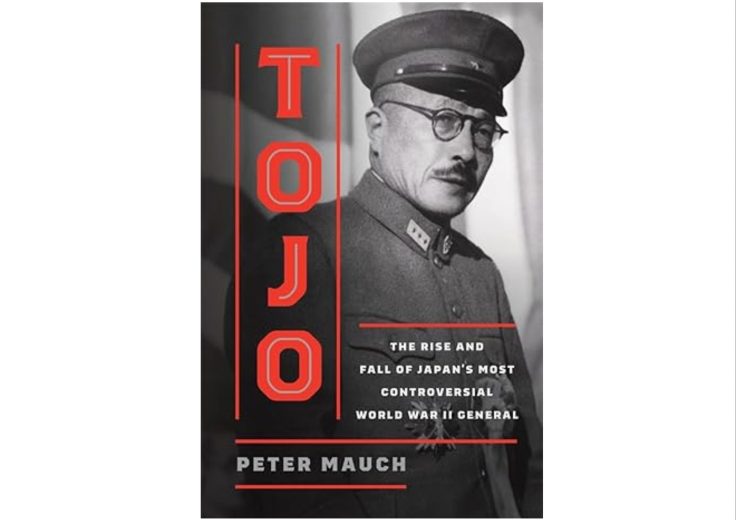
General Hideki Tojo served as Japan’s war minister (administrative leader of the Imperial Army) from July 18, 1940, to July 18, 1944, and then concurrently as prime minister from October 17, 1941, to July 18, 1944. As such, he is a central figure in the war, functionally parallel to Winston S. Churchill and Franklin D. Roosevelt. Despite his indisputably high standing among all World War II leaders, this outstanding work by Peter Mauch provides the first full English-language portrait of Tojo in a reader-friendly narrative based on formidable research and shrewd judgment.
Selected highlights in this packed banquet include Tojo’s career path that proved fundamental to his war performance. He developed keen understanding of war preparation and “total war” execution, but he was never exposed to a rigorous contemplation of the crucial strategic question of whether a war was worth undertaking with prospects of success. In 1941, Tojo bureaucratically marched Japan to catastrophe without pausing to ponder this basic question. Meanwhile he did skillfully woo Hirohito, who opposed Tojo’s appointment as war minister. Eventually, he won the emperor’s firm support.
Interestingly, the dominant radical strands in the Imperial Army often found Tojo lacking their level of fervor, especially during 1941 as Japan moved to widen hostilities beyond its war in China. Tojo kept his war minister hat when he became prime minister because under Japan’s dysfunctional top political and military decision-making structure, a P.M. was not privy to deliberations by the army and navy leadership, whereas the war minister was. This led to the absurd situation where Tojo the prime minister had to act as though he did not know what Tojo the war minister knew.
Tojo was contemptuous of any serious U.S. military threat to his country. After Japan’s enormously successful opening drive following Pearl Harbor, Tojo projected the United States could not mount a counterattack before the fall of 1944. He dismissed as minor and transitory the American landing on Guadalcanal in August 1942. He became incensed when he learned the Japanese soldiers sent there were starving because of the inability of the Imperial Navy to resupply them. By late November, Tojo recognized retaking Guadalcanal was futile. There then erupted a superheated dispute with literal fisticuffs and screaming matches when Tojo refused army demands for massive diversion of scarce shipping resources that imperiled Japan’s overall war effort and the well-being of the people. In 1943, he clung to the idea that the Japanese could still prevail in a war with the United States that might go one or two decades—provided he held an indispensable role.
Mauch takes pains to highlight the contradiction Tojo could not resolve between Japan’s pursuit of an autarkic self-existence and self-defense and the “co-prosperity” of the other peoples and nations in its empire. The former prioritized Japan’s interests, the latter attempted fraudulently to cast Japan’s actions as a noble service to other Asians.
In 1944, Japan’s ever more disastrous strategic situation broke Tojo’s grip on power. When Hirohito recognized his prime minister had to go, Tojo’s tenure ended. In his subsequent role as a member of the jushin, the advisory body of former prime ministers, Tojo adamantly opposed surrender to the end. But ultimately he opposed any coup to prevent the surrender. He debated whether his duty was to commit suicide or to present an unapologetic defense of Japan’s noble purposes at a war crimes trial. When he recognized he was about to be arrested and placed on trial, he shot himself in the chest, but U.S. medical treatment saved his life. At the Tokyo War Crimes trials, Tojo did his best to shoulder all “war guilt” to shield Hirohito. He was hanged on December 23, 1947.
My only reservation about this work is that it accepts as normalized the Japanese viewpoint of many events that have much more complex and disputed contexts. A prime example involves the “Hull Note” in November 1941 by U.S. secretary of state Cordell Hull. Reduced to the essentials, this complicated episode unfolded as follows.
Japan had submitted two proposed settlement frameworks of conflicts between Japan and the United States. From the U.S. perspective, both of them were one-sided offers effectively demanding the United States abandon China to extricate Japan from its quagmire in that country. Hull kept working on a response until decrypted Japanese diplomatic cables on November 22 and 24 revealed the absolute Japanese deadline for a settlement on Japanese terms was November 27, U.S. time. Hull recognized there was no chance of a satisfactory agreement on those terms in that time frame. With the Munich abandonment of Czechoslovakia in mind, Hull prepared a message for the historical record laying out the principles for which his country stood. While the Japanese deemed this an ultimatum, in technical diplomatic legal framework, it was not.
The Japanese Pearl Harbor carrier striking force had sailed on November 26 Japanese time, hours before the Hull Note was delivered. Its orders provided for recall only if the United States buckled to Japanese terms.
Tojo: The Rise and Fall of Japan’s Most Controversial World War II General
by Peter Mauch
Belknap, 492 pp., $32.95
Richard B. Frank is a military historian and the author, most recently, of Tower of Skulls: A History of the Asia-Pacific War: July 1937-May 1942 (W.W. Norton).