
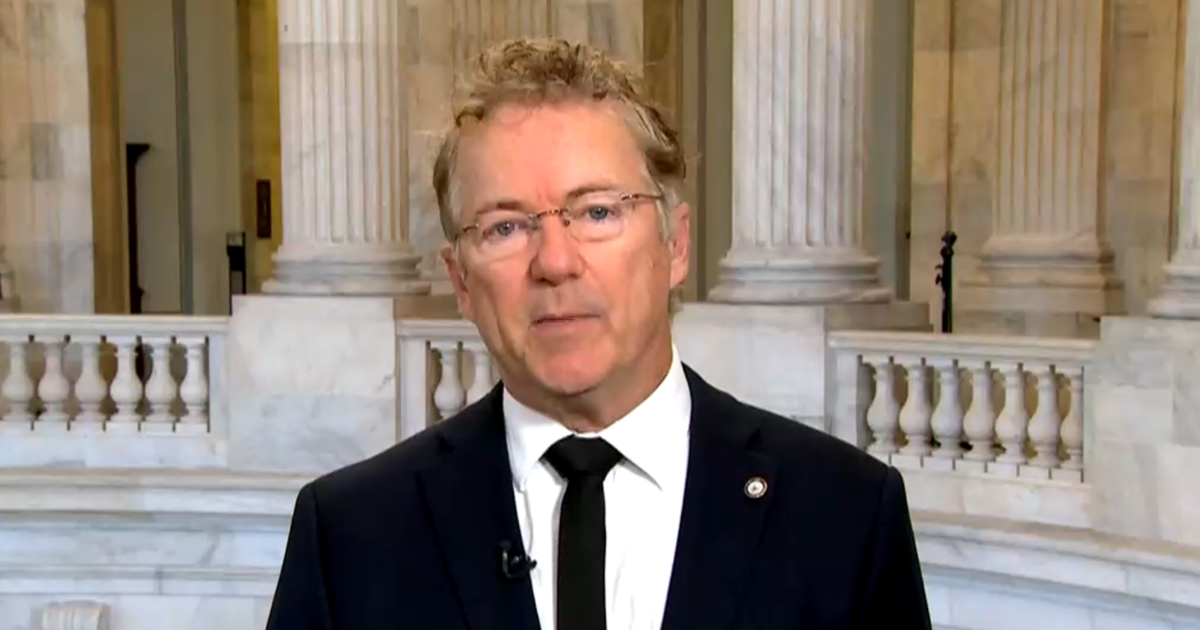
GOP Sen. Rand Paul said Wednesday he opposes any U.S. military action in Greenland as the White House says it is exploring all options for acquisition of the territory.
“It won’t happen under my watch,” Paul said on “CBS Mornings” about military action in Greenland. “I will do everything to stop any kind of military takeover of Greenland.”
The Kentucky senator, who sits on the Senate Foreign Relations Committee, has long opposed offensive U.S. military action overseas. He voted to advance a war powers resolution, which would have limited the president’s authority to continue a military campaign in Venezuela, but Senate Republicans blocked the measure. The Trump administration did not seek congressional approval before launching last week’s strikes. The Senate is expected to bring up a war powers resolution again this week.
White House press secretary Karoline Leavitt said of President Trump’s interest in Greenland that he and his team are “discussing a range of options to pursue this important foreign policy goal, and of course, utilizing the U.S. military is always an option at the commander-in-chief’s disposal.”
Greenland is a semi-autonomous territory in the Kingdom of Denmark. A lawmaker and a source familiar with the discussions said Secretary of State Marco Rubio told members of Congress at briefing Tuesday that Mr. Trump would buy Greenland and not take it by force.
Paul did not raise an objection to purchasing Greenland, noting that the U.S. has acquired territory in the past.
“Half of the United States came to us through the Louisiana Purchase,” Paul noted. “Alaska came to us through a purchase. But you didn’t get to those purchases like any deal or diplomacy by insulting your opponent. You get there by actually trying to please and get your opponent to agree to this, because it would have to be done voluntarily.”
Paul said that this type of action in Greenland would have to be initiated by a vote from its more than 50,000 citizens declaring their independence from Denmark, adding, “I think the people of Greenland are inclined to do” this.
That would also have to be followed by “some sort of offer of something that makes it better to be a part of the United States,” he continued.
When Mr. Trump announced the strikes in Venezuela, Paul suggested it marked the beginning of the “Don-roe doctrine,” leading to questions about expansion extending to other territories, including Greenland and Canada.
Paul said that he had “never thought about” taking Greenland, but “now that it’s been brought up, if you want to effect that, you don’t do it by beating people up the same way, like in regard to Canada.”
Mr. Trump has referred to Canada the “51st state” and imposed punishing tariffs against the U.S.’ northern neighbor, raising tariffs to 35% in August, though a large share of goods are exempt because they’re covered by the 2020 U.S.-Mexico-Canada Trade Agreement.
Paul said he’s been consistent about his opposition to military action overseas, and he stressed the importance of maintaining Congress’ constitutional authority to declare war.
“I think that this is an important debate to have,” Paul said. “Doesn’t mean I have anything against President Trump. It doesn’t mean that I don’t even dislike the result of (former Venezuelan President Nicolás) Maduro gone … But I do think the constitutional debate is an important one.”