
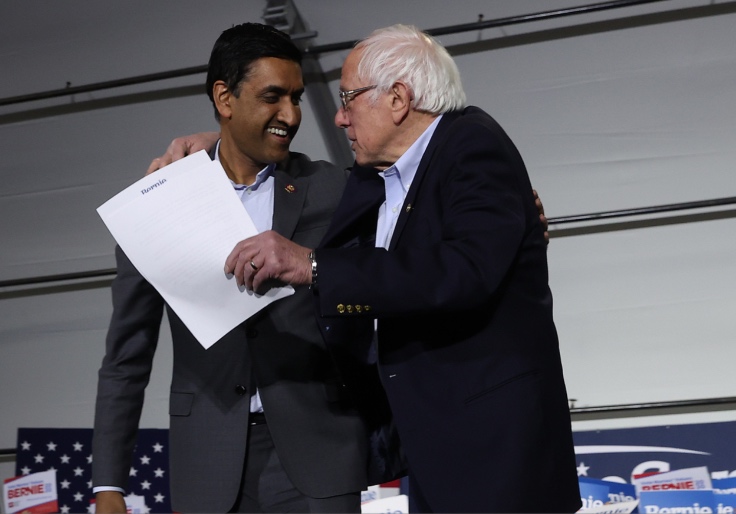
Sen. Bernie Sanders, socialist of Vermont, and Rep. Ro Khanna, a Democrat from California best known for trafficking in Epstein-related conspiracy theories, are pushing legislation that would impose a new 5 percent annual wealth tax on billionaires and use the revenue to give money to everyone earning less than $150,000 a year.
The bill, which the politicians are calling the Make Billionaires Pay Their Fair Share Act, would raise $4.4 trillion over a decade, according to a letter from Emanuel Saez and Gabriel Zucman, economists at the University of California, Berkeley, that was released by the leftist politicians.
The March 2, 2026, letter from the two economists, on University of California, Berkeley, letterhead, advocated the tax less as a tool to raise revenue and more as a way of curbing what the economists describe as an “unprecedented level” of wealth concentration.
“Democracies become oligarchies when wealth becomes too concentrated,” says the letter. “A billionaire wealth tax is the most direct policy tool to curb the growing concentration of wealth among the billionaire class in the United States.”
Almost as if coordinated, the New York Times unleashed a four-byline project about what it called “America’s New Gilded Age.” The Times story, which was published as a news article, hit nearly the same theme as the Sanders and Khanna press release. “One of the central quandaries the country now faces is how to govern in an era when such vast wealth both controls a large part of the economy and is increasingly used to access political power,” said—OK, you guess, was that from the Times article or the Sanders and Khanna press release?
It was from the Times news article. The Sanders and Khanna press release said, “One of the most important moral and economic issues of our time is the urgent need to confront the obscene level of income and wealth inequality that we are currently experiencing. Never before in our nation’s history have so few people held so much wealth and so much power.” Other than the word “obscene,” it’s about the same as the Times news article.
The Times article also includes fine print acknowledging that “official statistics do not directly indicate how much income, in any given county, goes to the top 1 percent of earners. To estimate those figures, The Times followed statistical methods published by economists Thomas Piketty and Emmanuel Saez.” That’s the same Emmanuel Saez plumping for the wealth tax.
Piketty wrote a book published by Harvard University Press in 2014, Capital in the Twenty-First Century, arguing for a wealth tax. The date is significant, because the Times manages to blame the 2017 Trump tax cuts for having “minted hundreds of new billionaires,” yet Piketty was already complaining about the wealth imbalance and calling for higher taxes on capital back in 2014, before the Trump tax cuts.
Strangely absent from the Times article about billionaire creation is any mention of monetary policy, particularly the Federal Reserve’s ZIRP (zero interest-rate policy) and QE (quantitative easing). It’s a particularly glaring omission given that the Kansas City Fed has an annual economic policy “symposium” in Jackson Hole that attracts central bank officials and their hangers-on. Those policies drove up asset prices and eventually, along with former president Joe Biden’s spending binge, fueled inflation, too.
To some degree, Sanders and Khanna are replicating the “tax the rich” politics of Zohran Mamdani, the socialist who was elected mayor of New York. Sanders campaigned alongside Mamdani in New York City in 2025 and attended Mamdani’s inauguration on Jan. 1, 2026. In other ways, it’s a departure. While Mamdani proposed to use additional new millionaire-tax revenues to pay for “free” buses and “free” childcare, Sanders and Khanna are proposing an explicit cash transfer: “a $3,000 direct payment to every man, woman and child in a household making $150,000 or less—$12,000 for a family of four.” The federal lawmakers also say they’d use the money to add dental, vision, and hearing coverage to Medicare, “establish a $60,000 minimum annual salary for every public school teacher in America,” and restore Obamacare subsidies.
Republicans now control the House and Senate, so the Sanders and Khanna legislation is unlikely to become law. But it could be fodder for Democrats if they take over Congress in the midterm elections or as part of the 2028 presidential campaign that Democrats simultaneously obsess about and fret that President Trump is not going to permit ever to happen.
Sanders and Sen. Elizabeth Warren (D., Mass.) both campaigned for president on wealth taxes in 2020. It wasn’t part of Biden’s 2020 platform, but as president he proposed what I called a Biden-Wyden wealth tax on unrealized capital gains (Sen. Ron Wyden of Oregon is the top Democrat on the Finance Committee).
The executive vice president of the National Taxpayers Union Foundation, Joe Bishop-Henchman, said the proposed tax is unconstitutional and “would greatly reduce investment activity and GDP and the income tax revenue it generates.” He also noted in a social media post that “Zucman’s home country of France abandoned their broad wealth tax in 2018 because the tax was too difficult to administer and 60,000 millionaires left.”
Another feature shared by both the Sanders and Khanna press release and the Times news article is a tendency to demonize and dwell on individual billionaires.
The Sanders and Khanna release says, “Under the bill, Elon Musk—worth $833 billion and now wealthier than the bottom 53% of American households combined—would owe $42 billion in taxes, leaving him with approximately $792 billion. Mark Zuckerberg, worth $220 billion, would owe $11 billion. Jeff Bezos, worth $218 billion, would owe approximately $11 billion.” Musk helped Trump get elected and worked on government efficiency in the early months of the administration, while Bezos killed an editorial endorsing Trump’s opponent in the Washington Post, which Bezos owns. The Saez and Zucman letter released by the politicians includes a table estimating how much less money Larry Ellison, Steve Ballmer, Michael Dell, and Sergey Brin would have if a billionaire tax had been in place.
And the Times article for some reason singles out TD Ameritrade founder Joe Ricketts. It reports, “Wyoming tycoons were among Mr. Trump’s supporters. Marlene Ricketts, the wife of Joe Ricketts, and B. Wayne Hughes Jr., a fellow Wyoming billionaire, each donated $1 million to the president’s inaugural committee; and Mr. Ricketts’s son Joe co-hosted a pre-Inaugural Ball reception for wealthy donors with fellow hosts Mark Zuckerberg and Miriam Adelson, the widow of the casino magnate Sheldon Adelson.” The Times also reports, “Mr. Hughes also owns Cowboy State Daily, a widely read news website with a right-leaning editorial board.” Maybe what the Times really dislikes is competition; nothing after all, is more dangerous than a right-leaning widely read news website.
It’s easy to understand why Sanders and Khanna would want to tax those fortunes away—they would get to spend the money themselves and use it to diminish the power of forces that constrain unlimited government power. Why the Times wants to pile on in the campaign by French economists and socialist politicians against the non-Sulzberger rich is a separate question.
One billionaire wealth pool that Sanders and Khanna and the Times‘s intrepid investigative journalists don’t seem eager to shine a light on is the New York Times Company itself, whose stock today traded at a price above $81 a share, a record. Leave it to the people with inherited sixth-generation family control of a company with a $12.4 billion enterprise value and political agenda-setting power that, if sharply diminished, remains significant to sound a panicky alarm about the creation of new fortunes.
The funniest thing about the Times billionaire article is the undertone of old-money horror at the arrivistes. “The number of U.S. billionaires jumped 50 percent by some estimates between 2017 and 2025, to more than 900 people,” the Times frets, fulminating about “stunning velocity” and the “colossal leap.” At pro-growth widely read news websites, we call that the American dream of upward mobility and opportunity. Celebrate it rather than complain about it.