
Washington — The Senate failed to advance a measure to fund the Department of Homeland Security on Thursday, likely paving the way for another partial government shutdown without a last-minute breakthrough.
In a 52 to 47 vote, all but one Democrat — Sen. John Fetterman of Pennsylvania — opposed moving forward with the bill, which would fund DHS through September. The motion needed 60 votes to succeed. Senate Majority Leader John Thune, a South Dakota Republican, voted against the motion in a procedural move that allows him to bring it up again.
Funding for DHS, which oversees Immigration and Customs Enforcement and Customs and Border Protection, is set to lapse at 12 a.m. Saturday. ICE and CBP would continue operating if that happens, since they received billions of dollars in separate funding last year.
Senate Minority Leader Chuck Schumer, a New York Democrat, said his caucus would vote against moving forward because the bill “fails to make any progress on reining in ICE and stopping the violence.”
Sen. Katie Britt, an Alabama Republican who has led the negotiations with Democrats and the White House, sought to approve a two-week funding extension by unanimous consent after the failed vote.
“Two weeks ago we agreed to extend funding while we talked and tried to find a pathway forward. However, the timeline we knew was going to be short,” Britt said. “We are working in good faith to find a pathway forward. What we’re asking is, let us continue to do that.”
Sen. Chris Murphy, a Connecticut Democrat, objected.
“I wish we weren’t here. I wish our Republican colleagues and the White House had shown more seriousness from the start,” Murphy said. “But Senate Democrats have been clear that we have all taken an oath, an oath to uphold the law of the country, and this Department of Homeland Security, this ICE, is out of control.”
Democrats and Republicans have been negotiating reforms to ICE and CBP, but the two sides have failed to reach an agreement. The White House sent a legislative proposal for full-year funding late Wednesday, days after Democrats sent their own draft bill. On Thursday, House Minority Leader Hakeem Jeffries, a New York Democrat, told CBS News that his “preliminary assessment” of the latest offer “is that it falls short of the type of dramatic changes necessary in order to change ICE’s out-of-control behavior.”
Last week, in a letter to their GOP counterparts, Democratic leadership laid out a list of their demands for ICE reforms. Congressional Democrats have demanded changes to ICE and CBP in exchange for their votes to fund DHS since Alex Pretti was shot and killed by immigration agents in Minneapolis last month.
Democrats want to restrict immigration agents from wearing masks, require them to wear identification and body cameras and standardize their uniforms and equipment. They also want to ban racial profiling, require judicial warrants to enter private property and bar immigration enforcement at medical facilities, schools, child care facilities, churches, polling places and courts. And they pushed to impose “reasonable” use-of-force standards; allow state and local jurisdictions to investigate and prosecute “excessive force;” and introduce safeguards into the detention system.
President Trump told reporters Thursday afternoon that some of the Democrats’ demands are “very, very hard to approve.”
Thune told reporters Thursday morning that he thought the White House’s latest offer is “pretty close” to getting into the “agreement zone.”
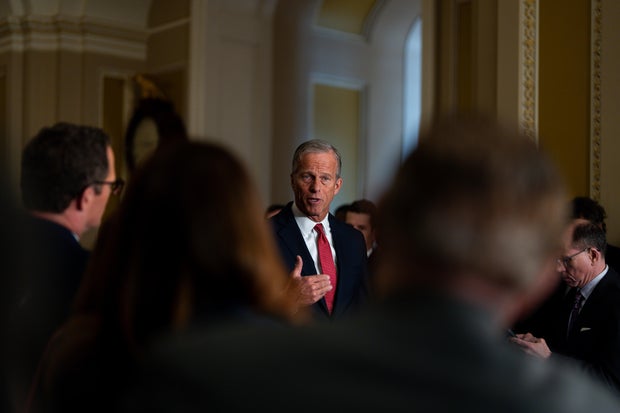
“I think it’s up to the Dems to react to this,” Thune said. “Right now, at least there ought to be an understanding that these discussions need to continue, and that a solution is at least in sight.”
Still, senators are leaving town after Thursday and are set to be away from Washington on recess next week. And Thune said he doesn’t see the benefit of keeping senators around as talks continue.
“If and when there’s a breakthrough, we’ll make sure people are here to vote on it,” Thune said. The GOP leader told CBS News that senators would be expected to return within 24 hours or as soon as possible if a deal is reached.
Along with funding for the immigration enforcement agencies, DHS also oversees the Coast Guard, FEMA and TSA, all of which would be impacted by a lapse in funding. ICE and CBP operations would continue because they received an influx of funds in last year’s One Big Beautiful Bill Act.
The impasse over DHS funding led to a four-day-long partial government shutdown earlier this month. Lawmakers ultimately agreed to fund every government agency except DHS until the end of the fiscal year. They also extended DHS funding for two weeks to buy more time for negotiations.