
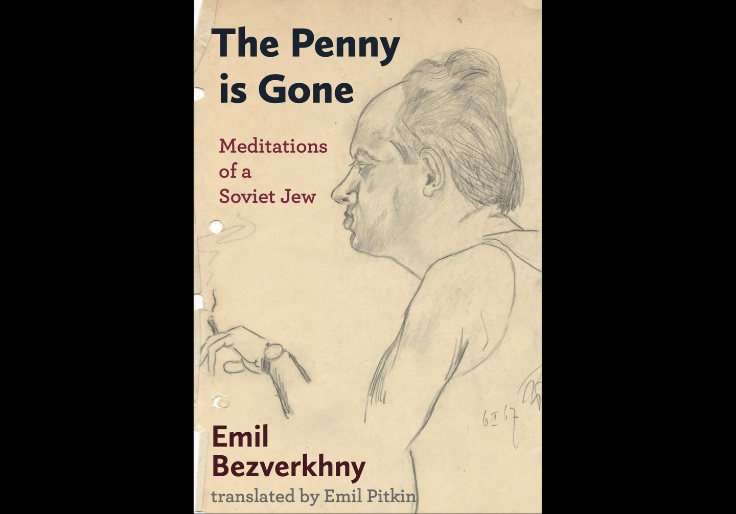
It is the easiest of questions, it is the most difficult of questions: “Why are the Jews leaving the Soviet Union?” asks Emil Bezverkhny. He writes throughout the latter half of the 20th century, each chapter in his posthumously published The Penny is Gone a capsule preserving the maddening, almost otherworldly qualities of being a Jew, a scientist, just a man, in that time and place. It’s easy to see why Jews are leaving the Soviet Union. They are second-class citizens in the nation that promised such a concept was anathema to its very existence. They are kept out of jobs they deserve, left to destitution and dishonor, neither allowed to practice the Mosaic law nor the new secular religion of science and development of the rational faculties.
Yet it raises the most difficult of questions: Even here? Even now? “Why are they leaving behind a country with a constitution guaranteeing equal opportunity for all, irrespective of nationality or race?” Bezverkhny rephrases the question: How can it be that even the most enlightened people, consistently to their own detriment, drive away their Jewish neighbors? The Germans alienated Einstein; Einstein helped defeat the Germans. Bezverkhny would not claim to be an Einstein or von Neumann or Oppenheimer, but he was accomplished and dedicated. On merit, he should have risen to the top of the Soviet academy and helped further the aims of the revolution, even if he seemed lukewarm at best about their utility from the outset. Yet the Soviets fell prey to the same disease of self-sabotage. They killed, banished, or alienated their brightest Jewish minds. Thankfully, for us if not Bezverkhny, this led to the downfall of the Soviet empire and enormous contributions to American wealth, health, and power.
Bezverkhny’s reflections on the recurring historical tendency of nations to make life miserable for Jews for any reason or no reason at all are newly brought to light by his grandson and namesake, Emil Pitkin. An entrepreneur and data scientist, the younger Emil has translated his grandfather’s writings skillfully, preserving their literary (and distinctly Russian) qualities, while producing an eminently readable book despite the barrier between the two languages. What results is a memoir—even if Bezverkhny insists he has not written a memoir but an attempt to unearth “the roots of today’s tragedy”—which places readers in the restless mind of a man who did everything right, suffered enormously, and was in the end let down by those who promised him utopia.
The descriptions of poverty in Bezverkhny’s childhood are familiar yet still pack a punch. “We would bring home 375 grams of bread from the bakery” on Fridays, he recalls.
We carried it like a bowl filled with holy water. One time, Grandpa Yihiel came over. After the evening prayers, honoring custom, he dipped a morsel of bread in salt and ate it. I began to cry: it seemed to me that the piece was too big. Grandfather starved to death in March of ’42. Not long before him, Grandma Haika had perished from hunger too.
Such was life in Eastern Europe, indeed in nearly the whole world for all of time before the advent of capitalism. For Soviet Jews, grinding poverty, death, war, and oppression served as compounding indignities. The shadow of a long history of Jewish suffering, a history that would rear its head once again as the Soviets turned their backs on the Jews, was omnipresent. That sense of historical inescapability haunts Bezverkhny, and from it the book draws its title. Bezverkhny writes of his father’s “inexhaustible” stories, such as the one about the destitute boy who lost his penny. “Let’s cheer you up,” says a benevolent passerby, and gives him a new penny. “Suddenly, the boy starts crying again … ‘why are you crying again?’ ‘I’m sad about my penny. If I hadn’t lost it, I would have had two.'” The penny is gone, and cannot truly be replaced.
Each Jew lost to history, to senseless hatred and subjugation, “used to count at least as cogs in the system; now they don’t even count for a penny.” Their absence is palpable. Even small moments of accomplishment and hope are haunted by the ghosts of Jews who were not sustained until that day, and Bezverkhny’s sense that he would soon meet the same fate.
Indeed he would. His account of his unceremonious dismissal from an important post at a military research institute rivals Kafka’s descriptions of mindless bureaucracy coupled with mendacious hypocrisy. No one can admit that on merit, Bezverkhny ought to retire a national hero, but he is a Jew—yet that fact (and its perfect irrelevance to his job) cannot be stated lest the soaring principles of the Soviet Union come crashing down. “Do you have any idea what I’m accused of?” asks our protagonist, repeatedly. The reader waits in vain for Bezverkhny’s friends and colleagues to let their guard down and admit they know exactly that it’s all a show.
The difficult question with which Bezverkhny’s inquiry began has an answer. Why do nations expel their Jews as part of their decline and fall? They lose faith in the objective value of their enterprise. What good was Bezverkhny’s expertise when a critical mass of his fellow researchers recognized that the fight for perfect equality was a sham, that their empire was built on a lie its leaders never intended to treat as a truth?
There is a profoundly Jewish element to Bezverkhny’s story, but there is also something distinctly Soviet about the resilience of the lies that control everyone’s life. Yet even as everyone around Bezverkhny continues to lie with words, their actions tell the truth about what they see around them. A culture that has given up on being great and turned into a war of all against all; like a body falling septic, critical resources are diverted toward the most basic forms of self-preservation. High ideals like equality, or aspirations like scientific discovery, no longer receive oxygen.
Americans are losing confidence in our own nation’s worthiness, our own high ideals, and the importance of upholding republican virtues when it would be easier just to look out for oneself. Perhaps that is why (spurred on by some open Soviet sympathizers) Americans are turning against the Jews to a degree not seen for decades.
Thankfully, we have something the Soviets did not: a free market, and entrepreneurs like Pitkin free to take risks and build new goods and services within it. Such people need the best talent to succeed. They have skin in the game, and need others to cooperate. Freedom breaks down prejudices and ensures that objective merit triumphs. We were not lucky enough to welcome the elder Emil to our shores and allow him to become fabulously wealthy and free here. Surely he is smiling down on his grandson, encouraging him to share the cautionary tale of the Soviet Jewish experience with those who would demoralize the great American project, to live out a very different story—one of freedom, merit, and enterprise—and never to take it for granted.
The Penny is Gone: Meditations of a Soviet Jew
by Emil Bezverkhny, translated by Emil Pitkin
Ben Yehuda Press, 199 pp., $24.95
Tal Fortgang is a legal policy fellow and adviser to the president at the Manhattan Institute.