
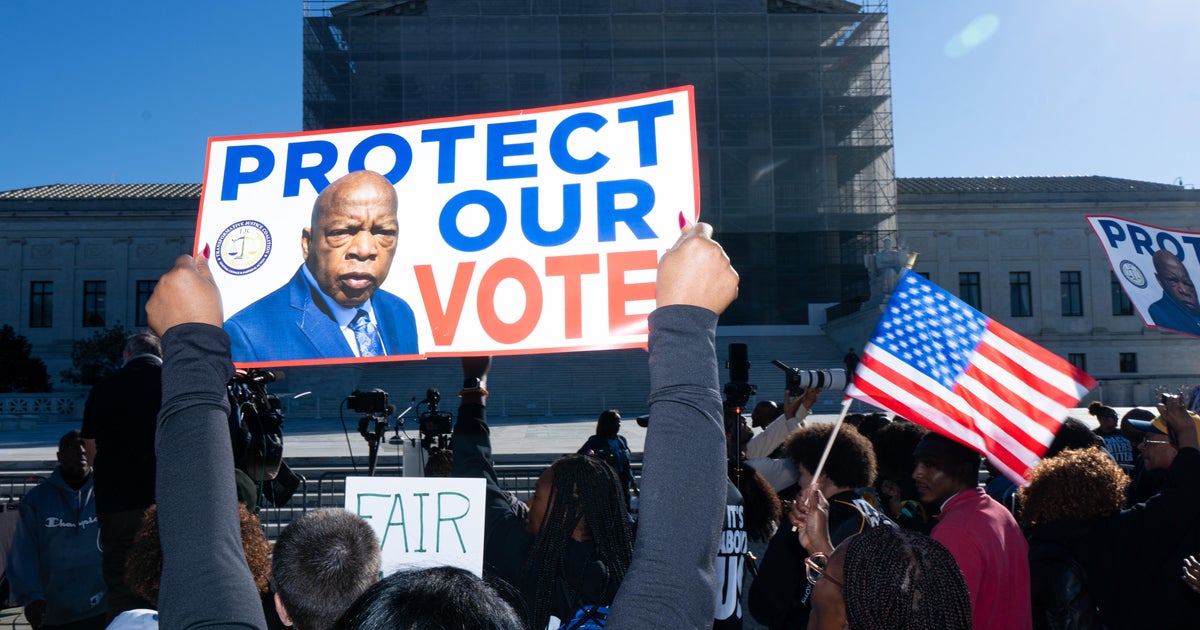
Washington — The Supreme Court on Wednesday struck down Louisiana’s congressional map that includes two majority-Black districts, delivering a significant victory for Republicans in a major decision that narrows the landmark Voting Rights Act.
The high court upheld a lower court ruling that found Louisiana mapmakers relied too heavily on race when they redrew the state’s voting boundaries to comply with Section 2 of the Voting Rights Act. In a 6-3 decision authored by Justice Samuel Alito, the Supreme Court’s conservative majority found that compliance with Section 2 could not justify the state’s use of race in redrawing its House district lines.
Justice Elena Kagan read a summary of her dissent from the bench.
“Because the Voting Rights Act did not require Louisiana to create an additional majority-minority district, no compelling interest justified the state’s use of race in creating SB8,” Alito wrote, referring to the map. “That map is an unconstitutional gerrymander, and its use would violate the plaintiffs’ constitutional rights.”
The decision has implications far beyond political representation in Louisiana. The Voting Rights Act’s protections have been key for voters seeking to challenge redistricting plans that they argue are racially discriminatory. The ruling will likely make it more difficult for minority voters and voting rights groups to successfully challenge voting maps under Section 2.
The high court’s conservative majority changed the legal framework courts use when evaluating claims brought under the voting rights law. The “updated” standard, Alito said, “reflects important developments” since it was first adopted by the Supreme Court 40 years ago.
“In short, Section 2 imposes liability only when the evidence supports a strong inference that the State intentionally drew its districts to afford minority voters less opportunity because of their race,” he wrote. “Not only does this interpretation follow from the plain text of Section 2, but it is consistent with the limited authority that the Fifteenth Amendment confers.”
The decision comes just months ahead of the November midterm elections. Candidates have already filed to run across Louisiana’s six congressional districts, but it’s unclear whether state Republicans will mount a late attempt to redraw the map.
Still, the decision could be a boon for Republicans across the country, who have had to craft majority-minority districts in some states in order to comply with the Voting Rights Act. The question before the court was whether race-based redistricting violates the 14th and 15th Amendments to the Constitution.
The map, which was also used in the 2024 election cycle, includes four majority-White districts and two majority-Black districts. It had been invalidated by a three-judge district court panel as an unconstitutional racial gerrymander.
Louisiana v. Callais
The protracted legal battle over Louisiana’s congressional map began in 2022, when state Republican lawmakers adopted new House district lines in the wake of the 2020 Census. That map consisted of five majority-White districts and one majority-Black district. Nearly one-third of Louisiana’s population is Black, according to Census data.
A group of African-American voters filed a lawsuit arguing the map violated Section 2 because it diluted Black voting strength and deprived minority voters of the opportunity to elect their preferred candidate. A federal judge in Baton Rouge ruled for the voters and ordered the state to enact a remedial map with a second majority-minority House district.
The re-drawn plan was adopted by Louisiana’s legislature in 2024 and reconfigured the state’s 6th Congressional District to ensure the map complied with the Voting Rights Act. Republicans in the state said they also crafted the map with a political goal: to protect powerful GOP incumbents in the House, namely Speaker Mike Johnson, Majority Leader Steve Scalise and Rep. Julia Letlow, a member of the Appropriations Committee.
Congressman Cleo Fields, a Black Democrat, was elected to represent Louisiana’s 6th Congressional District in November 2024.
But the new map drew its own challenge from a group of 12 self-described “non-African-American” voters, who argued it was an unconstitutional racial gerrymander. A divided panel of three judges invalidated the new district lines and found that the state legislature relied too much on race when it crafted them.
Louisiana Republicans and Black voters appealed the decision to the Supreme Court in its last term and urged the justices to keep the re-drawn map intact. But the high court scheduled the case for re-argument in June and asked the parties to address whether race-based redistricting comports with the Constitution.
When the case was before the Supreme Court last year, Louisiana officials defended the new voting boundaries and urged the high court to leave them in place. But after the court said it would weigh the legality of race-based redistricting, the state reversed course and said its intentional creation of a majority-minority district violated the Constitution.