
Iranians call Sunnis dogs. They don’t mean it as a compliment.
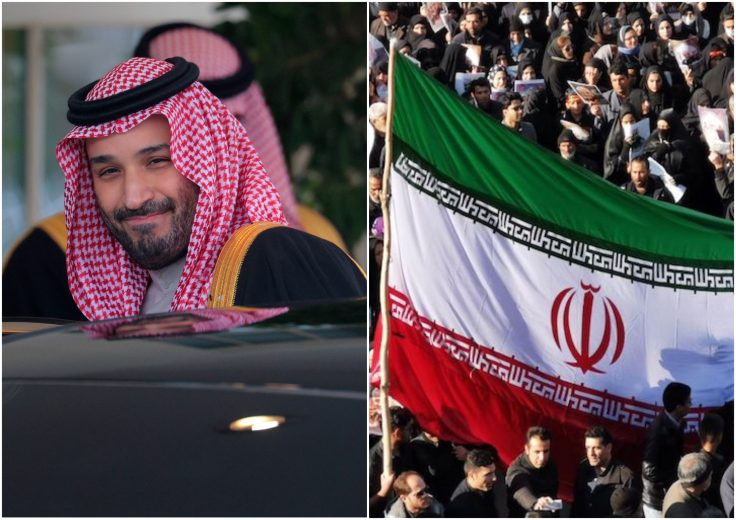
Iranian Shiites have a saying, “Sag Sunni.” It means Sunni Muslims are dogs. The Iranians don’t mean it as a compliment.
The framing of the recent military action in the Middle East so far has been the U.S. and Israel against Iran. Yet President Trump pointed out during a White House appearance with the German chancellor, Friedrich Merz, on Tuesday that Iran has also attacked other countries nearby: “They’ve hit Qatar. They’ve hit U.A.E. They’ve hit Saudi Arabia. They’ve hit Oman,” Trump said. Iran also used missiles and drones to attack Bahrain, Iraq, Jordan, and Kuwait, according to a statement by those governments and the U.S. Reports on social media yesterday showed what appeared to be an Iranian drone strike near a U.S. consulate in Dubai in the United Arab Emirates.
What’s up with that? It goes beyond just Iranian incompetence in reaching Israeli targets or Iranian attempts to hit American military bases and diplomatic installations in the Arab countries. It—like much of what happens in the Middle East—has something to do with the split between Sunni Islam—the dominant variety and the religion of most of the regional royalty—and Shiite Islam—the religion of Iran’s ruling clerics and of its Lebanese proxy, Hezbollah. Iran is a Shiite country with some Sunni minorities. The Sunni-Shiite split is frequently a stronger explanatory dynamic in the Middle East than settler-colonialism or U.S. imperialism or oil or whatever other favored explanation the press or academia are pushing.
Some of these tensions are visible also in the U.S. internal reaction to the campaign against Iran, which has been more muted than the opposition to Israel’s military actions against Hamas terrorists in Gaza after Hamas attacked Israel on October 7, 2023. Many of the U.S. mosques and activist groups are Sunni-aligned, and, perhaps as a result, they haven’t been organizing massive protests against the U.S.-Israeli strikes against the Iranian regime. An exception is the mayor of New York City, Zohran Mamdani, a Shiite Muslim who inaccurately described the U.S. and Israeli actions as “catastrophic” and as an “illegal war of aggression.”
Brigadier General (Reserve) Amir Avivi, the founder and chairman of Israel’s Defense and Security Forum, said the Iranian regime was “acting in an hysterical way … maybe in order to create some kind of pressure on the U.S.,” but actually counterproductively, upsetting the UAE and pushing Saudi Arabia more into the U.S.-Israel camp.
A former Pentagon official with serious expertise in Arab and Muslim religion and culture, Harold Rhode, said Middle Easterners like to go with the strongest horse. Rhode told the Washington Free Beacon from Jerusalem, Israel, that he understands that last week, Iran went to the Saudis and other Gulfis “instructing” them not to let America fly over their airspace and use military bases in their countries to attack Iran. The Arabs told the Iranians that they would do what Iran said. But the Arabs then went with the real strongman—Trump—and ignored the Iranians. The Saudis et al realized that Trump was serious and went with the strongest horse—Trump. The Iranians, feeling betrayed, shot off missiles and drones against the Gulf Arab kingdoms, pushing them further into the arms of the U.S.
One key to understanding this came from my barber, who is a religious Sunni Muslim. At one point after October 7, 2023, we were discussing whether Israel would invade Lebanon. I said that the Iranian-backed Shiite militia, Hezbollah, posed a threat to the Jewish state. He shrugged—or as much as a barber can safely shrug while holding an electric razor near a customer’s head—and said, “they’d kill me before they kill you.”
Rhode said, “Shiites call the Sunnis dogs. They don’t see them as real Muslims, they see them as heretics.”
It’s not that all Sunnis and Shiites hate each other. In some countries, there’s intermarriage between the two groups, and the denominations coexist in places such as Kuwait, Saudi Arabia, and Bahrain. But there’s resentment, too. In Saudi Arabia, for example, the Shiites are populous in the oil-rich Eastern provinces. Kuwait and Bahrain have large Shiite populations but the prosperous ruling monarchs are Sunni.
The split dates to 632, when the Muslim prophet who founded the religion of Islam, Muhammad, died. A fight emerged over who would inherit control and leadership of the movement after his death—the aristocratic families of Mecca, now in Saudi Arabia, or Muhammad’s cousin Ali, who was married to Muhammad’s daughter Fatima. The followers of Ali—Shiat Ali or Shia for short—became Shia Muslims. Not all of them are Iranian or Hezbollah terrorists—some of them are more moderate, and the Iranian Revolution has some modern ideological elements as well. And there are Sunni anti-Israel and anti-American terrorists, too, including Hamas and ISIS. Hamas took some backing and training and inspiration from Iran even though Hamas is Sunni and Iran is Shiite. Yet 1,400 years later, the Shiites are shooting missiles and drones at the Sunnis.