
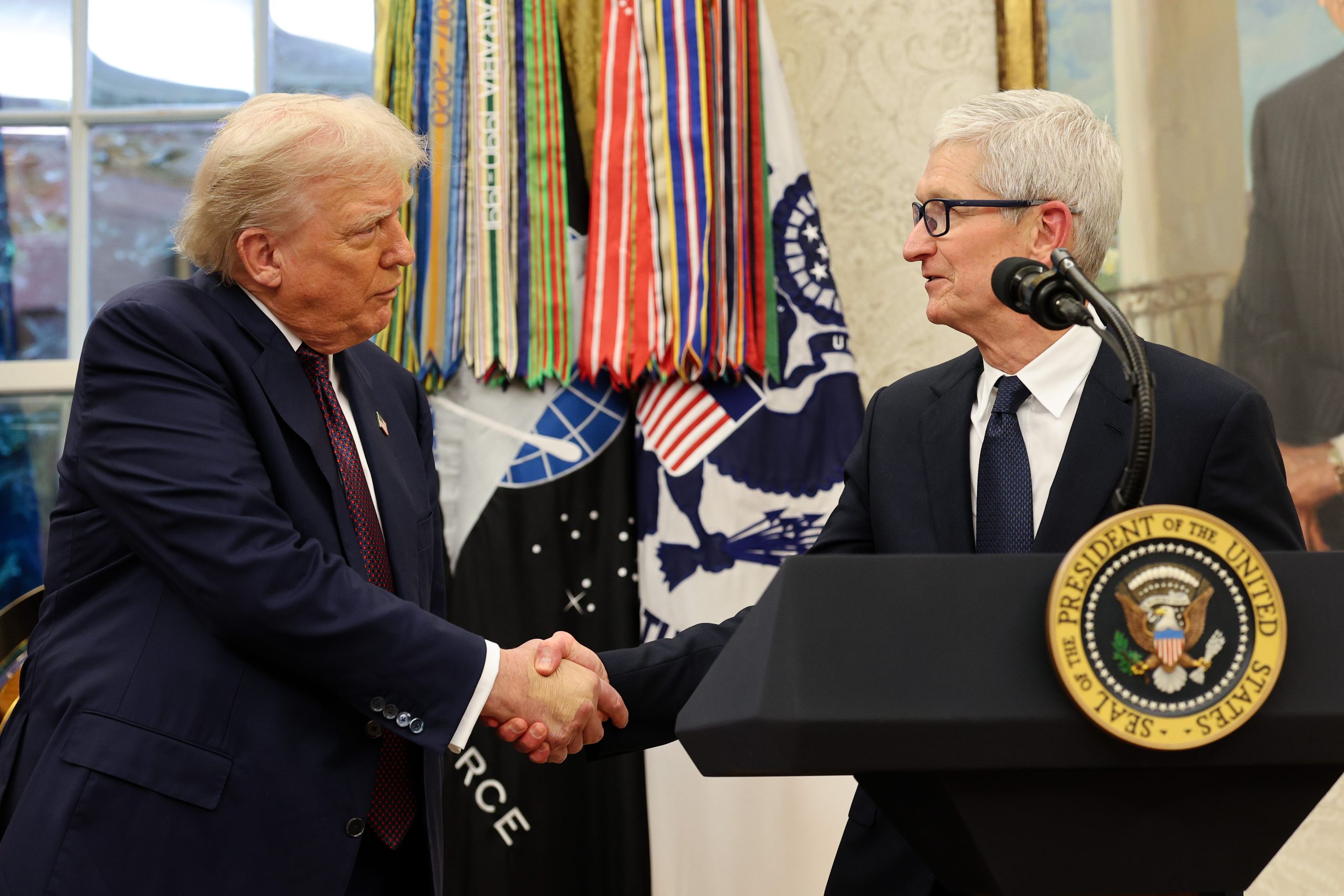
Kind words and accolades poured in after this week’s announcement that Tim Cook is stepping down as Apple’s CEO. The tech magnate has been at the helm since 2011, and Apple has enjoyed a remarkable run during that time. At the personal level, Cook’s success is a wonderful reminder of the many blessings Americans enjoy thanks to capitalism and free enterprise. But those blessings will only endure if the United States dissuades other countries from following Apple’s path.
Under Cook, Apple has grown tremendously. The company’s value skyrocketed from $350 billion to $4 trillion. At times, it has been the most valuable company in the world. Some of the other “FAANG” tech giants have grown even faster during that time, but none have married advanced technology to manufactured goods. Apple’s success despite facing tougher impediments to growth than its major competitors makes its rise even more impressive. Small wonder that nearly everyone has a kind word for him, including a warm yet qualified endorsement from Donald Trump.
But Apple’s strategy for overcoming these problems has been less beneficial for the United States. Throughout his tenure, Cook tied his company’s fortune to China.
At first, this seemed like a way to do well and do good. The partnership with Taiwanese-owned Foxconn that brought Apple to China largely followed the American strategy of pursuing economic openings with China in the hopes of reducing the Chinese Communist Party’s control over society. And the CCP provided Apple with not only cheap labor, but also with all of the other infrastructure it needed.
But Apple doubled down even as Chinese malevolence and incompetence increased the risks. Cook pledged in 2016 to invest $275 billion in China even though Xi Jinping’s aggressiveness was unmistakable. He prevented his Chinese customers from accessing American media and apps designed to get around the Great Firewall while his company squawked about civil liberties in the incomparably freer United States. Even after the initial COVID outbreak in Wuhan demonstrated the perils of single-source manufacturing, Apple kept about 90 percent of its manufacturing in China.
The most dismaying part of Apple’s move to China is how avoidable it was. China’s initial contribution to the iPhone was assembling the high-tech parts made elsewhere, which cost about $6.50 per unit. By 2018, Chinese workers made many of the components and added about $107 of value to each phone. The initially low-skill labor is abundant around the world, but the entire supply chain is much harder to replace.
In the meantime, Cook’s company strengthened China’s national power and, inadvertently, some major competitors. Apple trained hundreds of thousands of Chinese engineers, many of whom are staffing Chinese national champions like Huawei, Xiaomi, and BYD.
Preventing other American companies from following in Apple’s footsteps should be a national priority, but it is not yet. The 2022 CHIPS and Science Act provided some incentives for domestic semiconductor manufacturing, and Trump’s “Liberation Day” tariffs were meant to bring more production back home, too. But there are many other obstacles to building high-tech capabilities.
The energy problem is the most important. In 2024, the Department of Energy estimated that data centers will require two or three times as much power by 2028 because of the artificial intelligence boom. Goldman Sachs found in February that electricity prices rose more than twice as fast as general inflation in 2025 and that data centers will drive about 40 percent of new demand for energy through 2030. Understandably, neither tech companies nor American families want these higher energy bills.
China is rooting for Americans to pick the anti-growth policies championed by the hard left. Led by Bernie Sanders, American socialists are trying to block new data centers rather than build new power plants. Prominent environmental groups reportedly are cooperating with Chinese organizations to block further energy development in the United States.
Some of their fellow travelers are resorting to fighting a dirty war against U.S. tech companies. Agitators are trying to drive such companies, like Palantir, out of American cities. Another attempted to murder OpenAI chief Sam Altman.
Palantir’s Alex Karp recently posted that “the engineering elite of Silicon Valley has an affirmative obligation to participate in the defense of the nation,” and his insight applies to other industries as well. Most American companies depend on the free flow of goods and information across national borders, and only American power sustains that kind of international order.
But demanding that U.S. firms or families bear extra burdens indefinitely is not a good solution. It’s far better to make the money work for them, and there is a lot to do at all levels of government.
If the United States gets this right, Tim Cook will be remembered as a great American innovator and not as one of the great blunderers in American history.