
In the buildup to the release of his memoir, Young Man in a Hurry, California governor Gavin Newsom had an offer for his supporters: Contribute “ANY AMOUNT” to Newsom’s PAC—even “a few bucks”—and receive “a copy of my new book when it comes out.”
“The average cost per book is $22.45 including shipping,” Newsom—who’s widely expected to seek the 2028 presidential nomination—wrote in one December 2025 Facebook post. “If you can give that, great. If you can only give $5, great. If you want to cover the cost for a few folks who can only give a few bucks, great. … But make a contribution of ANY AMOUNT today and I will send you a copy of my new book, ‘Young Man in a Hurry.'”
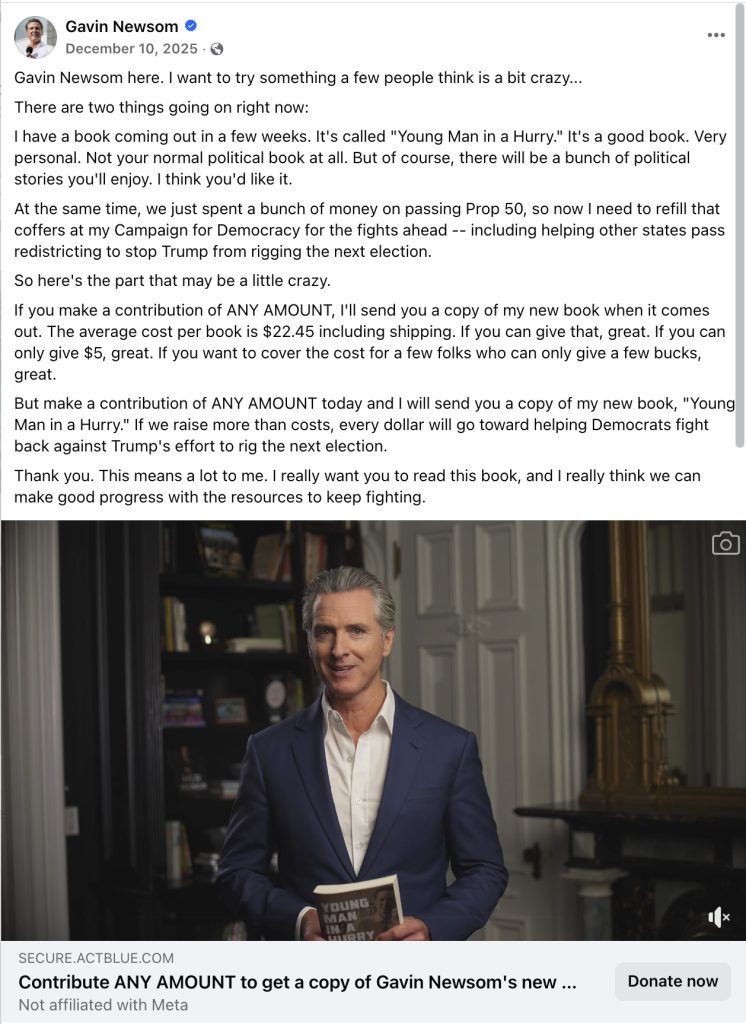
The plea, which Newsom repeated in identical Facebook posts and fundraising emails between early November and late January, is certain to increase sales of Young Man in a Hurry (which is also the title of the 1992 biography of Bill Clinton by Jim Moore). But it could also get him in trouble with the prestigious New York Times Best Sellers list, a perch on which is a valuable accolade for a presidential candidate trying to be taken seriously.
Posted online every Wednesday night, the list, according to the Times, is compiled using sales data from “tens of thousands of storefronts and online retailers as well as specialty and independent bookstores.” The list’s editors then apply the Times‘s “rigorous standards for inclusion,” meaning they “scrutinize sales reports with a practiced eye to uncovering manipulation.” If an author were to, for example, use his or her own money—or money belonging to a group associated with the author—to buy thousands of copies and juice sales, that author would run afoul of the Times‘s Best Sellers standards.
The Times‘s complex and secretive methodologies have led to accusations over the years that it excludes books by conservatives in favor of books by members of the liberal literary and media establishment. In recent years, conservative authors such as Clay Travis, Michael Knowles, and Todd Starnes have not made the list despite ranking high on comparable lists by Publishers Weekly and Nielsen BookScan. The Times, when challenged, has denied bias and claimed it uses different and better methodologies.
Ted Cruz, the Texas Republican senator who is expected to seek the 2028 Republican nomination, is one conservative who has sparred with the Times over its list. In 2015, the Times refused to place his debut book, A Time for Truth, on its Best Sellers list “despite the fact that the book has sold more copies in its first week than all but two of the Times’ bestselling titles,” Politico reported. The Times cited an “overwhelming preponderance of evidence … that sales were limited to strategic bulk purchases.”
Cruz accused the Times of political bias, saying it “does not want people to read this book.” The controversy drove more sales, and Cruz landed on the Best Sellers list about a week after the Times‘s initial refusal. His campaign later disclosed a $122,000 payment to the book’s publisher around the time of its release.
Being a #1 New York Times bestseller is a big feather in the cap of any presidential aspirant. Barack Obama had two #1 bestsellers, The Audacity of Hope and Dreams From My Father, under his belt before his presidential run, and they were considered central to introducing him to an American audience. Now, the Times‘s handling of Newsom’s book—one by a politician who shares Obama’s presidential aspirations—is shaping up to be a test of whether the prestigious list indeed carries the bias Cruz alleged.
Newsom’s fundraising plea directs users to contribute to Campaign for Democracy, the federal PAC Newsom launched in 2023 that is expected to indirectly support his presidential run. The PAC has already spent millions of dollars on digital ads and cross-country travel boosting Newsom’s profile, even though he’s term-limited from seeking reelection as governor. The PAC ended 2025 with $3.4 million on hand. And while it will not file an updated financial report until April—one that could show a bulk payment from the PAC to Newsom’s prestigious publisher, Penguin Random House—Newsom has been forthcoming in his plans to use donor money to sell books at well below the list price, a scheme that seemingly runs afoul of the Times‘s Best Sellers list standards.
Times spokesman Charlie Stadtlander did not answer questions on Newsom’s book sale strategies, instead pointing the Washington Free Beacon to the Best Sellers list’s stated methodology.
Newsom’s move to use his PAC to push copies of his book could also pad his pockets.
Federal ethics rules prohibit members of the House and Senate from using campaign funds for personal gains—in other words, federal lawmakers cannot receive royalties when promoting their own book or purchasing copies with campaign cash. A left-of-center ethics watchdog accused Cruz of doing just that after his campaign spent roughly $14,000 to run ads promoting another Cruz book, One Vote Away: How A Single Supreme Court Seat Can Change History. Cruz provided an affidavit showing he had donated his royalties to charity and was cleared of wrongdoing.
But as a state officeholder, Newsom is not subject to federal ethics rules, explained Kendra Arnold, executive director of the ethics watchdog group Foundation for Accountability and Civic Trust. California allows state politicians to earn royalties from books so long as they do not use taxpayer resources to promote them. Newsom could, then, use his PAC to promote his book while collecting royalties, given that he is neither a federal lawmaker nor using his official gubernatorial office as part of the scheme.
“Where normally we see people running for office come into issue is when they have a campaign, and the campaign is doing this,” Arnold told the Free Beacon. “If he were a candidate—or if he were a federal office holder—taking the royalties could be construed as using that for personal financial gain. But he’s not, so it wouldn’t apply.”
Arnold noted that some federal officeholders release books without receiving an advance or taking royalties “essentially to promote the ideas in the book” rather than make money. That does not appear to be the case with Newsom’s memoir. In both 2023 and 2024, Newsom reported receiving between $10,000 and $100,000 from his publishing agent, Elyse Cheney Literary Associates, for a “book advance.” The agency, which has since rebranded as the Cheney Agency, released a guide ahead of the 2024 Frankfurt Book Fair that lists founder Elyse Cheney as the agent for Newsom’s Young Man in a Hurry. The book was originally scheduled to come out in May 2025, but Newsom delayed the release because of the 2025 Los Angeles wildfires.
Neither the agency nor Newsom’s PAC responded to requests for comment.
Newsom has faced criticism for how his memoir—set to be released on Feb. 24—depicts him as a disadvantaged boy who overcame a “schizophrenic upbringing,” as Vogue put it in a fawning profile, to become California’s governor. Newsom’s rags-to-riches tale recounts him picking up busboy shifts and working a newspaper delivery route to help his mother make ends meet. Newsom’s impeccable connections to San Francisco’s richest families, however, fueled his rise. Most notably, Newsom’s father was a lifelong friend of billionaire oil heir Gordon Getty and managed the family trust. Gavin Newsom would capitalize on his family’s connections, founding a wine business, PlumpJack, alongside Getty in 1992 that is now worth hundreds of millions of dollars.
Original News Source – Washington Free Beacon
Running For Office? Conservative Campaign Management – Election Day Strategies!