
It’s not an F-35, a B-2, or an aircraft carrier
“I love nuclear weapons,” a friend of mine, a veteran of the Cold War, once remarked. “Point them in the direction of a country, and freedom spreads.”
The context was the deployment in 1983 by America of Pershing II intermediate-range missiles in West Germany. In retrospect, that decision, along with the rest of President Reagan’s military buildup, did hasten the eventual defeat of the Soviet Union in what was the greatest U.S. strategic achievement—and advance of freedom—since the victory in World War II.
If only defeating the Islamic Republic of Iran were so simple. A Cold War replay—overthrowing an evil regime without an American military attack, just with a show of force and covert backing for the Iranian equivalent of Solidarity in Poland—would be a great outcome. Peace through strength, and save the heavy weaponry for future possible use against other adversaries. The best use of the weapons is deploying large numbers of them close enough to the enemy that freedom breaks out in a way that appears spontaneous. The deployment detonates the oppressed people inside the hostile regime, who in the end are the best weapons that our side has. The Pershing II is trivia but people remember the crowds flowing across and knocking down the Berlin Wall.
Many Americans today are too young to recall firsthand the Cold War victory. They remember instead the disastrous and deadly withdrawal from Kabul after a bipartisan consensus emerged opposing the continued presence of American troops to keep the Taliban and the terror threat at bay. The Afghanistan experience has been almost Vietnam War-like in its ability to make America hesitate before turning to military force to achieve foreign policy goals. A difference between dealing with the Soviet Communists and the Islamist revolutionaries in Iran, alas, as the great historian of the Middle East Bernard Lewis warned, is that for the ayatollahs, mutual assured destruction is not a deterrent but an inducement.
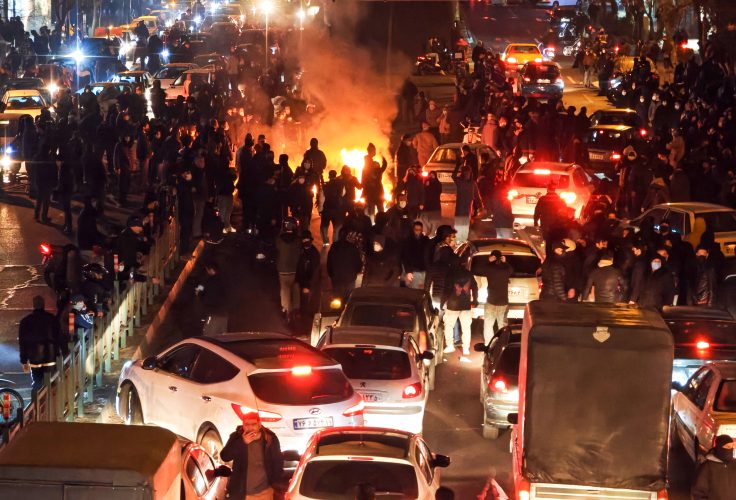
President Trump, in his State of the Union address, said the Iranian regime had killed 32,000 protesters in the past two months, and that Iran has “developed missiles that can threaten Europe and our bases overseas.” On Jan. 2, 2026, Trump had posted to social media, “If Iran sho[o]ts and violently kills peaceful protesters, which is their custom, the United States of America will come to their rescue. We are locked and loaded and ready to go. Thank you for your attention to this matter!” The “rescue” promise preceded the mass slaughter, which is not much consolation to the families of the 32,000 killed mostly on Jan. 8 and 9.
If there’s another Cold War precedent that comes to mind it’s that of Hungary in 1956, when America and its allies looked on as Soviet troops crushed a student-led pro-democracy rebellion. Everyone got the message—until decades later, Reagan, Pope John Paul II, Natan Sharansky, Andrei Sakharov, and Lech Walesa and his allies like Lane Kirkland and Albert Shanker in the U.S. labor movement began to see what might be possible.
It’s something for Trump and his generals to keep in mind as the refueling tankers, aircraft carriers, and warplanes deploy around Iran. America has the world’s most powerful, expensive, and high-technology weaponry, and Israel—with the same intelligence operation that put pagers on the waistbands of Hezbollah’s leaders—has been working overtime helping to come up with target lists. But as Trump and his team weigh which weapons to use and when and how, it is worth remembering that the most potent weapon of them all is a person living in an unfree country who wants freedom.
Trump and some of his advisers show signs of understanding this. The CIA is posting guidance in Farsi inviting Iranians who want to help to get in touch. When Hugh Hewitt asked Trump on Jan. 8, 2026, if he had a message for the people of Iran, Trump said, “All I can say is you should, you should feel strongly about freedom. There’s nothing like freedom.” The Persian word for it is Azadi, and if things go right in Iran, that is the word that will be remembered.