
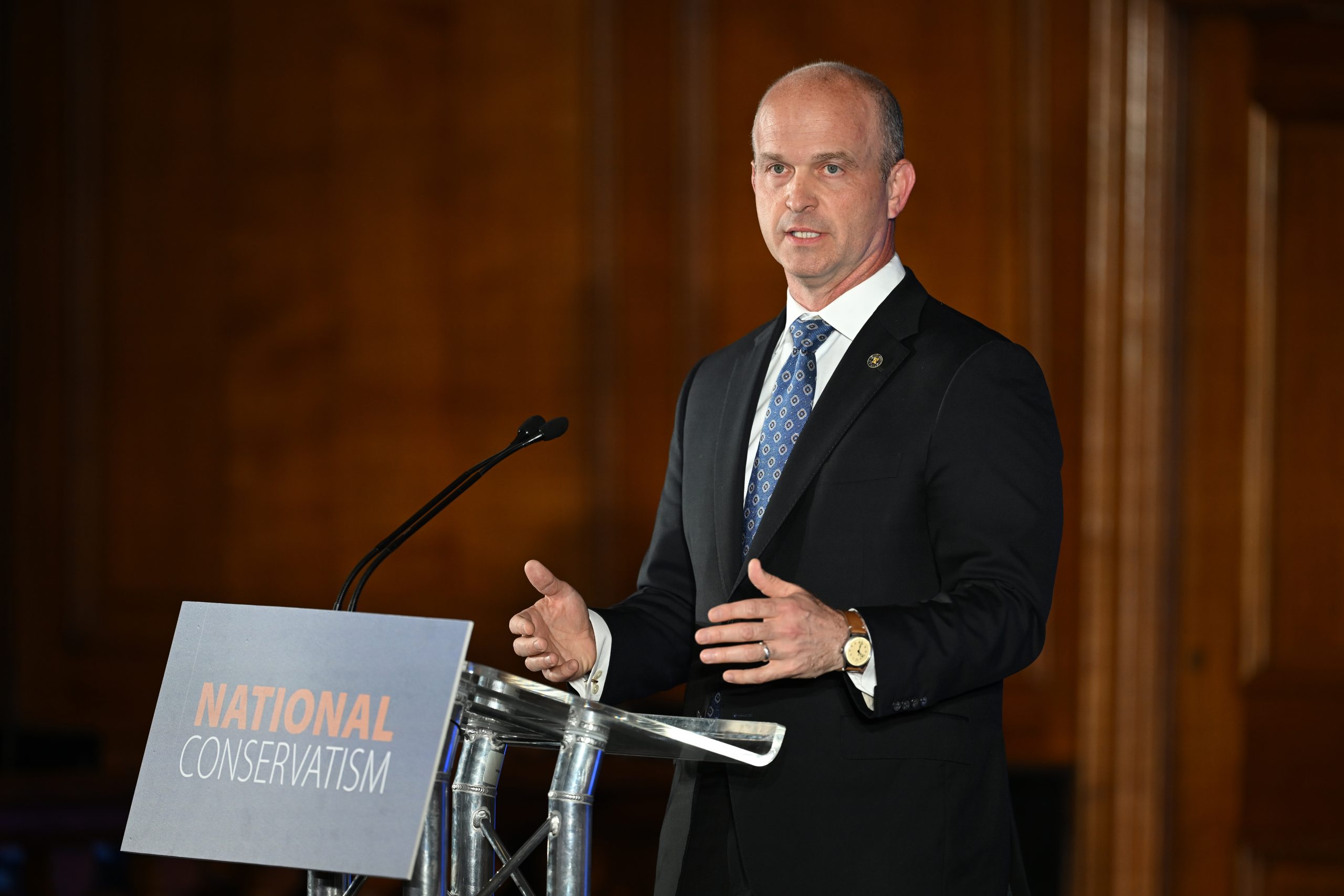
Twenty years ago Kevin Roberts was an assistant professor of history at New Mexico State University. Today he’s president of the Heritage Foundation, which bills itself as “America’s most influential policy organization” and is best known for its “Project 2025” presidential transition recommendations.
But the contrast between Roberts then and now is far more dramatic than those two facts alone suggest. Roberts was at NMSU after completing an M.A. degree and thesis at Virginia Tech in 1999 and then a Ph.D. and dissertation at the University of Texas at Austin in 2003. Both of those graduate student documents, easily available on the web, are works of truly impressive scholarly quality, manifesting original and sophisticated insights into a long-ago world which Roberts himself—a white, Acadian-Cajun Catholic, born in 1974—had no inherent connections to.
The titles of those two projects merit quotation in full: “African-Virginian Extended Kin: The Prevalence of West African Family Forms Among Slaves in Virginia, 1740-1870,” and “Slaves and Slavery in Louisiana: The Evolution of Atlantic World Identities, 1791-1831.” By the late 1990s the U. S. historiography of slavery was extensive indeed, but what especially stands out in Roberts’s works is his deeply empathetic view of his subjects. He sought to “explore slaves’ lives on their own cultural terms,” while “neither romanticizing nor denigrating the lives they led.” His appreciation of their full humanity repeatedly shines through. “Slaves were not powerless in the realm of preserving family relationships,” Roberts wrote in his Virginia Tech thesis. “The extended family group was perhaps the most important institution of cultural transfer and preservation,” and he criticized “the failure of most slave family scholars to recognize the importance of extended kin to enslaved African-Americans.”
In the past year, two veteran journalists have authored wide-ranging profiles of Roberts, including interviewing graduate school professors who knew him well and recalled him fondly. His University of Texas supervisor, James Sidbury, recounted how Roberts “enjoyed debating with people and always in a kind of completely open and friendly way.” Sidbury praised him as “a very scrupulous scholar,” and another UTA mentor recalled that “he never attacked anyone.”
After the 2005 academic year, however, Roberts resigned his NMSU professorship and spent the following year teaching at a north Alabama prep school. His NMSU department chair thought Roberts wanted better and more malleable students, and in 2006 Roberts returned to his hometown of Lafayette, La., to found John Paul the Great Academy. He led that school until 2013, and it continues to thrive today.
Roberts’s destination in 2013 was the small western town of Lander, Wyo., home to Wyoming Catholic College, a young school founded just eight years earlier. Under Roberts’s leadership, WCC rejected federal funds out of concern that doing so would require it to accept “transgendered persons or persons with a same-sex-attraction,” as Roberts phrased it. In a 2015 essay for First Things, he warned that “the culture has shifted against Christians,” worried about “prioritizing academic excellence over the formation of faith and morals,” and urged that “students conform their minds to Catholic truth.”
Roberts left WCC in 2016 to become executive vice president of the Texas Public Policy Foundation, which elevated him to chief executive officer in 2018 and where he remained until being named president of Heritage in October 2021. In December 2023 Roberts spoke with longtime former Los Angeles Times reporter Rone Tempest, who was profiling him for a Wyoming news website, Wyofile. It was the first piece to explore Roberts’s life history, and Roberts recounted his difficult childhood: His parents divorced when he was 4 in part because his father was “a terrible alcoholic” and when he was 9 his 15-year-old brother committed suicide after wrecking their mother’s car.
That “does still seem like yesterday,” Roberts told Tempest, adding that he instantaneously experienced a sense of unshakable faith. Roberts expands on that age nine memory in Dawn’s Early Light: “I then felt what I can only describe as the presence of the Holy Spirit, filling me with the peace that surpasses understanding. In that moment, I knew that God was with me and all would be well. That was when my faith became unshakable.”
To anyone who, like this writer, knows well the story of how Martin Luther King Jr., albeit at age 27, experienced a similar moment in what he referred to as his “vision in the kitchen” of his Montgomery, Ala., parsonage after enduring a deluge of death threats in early 1956, Roberts’s account is stunningly similar. Perhaps countless people recall and come to embrace analogous faith experiences, but Roberts went on to recount for Tempest how the economic devastation that Acadiana experienced in the late 1980s when oil prices cratered “was very formative in my kind of conservatism” and led Roberts to volunteer for Patrick Buchanan’s 1992 presidential campaign just as he was graduating from high school. “I don’t think I’ve had any radical shifts in perspective on anything” since that time, Roberts added.
Yet both Roberts’s 2024 foreword to the Project 2025 recommendations, “A Promise to America,” and now his almost 300-page Dawn’s Early Light evince such a tone of “revolutionary anger”—to quote Roberts himself—as to leave a reader fascinatingly perplexed by his evolution or indeed transformation from who he was in the 1990s and early 2000s.
Dawn’s Early Light—which features a foreword by incoming Vice President J.D. Vance!—touches on more issues, and enemies, than can be fully recounted in a fair-minded essay, but two important themes predominate. “The number one challenge Americans face in the twenty-first century is the crisis of family formation,” Roberts contends. “We must put everything in the service of enshrining the American family at the very heart of our civilization” and “encouraging the formation of new American families.” Observing that “there are too few two-parent families” and that “children benefit tremendously from living with their married parents,” Roberts argues that “family-first fusionism must be a big tent” and embrace “American parents of all stripes.”
So far, so good. Roberts wants to create a New Conservative Movement that “will build a majority coalition,” but repeatedly his religious beliefs appear to contradict, and indeed to subvert, his hopeful political agenda. In stark tension to all the phrases quoted above, Roberts invokes a “one-man, one-woman family” while expressing clear ambivalence—at best—about not only contraception but even in vitro fertilization. Project 2025’s foreword decried “second-class citizenship for women,” yet Dawn’s Early Light strikingly volunteers that “women should be able to work if they want to.”
More worryingly, Roberts asserts that “American society is rooted in the Christian faith” and even goes so far as to advocate that “freedom of religion should take precedence over the enforcement of other rights.” That’s starkly unconstitutional, and every serious student of the Constitution must acknowledge that the Framers intended the two religion clauses in the First Amendment—”Congress shall make no law respecting an establishment of religion, or prohibiting the free exercise thereof”—to stand in purposeful equipoise.
If Roberts is truly serious about wanting to build a family-first, child-oriented, religiously observant New Conservative Movement, he must eschew sectarianism and embrace all major faiths, such as the large, wonderful Chabad clans who are among my neighbors here in Squirrel Hill, Pittsburgh. He must also expressly acknowledge that not only do gay conservatives exist—ask Ambassador Ric Grenell—but that married gay couples raising multiple children—ask Treasury Secretary-designate Scott Bessent and his husband—also support the conservative policy agendas Roberts wants to advance.
Dawn’s Early Light secondly argues that “the challenge of our time is to reject and destroy the Chinese Communist institutions that threaten our way of life.” Project 2025’s foreword bluntly warned that “China is a totalitarian enemy of the United States,” and both works also want to “bust up the Big Tech companies” that “prey on children … to get them addicted to their mobile apps.” Roberts highlights the linkage. “If you want to understand the danger posed by collaboration between Big Tech and the CCP, look no further than TikTok,” which is “in effect a tool of Chinese espionage.”
Roberts correctly acknowledges “the parlous state of our military capability” and “the dire status of our defense industrial base” plus our pressing need for “the kind of industrial capacity needed to deter China.” Yet notwithstanding how prescient Roberts’s fears about the CCP are, he blithely overlooks the huge extent to which the party is actively aiding and abetting Russia’s neo-imperialist assault on Western democracy in Ukraine.
“Even as the United States continues to support the Ukrainian cause, we must begin earnest negotiations with the Russians to try to find a peaceful settlement in the wider region,” Roberts more than optimistically writes. Anyone familiar with the Institute for the Study of War’s invaluably comprehensive daily analyses of the Russian war of aggression fully appreciates that Vladimir Putin has zero interest in ending the conflict, as the incoming Trump administration will soon enough discover. Roberts’s further view that “our NATO allies can take on the challenge of deterring Russia” from further invasions targeting European democracies disregards how the state of Western Europe’s armed forces is even more parlous than ours.
Dawn’s Early Light addresses other issues and targets as well, but sometimes overshoots badly or just hilariously. Roberts believes that “America’s public school system, as a whole, is beyond saving,” but he accurately notes how, albeit inadvertently, “the biggest ally in our fight for universal school choice has been the teachers unions,” which in major cities such as Chicago are harming tens of thousands of black children. In an October lecture at Hillsdale College Roberts announced that “elite institutions have become the people’s and the nation’s enemies,” and in Dawn’s Early Light he identifies not only “every Ivy League college” but even “80 percent of ‘Catholic’ higher education” as among those enemies.
“There is no fixing Harvard or reforming the FBI,” Roberts writes. “These institutions cannot be saved. And so they must be defanged, defunded, and destroyed.” This of course badly begs the question of who or what would take over the many defense-of-America functions performed by today’s FBI should the bureau indeed be “destroyed,” but when this writer turned to page 232 and read that Roberts wants to “bring back the House Un-American Activities Committee (HUAC),” he literally laughed out loud, for as every good historian knows, how would a reborn HUAC know who to persecute without an FBI quietly leaking the names of who should be targeted?
Dawn’s Early Light is an energetically written and richly provocative book, even if it sometimes lacks the empathy and sophistication that Professor Roberts so richly demonstrated 20-plus years ago.
Dawn’s Early Light: Taking Back Washington to Save America
by Kevin D. Roberts
Broadside Books, 304 pp., $32
David J. Garrow’s books include the Pulitzer Prize-winning Martin Luther King Jr. biography Bearing the Cross and Rising Star: The Making of Barack Obama.
Original News Source – Washington Free Beacon
Running For Office? Conservative Campaign Management – Election Day Strategies!