
Israeli military adviser Amir Avivi told the Free Beacon that the United States learned from the war in Ukraine, where Russia has employed its own modified Iranian drones
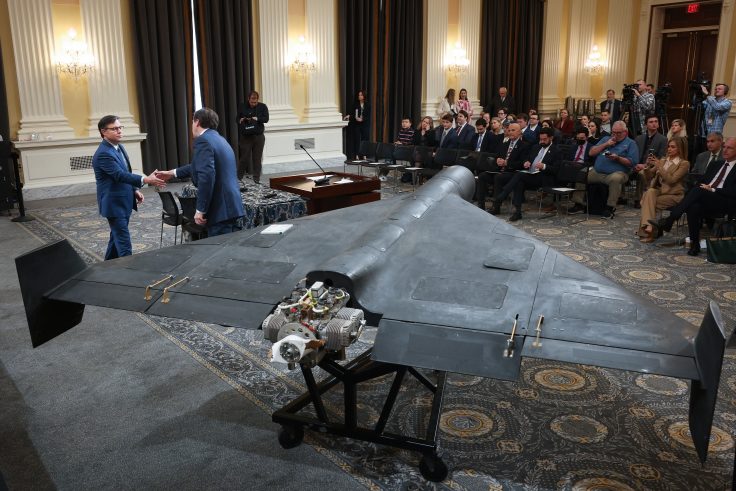
The United States successfully reverse-engineered Iran’s drone technology and is now deploying it against the Islamic Republic on the battlefield, flipping the script on a regime that has used long-range, low-cost unmanned systems to wreak havoc on Israel and the wider Middle East, according to U.S. and Israeli officials.
U.S. Central Command (CENTCOM) announced on Feb. 28 that the United States was using one-way attack drones modeled on Iranian Shaheds, and CENTCOM head Adm. Brad Cooper said during a March 5 briefing that the U.S. military was employing “an original Iranian drone design” on the battlefield. “We captured it, pulled the guts out, sent it back to America, put a little made-in-America on it, brought it back here, and we’re shooting it at the Iranians.”
The Shahed drone, a large unmanned aircraft, operates similarly to a cruise missile and has been a common sight in cities across Ukraine during the ongoing Russian invasion. Iran provided Russia with drones early in the conflict and Moscow has scaled up production domestically while also upgrading the drone’s “navigation, communications, warhead, flight algorithms, [and] deception measures,” according to the Snake Island Institute, a Kyiv-based military think tank.
The New York Times reported last week that the United States began working on reverse-engineering Shaheds in 2024 when researchers realized that employing a U.S.-made version on the battlefield would give the military a low-cost, effective tool. The U.S. military has not detailed modifications it has made to the Iranian technology, but Russia’s own work on the Shahed provides a model for what that might look like.
Between 2024 and 2025, Russia began equipping its Shaheds with antennas that can resist electronic countermeasures like signal jamming, the Snake Island Institute wrote in a report. Moscow additionally upgraded the drone’s physical capabilities so that newer models can fly over 300 miles per hour, giving air defenses less time to respond before a strike. The Russian-modified Shaheds also contain significantly heavier warheads that can more effectively destroy bunkers and targets inside buildings. If the United States has made similar modifications, it now has a low-cost method of taking out military and regime infrastructure in Iran.
Eugene Lesin, deputy company commander of a Ukrainian drone interceptor battalion, told the Washington Free Beacon that the United States’ use of Shaheds in Iran involves “rejecting that terroristic approach” the Iranian regime uses. Lesin described the difference as “using the weapon as they’re meant to be used, precisely, and not using it massively to just make terror and overload the air defenses.”
Israeli military adviser Amir Avivi told the Free Beacon it was clear that the United States learned from the war in Ukraine. He added that drones like the Shaheds “are a big deal, especially if you utilize them on a massive scale, and it’s very, very cheap.” The United States, he said, “has the capability to, if they want, produce these very quickly and in very large numbers.”
Steve Feldstein of the Carnegie Endowment for International Peace told the Free Beacon that the reverse-engineering project shows that “new innovations come from a variety of sources.”
“Iran’s designs have clearly shown their benefits, including in Ukraine, to the point where Russia has invested $2 billion in setting up a dedicated factory to produce these drone models, which it calls Geran-2 units,” Feldstein said. “It should come as little surprise that the United States would emulate this design as well.”
As the United States uses reverse-engineered Iranian drone technology against the Islamic Republic, Tehran’s own drone activity has dropped. Secretary of War Pete Hegseth said at a Friday press conference that drone strikes from Iran have decreased by 95 percent since the beginning of Operation Epic Fury, likely a result of joint U.S.-Israeli operations targeting production facilities and storage sites.
Chairman of the Joint Chiefs of Staff Gen. Dan Caine noted during a Tuesday press briefing that U.S. targets have included “several one-way drone factories to get at the heart of their autonomous capability.” He detailed “production facilities, research and development sites, and infrastructure” linked to the hardline regime’s terror forces, including unmanned systems, as a second focus.
Caine said destroying Iran’s drone capabilities is a key objective of the war effort, saying U.S. operations continue to annihilate “launch sites, command and control nodes, [and] stockpiles before they can threaten our personnel, our facilities, and our partners.”