
For decades, California lawmakers requested state audits, Californians have paid for those audits, and the State Auditor provided detailed recommendations on how to fix waste, fraud, and oversight failures across state government.
In most cases, CBS News California found lawmakers did not act on those recommendations.
When they did act, former majority party leaders quietly killed dozens of audit-backed bills in committee. Gov. Gavin Newsom vetoed at least a dozen more.
A CBS News California investigation found lawmakers failed to enact roughly three out of every four state audit recommendations directed at the Legislature, leaving more than 300 outstanding statutory fixes unresolved.
Now, lawmakers from both parties — and both state houses — say it’s time to address the backlog.
The new Legislative Audit Chair, Democrat Assemblymember John Harabedian, called the findings a “wake-up call” and said the Legislature has an opportunity to tackle long-standing issues with a new class of members this session and a new state leadership next year.
“I think that there is a great opportunity with a new class in the Legislature, a new governor, to really tackle these things head-on,” Harabedian said.
Republican Senate Minority Leader Brian Jones agreed the numbers are concerning.
“Three out of four is ridiculous that that’s not being addressed,” Jones said.
Both lawmakers emphasized that the audit process itself is nonpartisan.
“It’s nonpartisan. It’s not even bipartisan — it’s nonpartisan,” Jones said. “When the auditor takes that issue up, they come at this with no bias.”
Agencies comply. Lawmakers don’t.
Under the Omnibus Audit Accountability Act of 2006, the State Auditor must issue annual reports identifying agency recommendations not implemented after one year. Agencies are required to publicly explain why they have not acted or when they intend to comply.
Agencies implement roughly three out of every four recommendations. By comparison, lawmakers fail to enact three out of every four recommendations directed to them.
For lawmakers, there is:
- No required annual summary of unfinished legislative recommendations
- No formal explanation requirement when lawmakers fail to act
- No centralized tracking once bills die or are vetoed
Why fixes stalled
A deeper dive into legislative records revealed multiple reasons proposed audit-backed reforms failed.
More than 60 bills were drafted or introduced based on audit findings, but later died. Some stalled due to internal political disagreements. Others faced resistance from state agencies.
Some were quietly held in committee or on the suspense file without a public vote, often an indication that Democratic supermajority leadership did not support the bill.
At least another dozen audit-related bills passed the legislature only to be vetoed by Gov. Newsom.
In several veto messages, the governor argued that additional oversight was unnecessary or that the proposed changes were too costly.
A shift in “tone”
For years, former State Auditor Elaine Howle voluntarily issued annual reports summarizing outstanding recommendations directed specifically to the legislature.
Those reports:
- Listed every unresolved legislative recommendation
- Identified which policy committee was responsible
- Documented whether related bills were introduced, stalled, passed, or vetoed
They functioned as a centralized accountability framework, essentially a legislative checklist of unfinished business.
That reporting ended in 2022 after Howle retired and Gov. Newsom appointed a new state auditor, Grant Parks.
CBS News California identified at least a dozen audit-recommended bills that Governor Newsom vetoed during his first term, while Howle was auditor. Based on publicly available records, it does not appear he has vetoed any audit-related bills since appointing Parks.
At his first Joint Legislative Audit Committee hearing, where the lawmakers decide which audit requests to approve, Parks signaled a shift in tone.
Before introducing Parks, the newly appointed JLAC Chair David Alvarez acknowledged that, in the past, audits had sometimes created “an adversarial relationship between the Legislature and the Administration.”
In response, Parks emphasized the importance of maintaining a “balanced tone” and “working with the Administration,” adding, “We’re not looking out to get people or gain media attention,” Parks clarified.
A change in reporting
The auditor’s office told CBS News California the decision to discontinue producing the special legislative reports detailing outstanding recommendations and audit-related vetoes was made to “optimize the use of auditor resources.”
In a statement, spokesperson Dana Simas said redirecting efforts toward core audit work would improve timeliness for statutory and legislatively approved audits. She added that recommendations remain publicly accessible on the auditor’s website, “which we upgraded in January 2024 to offer a significantly improved user experience that now offers detailed search capabilities of recommendations by issue or policy area, agency, and the year the audit was published.”
However, the updated site does not provide a dedicated search for “Recommendations to the Legislature.”
Using public safety as an example, the site’s current search function returns just four public safety audit reports, with only two visible legislative recommendations, overlooking dozens of additional outstanding legislative recommendations in other public safety audits issued over the past five years.
To identify those recommendations, users must manually search the archive, reviewing hundreds of individual audit reports to identify the dozens of outstanding legislative recommendations issued since 2021 alone.
In practice, lawmakers relying solely on the current search tools would not see the full scope of unfinished legislative recommendations.
Lawmakers say that gap matters.
The legislature trusts the auditor’s findings so much that they passed a law requiring state agencies to either implement audit recommendations or publicly explain why they have not.
That public accountability has proven effective. Agencies implement more than 80% of audit recommendations. No comparable framework exists for the legislature.
So CBS News California built one.
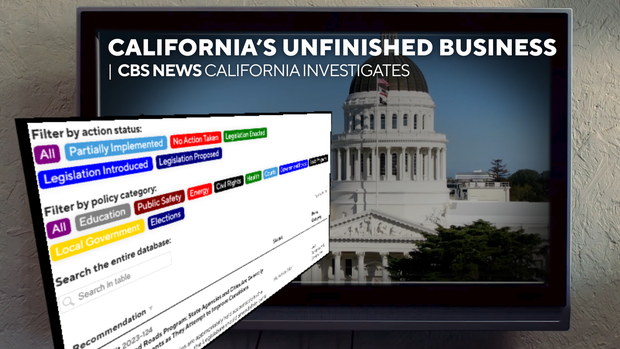
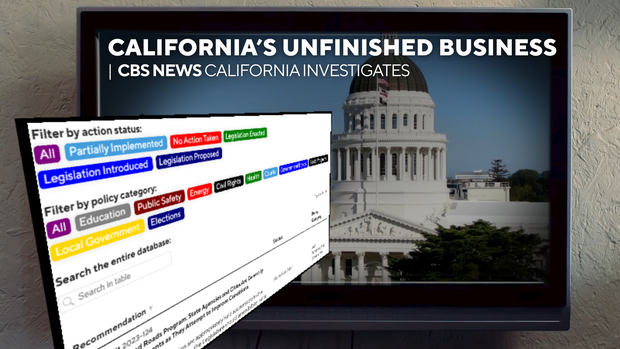
Using public records, we scraped and consolidated legislative recommendations across audit reports to create the Audit Accountability Tracker — a database focused specifically on recommendations directed at elected lawmakers.
Rebuilding the accountability framework
The CBS News California | Legislative Audit Accountability Tracker is intended to serve both lawmakers and the public.
The database compiles a decade of legislative audit recommendations and tracks:
- Which bills were introduced
- Which stalled
- Which passed
- Which were vetoed
- Which remain unresolved
Nearly half of the California Legislature is new this session. Many outstanding recommendations were issued before current members took office.
“When these reports come back to the legislature, it’s our job to take that information and legislate intelligently,” said Jones, who acknowledged they need to educate new lawmakers on the importance of state audits.
Harabedian says he intends to work across committees and across party lines to address the backlog.
“I’m hoping by the end of this year we tackle some of it, by the next year we tackle more, and we just keep going,” he said. “We owe it to the people to do that.”
For years, the warnings were written and the solutions were identified. Now, lawmakers say they’re ready to move forward.
CBS News California will continue tracking whether those promises become law.