
The president said the move would ‘eliminate over $1.3 trillion of regulatory cost’
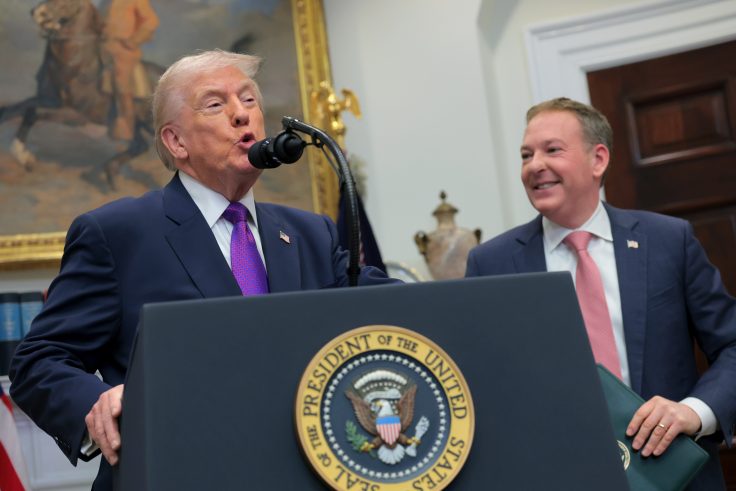
WASHINGTON, D.C.—Flanked by EPA administrator Lee Zeldin in the Roosevelt Room, President Donald Trump announced that his administration has formally rescinded a 2009 Obama-era finding that greenhouse gases like carbon dioxide endanger public health. That finding led to a slate of federal climate regulations targeting gas-powered vehicles, including former president Joe Biden’s top-down effort to force Americans to buy more electric cars.
Trump’s action will have a domino effect, toppling years of federal regulations targeting emissions produced by vehicles, power plants, and oil facilities. Zeldin said it is the “largest act of deregulation in the history of the United States” and would save Americans more than $1 trillion, a point Trump emphasized.
“This is about as big as it gets,” Trump remarked as he entered a news conference announcing the action. “This action will eliminate over $1.3 trillion of regulatory cost and help bring car prices tumbling down dramatically. You can get a better car, you can get a car that starts easier, a car that works better, for a lot less money.”
Surrounding Trump were signs emblazoned with the $1.3 trillion figure and stating that the action would decrease the cost of the average vehicle by $2,400. “Largest deregulation in U.S. history,” read another sign.
“Under President Trump’s leadership, vehicle manufacturers will once again build what Americans want, not what politicians and bureaucrats in Washington demand,” Zeldin said.
The action makes good on Trump’s 2024 campaign promise to achieve the “most aggressive regulatory reduction” in the nation’s history and represents the president’s single greatest achievement to date in his pursuit to unwind previous administrations’ climate policies. The president has labeled efforts to fight global warming as a “scam” and, like many critics of the climate movement, blamed it for rising affordability issues in the United States.
Still, the action tees up an expected deluge of lawsuits from Democrat-led states and far-left activist organizations that have argued that preserving the endangerment finding and regulating greenhouse gases is essential for combating climate change. Many of those states and groups have vowed to challenge any move to rescind the finding.
“California will not stand by,” Governor Gavin Newsom (D., Calif.) wrote to Zeldin in September. “You still have a choice: honor the law, follow the credible and established science, and fulfill your duty to the American people. Or go down in history as the administration that abandoned its mission, betrayed its mandate, and failed its country.”
Every Senate Democrat signed a separate letter to Zeldin, warning that rescinding the finding would be a “dereliction of duty” and take “breathtaking hubris.” And Loren Blackford, the Sierra Club’s acting executive director, wrote this week that “removing EPA’s authority to limit deadly greenhouse gas emissions is as shortsighted as it is stupid.”
The expected litigation could ultimately force the Supreme Court to weigh in on the issue. According to former DOJ counsel Michael Buschbacher, that means Trump’s action on Thursday risks having the opposite of its intended effect and could solidify the endangerment finding.
“Unless this is done really, really well, this has the potential of being a kind of regulatory Vietnam, which is surely what administration opponents will be trying to accomplish,” Buschbacher told the Washington Free Beacon in July.
The issue dates back to the 1970s, when Congress passed the Clean Air Act. The act requires the EPA to regulate any air pollutant emitted by mobile sources, like cars, and stationary sources, like power plants, that the agency determines to cause or contribute to pollution endangering public health or welfare. For decades, the EPA did not interpret that provision to include greenhouse gas emissions such as carbon dioxide and methane.
A coalition of states led by Massachusetts eventually sued the EPA after the agency formally determined in 2003 that the Clean Air Act did not authorize it to consider greenhouse gas emissions. In 2007, the Supreme Court ruled in favor of the states and directed the EPA to consider whether greenhouse gas emissions do, in fact, endanger public health, leading to the 2009 endangerment finding.
Original News Source – Washington Free Beacon
Running For Office? Conservative Campaign Management – Election Day Strategies!