
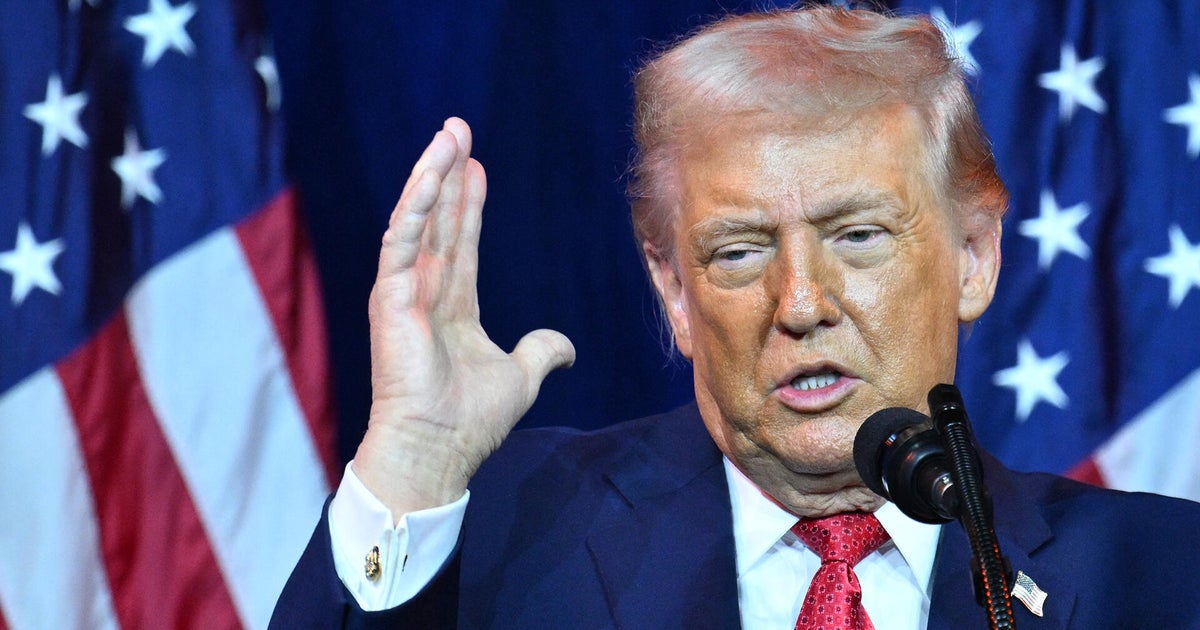
The big oil companies meeting with Trump today
CEOs from these companies will be attending the meeting with Mr. Trump: Chevron, Exxon, Conoco Phillips, Continental, Halliburton, HKN, Valero, Marathon, Shell, Trafigura, Vitol Americas, Repsol, Eni, Aspect Holdings, Tallgrass, Raisa Energy and Hilcorp.
Secretary of State Marco Rubio, Energy Secretary Chris Wright and Interior Secretary Doug Burgum will be at the meeting. Wright also met with several oil executives earlier this week.
White House spokeswoman Taylor Rogers said they will discuss “investment opportunities that will restore Venezuelan oil infrastructure.”
Pope calls for governments to “respect the will” of Venezuelans
Pope Leo on Friday called for world governments to “respect the will” of the Venezuelan people and said nations must “safeguard the human and civil rights” of Venezuelans, Reuters reported.
In the pope’s annual audience with the Vatican diplomatic corps, which traditionally amounts to his yearly foreign policy address, he called for a peaceful political solution that keeps in mind the “common good of the peoples and not the defense of partisan interests.”
Leo also critiqued U.S., Russian and other military incursions in sovereign countries, denouncing how nations were using force to assert their dominion worldwide, “completely undermining” peace and the post-World War II international legal order.
“War is back in vogue and a zeal for war is spreading,” Leo said.
He didn’t name countries that have resorted to force, but his speech came amid the backdrop of the Venezuela operation, Russia’s war in Ukraine and other conflicts.
“A diplomacy that promotes dialogue and seeks consensus among all parties is being replaced by a diplomacy based on force, by either individuals or groups of allies,” he said. “The principle established after the Second World War, which prohibited nations from using force to violate the borders of others, has been completely undermined.”
-CBS/AP
Executives from Halliburton, Exxon, other companies expected at White House meeting
Senior oil executives from a number of producers, refiners and at least one oilfield services company are expected to meet with President Trump, Treasury Secretary Scott Bessent, Interior Secretary Doug Burgum and Energy Secretary Chris Wright at the White House Friday, according to a source familiar with the meeting and a White House official.
Companies whose executives are expected to attend include: Halliburton, Chevron, Exxon, ConocoPhillips, Valero, Marathon and Continental. The executives only are expected — not their staff, according to the sources.
Trump says he’s called off “second wave of attacks” on a cooperative Venezuela
President Trump announced on his Truth Social platform overnight that he has “cancelled the previously expected second Wave of Attacks, which looks like it will not be needed.”
Mr. Trump said Venezuela “is releasing large numbers of political prisoners as a sign of ‘Seeking Peace,'” which he called “a very important and smart gesture.”
The president said the U.S. and Venezuela “are working well together, especially as it pertains to rebuilding, in a much bigger, better, and more modern form, their oil and gas infrastructure,” and that he waved off the second set of attacks due to Venezuela’s cooperation with his administration.
“However,” he added, “all ships will stay in place for safety and security purposes.”
Trump to meet with oil executives this afternoon
President Trump is scheduled to meet with oil industry executives Friday afternoon as he pushes U.S. oil companies to invest in Venezuela.
The meeting is scheduled for 2:30 p.m.
Mr. Trump has pitched Venezuela’s oil wealth as a way to financially fuel the country’s economic recovery — and deliver benefits for energy consumers and oil companies. In an interview with Fox News’ Sean Hannity that aired Thursday, he said he’s expecting oil companies to spend at least $100 billion to “rebuild the whole oil infrastructure” in the South American country. He mentioned that amount again in an overnight post on his Truth Social platform.
The president told Hannity he’s meeting with executives from the “top 14” oil companies. Energy Secretary Christopher Wright also met with oil executives earlier this week.
Chevron is currently the only major U.S. oil company with a presence in Venezuela. It remains unclear whether any other firms plan to enter the market imminently.
Some experts say drawing in foreign investment could take years due to a combination of high costs, political instability and a history of the Venezuelan government nationalizing oil assets. And Venezuelan crude oil tends to be heavy and tough to refine, though some refineries on the Gulf Coast are equipped to process it.
Trump to CBS News: “It’s a doctrine of ‘don’t send drugs into our country'”
President Trump briefly spoke Thursday with CBS News’ Robert Costa about his overarching policy on Venezuela and about how he defines his foreign policy as responsive to threats.
Mr. Trump called the operation to remove Venezuelan leader Nicolás Maduro from power “incredible the way it worked out.”
“It was an incredible military maneuver,” Mr. Trump told CBS News. “It had a tremendous impact on everything. The impact has been incredible.”
When asked about his policy big picture, and whether it underscores the possible emergence of a “Trump doctrine,” the president said he’s not trying to pursue a specific ideology.
“No, it’s a doctrine of ‘don’t send drugs into our country.’ That’s what the doctrine is,” Mr. Trump replied. “Don’t send drugs into our country.”
Trump says he could meet opposition leader Machado next week
President Trump told Fox News’ Sean Hannity that Venezuelan opposition leader Maria Corina Machado could be coming to visit him in Washington at some point next week.
“I look forward to saying hello to her. That would be a great honor,” the president said.
Machado has sought to cultivate a close relationship with Mr. Trump, dedicating her Nobel Peace Prize to him and praising the U.S. military’s operation to remove Maduro. But Mr. Trump declined to back Machado as a possible post-Maduro leader of Venezuela last weekend, saying: “She’s a very nice woman, but she doesn’t have the respect.”
Machado told CBS News earlier this week that Venezuelans are “very grateful” to Mr. Trump. Pressed on why he appeared to dismiss her as a political leader, she suggested there could be lingering worries about Venezuela’s stability and the risk that armed groups could “resist a peaceful transition.” But she called it a “united country” and argued most members of the military and police “support an orderly transition to democracy.”
In her own interview with Hannity on Tuesday, Machado indicated she may give Mr. Trump her Nobel.
“I certainly want to give it to him and share it with him,” she said.
When asked about that Thursday, Mr. Trump responded, “I’ve heard that she wants to do that, that would be a great honor.”
Trump says U.S could be running things in Venezuela for “much longer” than a year
President Trump says he thinks the U.S. could be overseeing things in Venezuela for “much longer” than a year, in the wake of Maduro’s capture.
He told The New York Times Wednesday evening that “only time will tell” how long Washington will be running Venezuela. Asked if that could last three months, six months, a year or longer, he responded that, “I would say much longer.”
Mr. Trump has said that he intends to temporarily “run” Venezuela since shortly after the mission to capture Maduro. The U.S. has left Maduro regime loyalist Delcy Rodriguez in place as interim president, but administration officials have said they plan to maintain leverage over the country’s government through U.S. restrictions on oil exports.
The president said he expects the U.S. to be taking Venezuelan oil for years.
“We will rebuild (Venezuela) in a very profitable way,” Mr. Trump told the Times. “We’re going to be using oil, and we’re going to be taking oil. We’re getting oil prices down, and we’re going to be giving money to Venezuela, which they desperately need.”
He added that the remaining leaders of Venezuela are “giving us everything that we feel is necessary” even though they had all been loyal to Maduro.
Senate advances war powers resolution
The Senate moved Thursday toward limiting President Trump’s ability to strike Venezuela, after the U.S. leader took unilateral action against the South American country.
After two previous unsuccessful attempts, the Senate voted 52 to 47 to advance a war powers resolution, days after the U.S. captured Maduro and his wife in a nighttime raid that came not only as a surprise to the former president, but also to Congress.
Five Republicans joined all Democrats in support of the measure. The GOP senators voting in favor include Todd Young of Indiana, Lisa Murkowski of Alaska, Susan Collins of Maine, Rand Paul of Kentucky and Josh Hawley of Missouri.
Sen. Tim Kaine, a Virginia Democrat, introduced his latest resolution in early December. It would require “the removal of United States Armed Forces from hostilities within or against Venezuela that have not been authorized by Congress.”
Kaine said on the Senate floor Wednesday: “The indication from the administration [is] that this is not a few days or a few weeks, it’s likely a few years of U.S. occupation and involvement in this country.”
“This is not an arrest warrant. This is far bigger than that,” he said of the mission to capture Maduro and fly him to New York on drug charges.
Trump says war powers vote threatens national security
President Trump said Thursday that the Senate’s vote to restrict his ability to strike Venezuela could harm national security.
“This Vote greatly hampers American Self Defense and National Security, impeding the President’s Authority as Commander in Chief,” he said in a post on Truth Social.
He also called the War Powers Act unconstitutional and called out the handful of Republicans who supported the measure, saying other Senate Republicans should be ashamed of them.
Sen. Rand Paul, a Kentucky Republican who was among the five GOP senators who voted to advance the resolution, responded to the president by saying he sees the issue as “a constitutional debate” rather than “an anti-Donald Trump” stance.
“This debate is bigger than this particular president. I’ve had the same opinion under President Obama, President Biden, the last President Trump,” Paul told reporters outside the Capitol after the vote to push forward the resolution.
Meanwhile, Vice President JD Vance said at a press conference that he spoke to the Republican senators who voted to advance the measure and, in large part, “their argument was based more on a legal technicality than any disagreement of policy.”
Sen. Schiff argues military operation in Venezuela was “really about oil”
After the Senate advanced Thursday’s war powers resolution, Democratic Sen. Adam Schiff of California told CBS News he believes it picked up GOP support because “the circumstances have changed” since similar measures failed last year.
He said that “it became very clear in the aftermath of this military operation that this was really about oil,” arguing that if the primary goal was just to apprehend Maduro, “it would not have required us to essentially commit to running a country for the indefinite future or seizing its oil.”
Even if the resolution ultimately passes the House and Senate, Mr. Trump is likely to veto it, Schiff acknowledged on CBS News’ “The Takeout.” But he argued that it could “force a real debate” about the president’s use of military force.
Schiff said he’s concerned “we could really see ourselves getting bogged down” in Venezuela, despite the lack of U.S. forces on the ground right now. He said that it could start with diplomatic staff returning to Caracas, followed by security to protect those staff, and “pretty soon, you’ve got a major presence in the country.”
“Let’s face it, there’s not going to be a way to run another country at a distance,” he said.
U.S. Chinook helicopter pilot was wounded in leg during Venezuela attack, officials say
A Chinook helicopter pilot who also helped plan the mission to capture Maduro was wounded multiple times in the leg during the operation, U.S. officials told CBS News on the condition of anonymity to discuss national security matters.
The helicopter the pilot was flying — a heavy, twin-rotor MH-47 Chinook — was struck by hostile fire during the operation. Although it was damaged, it remained airborne and completed its run.
The Chinook was the lead aircraft in a formation of U.S. Army helicopters tasked with inserting the assault team in the Maduro capture mission. They were carrying a force of Delta Force commandos as they slipped toward Caracas in the overnight operation — at first, largely unnoticed. As the aircraft drew closer to the heavily fortified compound where Maduro was believed to be holed up, the calm broke and Venezuelan defensive positions opened fire. U.S. helicopters responded with their own suppressive fire, according to the U.S. officials.
A Pentagon official told CBS News on Tuesday that two U.S. service members were still recovering from injuries sustained during the incursion, which the Defense Department dubbed Operation Absolute Resolve.
“They are receiving excellent medical care and are well on their way to recovery,” the Pentagon official said. “Five additional service members suffered injuries but have already returned to duty. The fact that this extremely complex and grueling mission was successfully executed with so few injuries is a testament to the expertise of our joint warriors.”
The New York Times first reported the details of the engagement with the Chinook and the pilot being wounded.