
President Trump and Chinese President Xi Jinping are meeting in Beijing, as the two countries aim to stabilize their trading relationship after last year’s trade war and grapple with uncertainty over the United States’ war with Iran.
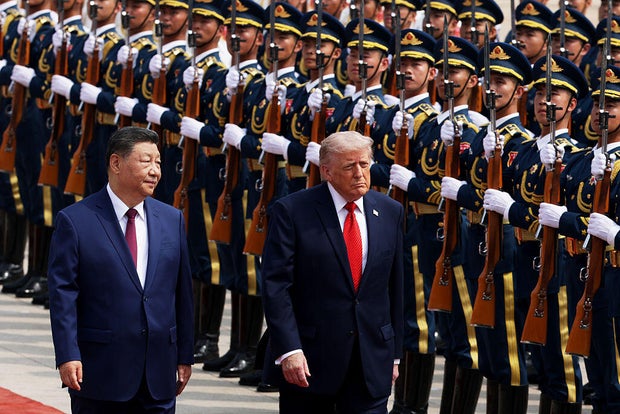
Mr. Trump and Xi shook hands outside Beijing’s Great Hall of the People on Thursday morning local time, or late Wednesday night ET, and the two leaders chatted during an opening ceremony that featured a brass band, marching military units and cheering children waving American and Chinese flags. Inside the meeting room, Mr. Trump and Xi offered positive words on the U.S.-China relationship before reporters were ushered out and talks between the two countries began.
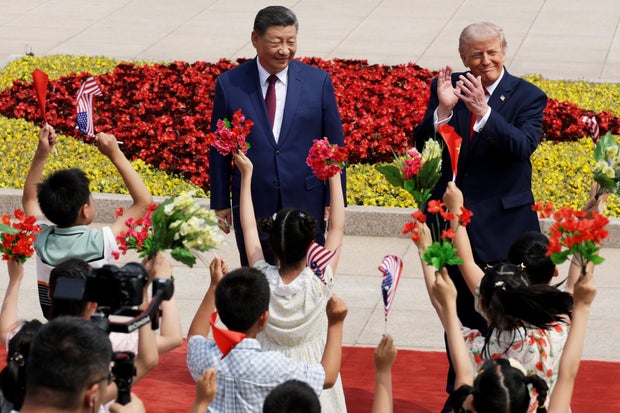
“A stable bilateral relationship is good for the world,” Xi said in translated remarks. “We should be partners, not rivals.”
Mr. Trump emphasized his personal relationship with Xi, calling him a friend and a “great leader” and saying the two have always been able to work out their disagreements. He also said the U.S. is eager to do business with China.
“We’re going to have a fantastic future together,” Mr. Trump said.
It’s the American and Chinese leaders’ first face-to-face meeting since October, and the first visit to China by a U.S. president since Mr. Trump traveled to Beijing in 2017.
Just over a year ago, the U.S.-China relationship was far rockier. President Trump’s hefty tariffs on China and dozens of other trading partners sparked a tit-for-tat trade war with Beijing, leading the two countries to briefly jack up tariffs on each other’s goods to over 100%. China and the U.S. also squared off over rare earth elements, semiconductors, student visas, shipments of fentanyl precursor chemicals, Chinese soybean imports and other issues.
Tensions have calmed since then, with both countries scaling back tariffs and China agreeing to halt export restrictions on rare earths. It’s unclear whether the U.S. and China are on track to strike a more comprehensive trade deal, but experts believe neither side is looking for a repeat of last year’s trade war, and both sides have said they are looking for stability.
The Trump administration has sought to preserve U.S. access to rare earths and to allow American companies to export food and other goods to the Chinese market — topics that could come up in this week’s Trump-Xi meetings. U.S. Trade Representative Jamieson Greer has also floated the idea of a U.S.-China “Board of Trade” to coordinate those deals.
“We’ll be talking with President Xi about a lot of different things. I would say more than anything else will be trade,” Mr. Trump told reporters before departing for Beijing on Tuesday.
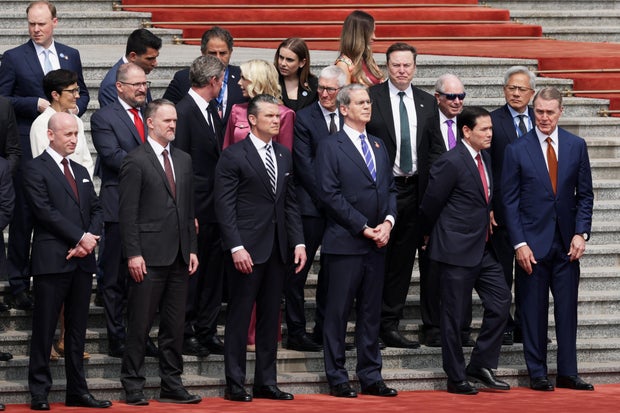
Several U.S. executives were also invited to travel to China. Figures like Tesla CEO Elon Musk, Nvidia CEO Jensen Huang and outgoing Apple CEO Tim Cook were among those who were in attendance at Thursday’s welcoming ceremony at the Great Hall of the People, standing alongside Trump administration officials in the U.S. delegation. China is a key market for many of their companies, with Nvidia seeking to sell more advanced chips to China.
The U.S.’ war with Iran is also hanging over the talks, though Mr. Trump has said he doesn’t expect it to come up as much as trade. Mr. Trump is seeking a deal with Iran, but talks appear to be stalled as both countries vie for control over the Strait of Hormuz. Mr. Trump said this week an early April truce that paused direct U.S.-Iran fighting is on “life support.”
Some experts argue the U.S.’ focus on the Middle East — including the munitions it has used in Iran — could make it more difficult to prepare for a potential confrontation with China.
At the same time, China imports large amounts of oil from the Middle East and is the world’s largest purchaser of Iranian oil, meaning China is both sensitive to the war’s dire impacts on the global oil trade and key to supporting Iran’s economy.
Rubio said on Fox News that he expects Iran to come up in this week’s talks with Chinese officials, and that “we’ve made clear to them that any support for Iran would obviously be detrimental for our relationship.” He argued that China has an interest in resolving the Iran conflict’s impacts on oil shipments, and “we hope to convince them to play a more active role.”
Taiwan is another lingering issue. The People’s Republic of China has long said it intends to reintegrate with Taiwan, and it has not ruled out using force to take over what it views as a breakaway province. The U.S. has provided billions of dollars in military support to Taiwan and said it opposes any unilateral change to the status quo, but the U.S. also has a longstanding policy of declining to say whether it would come to Taiwan’s defense in a war with China.
Meanwhile, some in Taiwan — a democracy that produces the vast majority of the world’s most advanced semiconductors — worry that the U.S.’ support for the island may be up for negotiation as Mr. Trump seeks agreements with China, experts say.