
Washington — Sometimes wrecking balls and bulldozers move faster than the legal system.
That’s the dilemma facing the National Trust for Historic Preservation, which lost its bid to temporarily halt construction of the White House ballroom last week. A judge sided with President Trump, allowing work to continue on the East Wing site while imposing limited requirements on the administration.
“The American people own these places. And we, the American people, have a right to weigh in when significant changes to them are proposed,” Carol Quillen, president and CEO of the Trust, said in an interview with CBS News. “This project needs to follow the already legally mandated processes.”
Mr. Trump has overhauled parts of the White House at a sprinter’s pace and with virtually no oversight. The East Wing and the corridor connecting it to the main residence were dismantled in a matter of days in October.
Mr. Trump’s next architectural adventure is anyone’s guess, but it appears there’s little standing in his way.
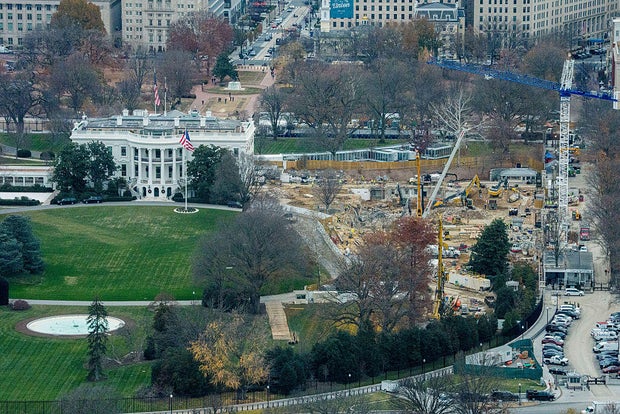
Quillen said she has “deep concern” about future projects. The Trust’s lawsuit seeks a judicial declaration that would impose pre-demolition requirements on White House construction so that more pieces of the building are not disappeared before experts and the public have a chance to weigh in.
The White House argues the 90,000-square-foot ballroom project is not yet far enough along to require approval from entities that typically have oversight of federal construction in Washington, D.C. Construction plans, government lawyers told the court, have not been finalized.
As for future projects at the executive mansion, a White House official said, “There are no plans for any demolition of any structures at this time.”
Quillen said there was a silver lining in Judge Richard Leon’s ruling against the Trust.
“We view the judge’s order as really helpful. And we learned a lot and it actually facilitates our aims in the suit,” Quillen said.
While ruling against the Trust, Leon ordered the government to file construction plans with the National Capital Planning Commission and Commission of Fine Arts by the end of the month — something the White House had already signaled it intended to do.
The administration has argued that it has no obligation to file construction plans with the NCPC prior to demolition because the commission’s authority, it says, only applies to vertical construction — not demolition.
The government also produced a previously unpublished environmental assessment of the ballroom. That document provided some details about the project’s scope, timeline and the steps taken to preserve and prepare White House grounds for the 90,000-square-foot addition. The National Park Service completed the assessment in August, but it was not released until last week in a court filing.
The Trust is also asking the court to enforce a law that would require ballroom construction to obtain congressional approval. The law holds that, “A building or structure shall not be erected on any reservation, park, or public grounds of the Federal Government in the District of Columbia without express authority of Congress.”
Congressional Republicans, who hold a majority in both houses, have yet to take a formal interest in the ballroom. The $400 million project is privately financed, and thus far no congressional appropriation or approval resolution is under consideration.
The White House maintains the president has the unilateral authority to build on White House grounds.
Quillen argues that because the White House has so far operated outside the process typically required for other federal construction in Washington, experts and the public have been excluded from providing pre-demolition input, and history could be lost.
“When projects like this go through these processes, the outcome ends up being better. The people have a voice. You build more support for the project. It becomes a more lasting legacy and improvements can be made to it along the way,” Quillen said.
The National Capital Planning Commission is slated to hear a presentation on the ballroom on Jan. 8. Another court hearing is scheduled for Jan. 15.