
Santander’s $12 billion deal for Webster Bank seen at risk
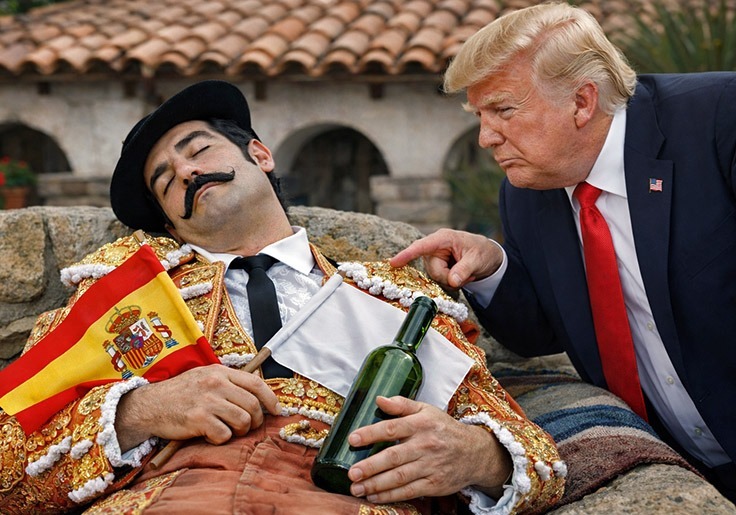
Spain, a country that was neutral in World War II and has been in decline since Maimonides left for Morocco in the mid-12th century, is infuriating President Trump by refusing to cooperate with America in the military action against Iran.
“Spain has been terrible,” President Trump said on March 3 in the Oval Office. “Spain actually said that we can’t use their bases. … They were unfriendly.”
“Spain has been very, very uncooperative,” Trump said.
Trump said he had instructed the Treasury secretary, Scott Bessent, to “cut off all dealings with Spain.”
“We’re going to cut off all trade with Spain. We don’t want anything to do with Spain,” Trump said, noting that the country had also refused to raise its defense spending to 5 percent of GDP, a level that other NATO allies have agreed to.
Some press reports indicated that Spain would respond to the American pressure by grudgingly deploying what little military force it has at its disposal. The Spanish military is best known for a four-masted sailing vessel, the Juan Sebastián de Elcano. The ship mainly goes around the world sailing in parades with other tall ships, and its website acknowledges that it “does not have missiles, torpedoes, or any weapons system for combat.” The reports claimed the Spanish ship would aid in defending Cyprus, an island in the Mediterranean Sea that has been targeted by Iran.
Yet even those press reports were denied by Spanish officials—”categorically.” “The Spanish government’s position on the war in the Middle East … and the use of our bases has not changed at all,” Foreign Minister José Manuel Albares told the private radio station Cadena Ser, according to Reuters. The Spanish foreign ministry issued a statement strongly condemning Iran’s attacks on Turkey and Qatar, while studiously omitting any condemnation of Iranian attacks on Israel. “Spain reiterates its commitment to a return to diplomacy and dialogue for urgent de-escalation, which will enable work to be done to ensure the security and stability of the region,” the statement said.
Spain’s president, Pedro Sánchez, has been hostile to Israel, taking measures including the “denial of entry into Spanish airspace of all state aircraft transporting defence material destined for Israel” and a “ban on transit through Spanish ports for all ships carrying fuel for the Israeli armed forces.” He’s accused Israel of a “genocide in Gaza” and of “the extermination” of Palestinians.
In so doing, Sánchez is hewing to a long history of Spanish decadence and hatred of Jews. Spain expelled the Jews in 1492. The Spaniards even tortured those of Jewish ancestry who had sincerely converted to Catholicism, as Benzion Netanyahu, the father of the Israeli prime minister, documented in his book, The Origins of the Inquisition in Fifteenth Century Spain. During the 1973 Yom Kippur War, with Israel desperately fighting for its survival after a surprise attack by Soviet-backed Arabs, Spain, which did not have diplomatic relations with Israel, wouldn’t allow the U.S. to use its bases to supply Israel. Its neighbor Portugal only acceded to use of the Azores Islands after a personal intervention by Senator Henry M. “Scoop” Jackson and his aide Richard Perle. Surveys of public opinion have found Spain among the worst in Western Europe when it comes to levels of anti-Semitic beliefs. The World Bank listed Spain’s GDP per capita in 2024 at $35,326, which is 35 percent lower than Israel, whose GDP per capita in 2024 was $54,177. The U.S. was at $84,534, which means a single American worker was more than twice as productive and prosperous as a siesta-taking, sangria-slurping Spanish sluggard.
The clash between Spain and the United States could do a little more damage to the economic fortunes of some Spaniards, potentially jeopardizing a significant deal by a Spanish bank to buy a U.S. bank. Trump’s comments and the underlying clash have helped send shares in Banco Santander, S.A. declining to $11.20 a share from its close of $12.96 a share on Friday, February 27. That is a drop of about 13.5 percent. Santander last month announced a $12.2 billion deal to acquire Stamford, Connecticut-based Webster Bank for a value of $75 a share, but the deal has not yet closed. Shares in Webster’s parent, Webster Financial Corporation, also slumped to about $69 a share. (By contrast, an exchange-traded fund tracking the Israeli stock market, which I own some of, is up 6.5 percent over the same period.) Banco Santander’s chief executive, Ana Botín, told Bloomberg TV that she expected the U.S. and Spain “very soon” to resume their “amazing relationship.” Botín had a warm interaction with Trump in January 2025 at Davos: Botín: “Mr. President, congratulations on a historic victory.” Trump: “I know very much about your bank, and you’ve done a fantastic job.”
Aside from Santander Bank, one of Spain’s main businesses is Iberdrola, an energy company that specializes in wind energy of the sort whose inefficiency President Trump hates. Its projects include Vineyard Wind, which is in the waters off Martha’s Vineyard and where a catastrophic failure of a turbine in 2024 polluted otherwise beautiful beaches with fiberglass shards.