
President Trump said Friday that he will be pardoning former Honduran President Juan Orlando Hernandez, who in 2024 was convicted in New York for drug trafficking and weapons charges and sentenced to 45 years in prison.
The president explained his decision on social media by posting that “according to many people that I greatly respect,” Hernandez was “treated very harshly and unfairly.”
In March of last year, Hernandez was convicted in U.S. court of conspiring to import cocaine into the U.S. He had served two terms as the leader of the Central American nation of roughly 10 million people.
Hernandez has been appealing his conviction and serving time at the U.S. Penitentiary, Hazelton in West Virginia.
Shortly after Mr. Trump’s announcement, Hernández’s wife and children gathered on the steps on their home in Tegucigalpa and kneeled in prayer, thanking God that Hernández would return to their family after almost four years apart.
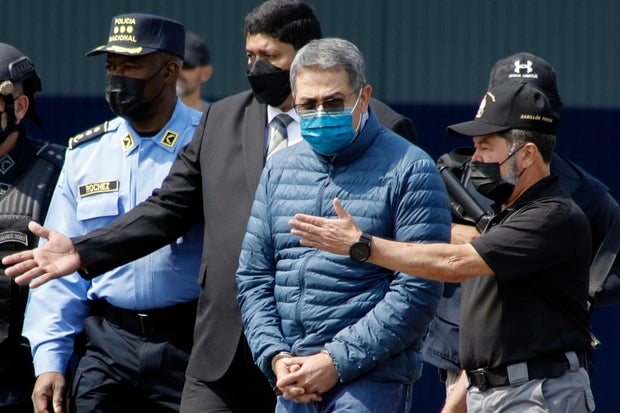
It was the same home that Honduran authorities hauled him out of in 2022 just months after leaving office. He was extradited to the United States to stand trial.
García said they had just been able to speak with Hernández and tell him the news.
“He still didn’t know of this news and believe me, when we shared it his voice broke with emotion,” she said.
García thanked Mr. Trump, saying Mr. Trump had corrected an injustice, maintaining that Hernández’s prosecution was a coordinated plot by drug traffickers and the “radical left” to seek revenge against the former president.
She said they had not been told exactly when Hernández would return, but said “we hope that in the coming days.”
A lawyer for Hernandez, Renato C. Stabile, expressed gratitude for Mr. Trump’s actions.
“A great injustice has been righted and we are so hopeful for the future partnership of the United States and Honduras,” Stabile said. “Thank you President Trump for making sure that justice was served. We look forward to President Hernandez’s triumphant return to Honduras.”
A separate lawyer for Hernandez, Sabrina Shroff, declined comment.
Republican Sen. Bill Cassidy, of Louisiana, was critical of the pardon, saying Sunday on social media, “Why would we pardon [Hernandez] and then go after Maduro for running drugs into the United States? Lock up every drug runner! Don’t understand why he is being pardoned.”
Mr. Trump defended the move to reporters aboard Air Force One on Sunday, claiming, “Many of the people of Honduras said it was a Biden setup. … He was the president of the country, and they basically said he was a drug dealer because he was the president of the country. And they said it was a Biden administration setup, and I looked at the facts and I agreed with them.”
When asked what evidence he had seen to indicate Hernandez’s case was a setup, Mr. Trump said, “You take any country you want, if somebody sells drugs in that country, that doesn’t mean you arrest the president and put him in jail for the rest of his life.”
Mr. Trump’s post on Friday was part of a broader message by the U.S. president backing Tito Asfura for Honduras’ presidency, with Mr. Trump saying the U.S. would be supportive of the country if he wins. But if Asfura loses the election this Sunday, Trump posted that “the United States will not be throwing good money after bad, because a wrong Leader can only bring catastrophic results to a country, no matter which country it is.”
Asfura, 67, is making his second run for president for the conservative National Party. He was mayor of Tegucigalpa and has pledged to solve Honduras’ infrastructure needs. But he has previously been accused of embezzling public funds, allegations that he denies.
In addition to Asfura, there are two other likely contenders for Honduras’ presidency: Rixi Moncada, who served as the finance and later defense secretary before leaving to run for president for the incumbent democratic socialist Libre party, and Salvador Nasralla, a former television personality who is making his fourth bid for the presidency, this time as the candidate for the Liberal Party.
Mr. Trump has framed Honduras’ election as trial for democracy, suggesting in a separate Truth Social post that if Asfura loses, the country could go the way of Venezuela and fall under the influence of that country’s leader, Nicolás Maduro.
Mr. Trump has sought to apply pressure on Maduro, who the Trump administration has accused of leading a drug cartel, ordering a series of strikes against boats suspected of carrying drugs, building up the U.S. military presence in the Caribbean with warships, including the Navy’s most advanced aircraft carrier, the USS Gerald R. Ford.
The U.S. president has not ruled out taking military action or covert action by the CIA against Venezuela, though he has also floated that he was open to speaking with Maduro.
Outgoing Honduran President Xiomara Castro has leaned into a leftist stance, but she has kept a pragmatic and even cooperative attitude in dealing with the U.S. administration and she has received visits from Homeland Security Secretary Kristi Noem and U.S. Army Gen. Laura Richardson, when she was the commander of U.S. Southern Command. The president has even backed off his threats to end Honduras’ extradition treaty and military cooperation with the U.S.
Under Castro, Honduras has also received its citizens deported from the U.S. and acted as a bridge for deported Venezuelans who were then picked up by Venezuela in Honduras.