
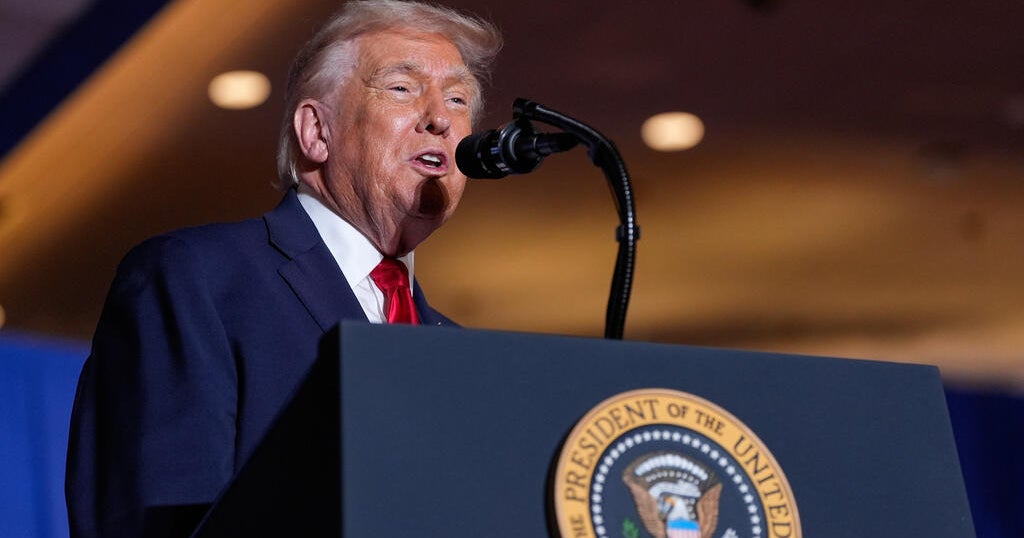
Washington — After weeks of decrying the focus on “affordability” and calling it a “Democratic hoax,” President Trump spoke in Mount Pocono, Pennsylvania, Tuesday night to sell his economic agenda ahead of a challenging midterm election season for congressional Republicans.
Mr. Trump spent much of the more than 90-minute-long rally-style speech promoting and defending his economic record, saying, “America is winning again” and “Pennsylvania is prospering again.” He touted job growth in the key battleground state, which has a slightly lower unemployment rate than the nation as a whole, and a decline in gas prices. The president also claimed his tariffs on foreign goods are paying dividends for the U.S. economy — despite worries from most economists that tariffs can lead to slower economic growth and higher consumer prices.
He pointed to the tax components of his “big, beautiful bill,” including a plan to create investment accounts for children — seeded with $1,000 from the federal government for eligible kids — and a tax deduction for tips.
Mr. Trump highlighted his decision to let Japan-based Nippon Steel buy U.S. Steel, a major employer in Pennsylvania. He said his administration “saved” the company, which he said is now “hot as a pistol.”
“The one thing you need, you need steel,” he said. “You know, you can give up certain products. You can give up pencils…You don’t need 37 dolls for your daughter. Two or three is nice, but you don’t need 37 dolls.”
He argued his administration is “crushing” inflation and said “prices are coming down.” Consumer prices rose 3% year-over-year in September, which is well below 2022 levels — when inflation hit 9.1% — but still higher than the Federal Reserve’s 2% inflation target. He also continued blaming Democrats for affordability issues.
“They caused the high prices, and we’re bringing them down,” the president said.
After initially focusing on cost-of-living issues, Mr. Trump veered off-topic at times, riffing about immigration and polling members of the audience about whether to refer to his predecessor, former President Joe Biden, as “sleepy Joe” or “crooked Joe.”
He also repeatedly brought up a fraud scandal that has enveloped Minnesota politics, and pointed to the fact that most of the defendants are of Somali descent. At several points, he urged Treasury Secretary Scott Bessent to “do your job” as Bessent’s agency investigates allegations that Minnesota tax dollars went to the terror group al Shabaab.
Trump addresses affordability after calling issue a “scam”
The president has publicly and privately vented about the focus on affordability as an issue for weeks, referring to it as a “hoax,” a “con job” and a “scam” perpetuated by Democrats.
Mr. Trump criticized Democrats for focusing on affordability issues in Tuesday’s speech, though he said: “I can’t call it a hoax because they’ll misconstrue that.”
Last week, the president called the affordability issue a “fake narrative” made up by Democrats to sway the public. But at the same time, he said he had inherited problems with affordability from his predecessor.
“They just say the word,” the president said during his Cabinet meeting on Dec. 2. “It doesn’t mean anything to anybody. They just say it — affordability. I inherited the worst inflation in history. There was no affordability. Nobody could afford anything.”
Inflation has edged higher in recent months, partly due to the Trump administration’s tariffs, but the latest inflation numbers have been delayed until mid-December — after the Federal Reserve’s interest rate-setting meeting this week — because of the recent U.S. government shutdown.
In an interview published Tuesday, the president told Politico that “prices are all coming down.”
Behind the scenes, aides told CBS News last week the president has grown increasingly irritated by perceptions that his policies aren’t easing prices.
His travel to sell his economic agenda in Pennsylvania is a quiet acknowledgement that he needs to do more to rally the public behind his policies. In Tuesday’s speech, Mr. Trump said he decided to speak about affordability in part because chief of staff Susie Wiles told him he needed to start campaigning for the midterm elections.
Polling shows voters are feeling the crunch of still-high prices and the cost of living, as well as the challenging market for job seekers — and many at least partially blame Mr. Trump.
In a November CBS News/YouGov poll, 60% of respondents agreed Mr. Trump makes prices and inflation “sound better than they really are.” Nearly two-thirds of respondents said the president’s policies are making grocery prices go up. Just 32% said the U.S. economy is good, down from 38% the month Mr. Trump took office in January. Respondents were most likely to say the economy and inflation are the most important to them, and among those who listed the economy and inflation as their top priorities, 77% said the president is not spending enough time on those issues.
The Palm Beach Post, a local paper near Mr. Trump’s Mar-a-Lago estate in South Florida, published an opinion piece Tuesday with the headline, “‘Affordability’ is not a hoax, Trump. Reality costs too much.”
Pennsylvania will feature key races for Republicans as they try to hold onto their majority in the House of Representatives in 2026. Mount Pocono, where Mr. Trump is speaking Tuesday night, is just over 30 miles from Scranton, former President Joe Biden’s hometown.
Cost of living worries still linger
Mr. Trump’s remarks come amid ongoing public frustration over the high cost of living in the U.S.
Although U.S. inflation has fallen, the high cost of food, shelter, health care, utilities, child care and other basic necessities has remained a sore spot for millions of Americans.
Mr. Trump has vacillated between downplaying complaints about the economy and defending his administration’s efforts to address affordability issues.
In November, for example, the Trump administration removed country-specific tariffs on imports of beef, bananas and coffee as consumers continue to grapple with high food prices. Mr. Trump last month also discussed offering Americans a $2,000 payment funded by U.S. tariff collections, while this month he floated the idea of using tariff revenue to cut federal income taxes.
More recently, Mr. Trump on Monday announced $12 billion in aid for farmers who have struggled under tariffs and because of the U.S trade war with China.
“We’re bringing prices way down,” Trump said at the White House on Monday. “You can call it ‘affordability’ or anything you want, but the Democrats caused the affordability problem, and we’re the ones that are fixing it.”
The economy has proved resilient this year despite earlier fears about the impact of steep new U.S. tariffs on imports. After losing steam in the first quarter, the nation’s gross domestic product has accelerated in the second half of 2025, while the nation’s labor market has remained steady despite slowing payroll gains.
Financial markets also continue to hover in record terrain, shrugging off concerns about a bubble in AI companies.
At the same time, some experts describe the economy as “K-shaped” — a reference to the divergent fortunes of wealthier consumers compared with people lower down the ladder.