
The U.S. military has killed the alleged leader of Venezuela-based gang Tren de Aragua, President Trump announced Friday.
The president said on Truth Social that U.S. Southern Command carried out a “swift and lethal kinetic strike” to “successfully execute” Hector Rusthenford Guerrero Flores, also known as Niño Guerrero. The mission was “closely coordinated” with the Venezuelan government, the president said, highligting the U.S.’s shifting relationship with Venezuela since its former leader was removed in an American military operation earlier this year.
Defense Secretary Pete Hegseth said on X the strike took place earlier this week on a Tren de Aragua compound in Venezuela.
Mr. Trump’s social media post included a video that showed a projectile hitting a building, causing it to erupt in flames.
“Tren de Aragua terrorists no longer have safe haven in Venezuela or anywhere else and, under my leadership, we will find these vicious murderers and drugs lords anytime, anyplace, and send them to the depths of hell where they belong,” he wrote.
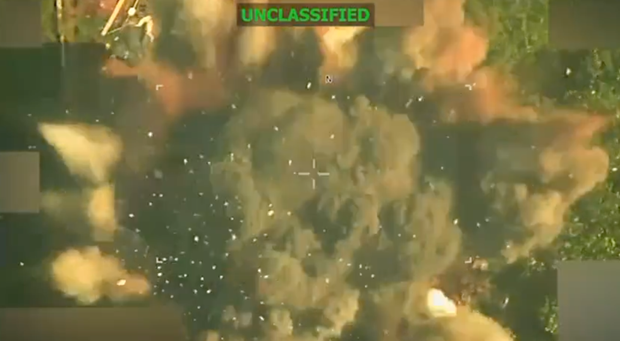
In a statement on the strikes, U.S. Southern Command described Guerrero Flores, 43, as a “wanted fugitive.” He was indicted late last year in New York federal court on charges that included racketeering, conspiracy to provide material support to terrorists and cocaine conspiracy. The State Department offered up to $5 million for information leading to his capture.
Also known as “The Unspeakable” or “The Big Eyebrow,” Guerrero Flores ran Tren de Aragua for more than a decade, helping to grow it from a Venezuelan prison gang to a transnational organization with a presence throughout the Americas, including in the United States, federal prosecutors say. The indictment accused him of leading a criminal enterprise that trafficked drugs and people, extorted local populations and committed acts of violence.

Prosecutors allege that Guerrero Flores initially operated Tren de Aragua out of Tocorón Prison, directing gang members on the outside and collecting a fee from their activities. CBS News’ partner network, BBC News, reported that Guerrero Flores was in and out of Tocorón Prison for years: He escaped in 2012 and was rearrested a year later. He was sentenced to a 17-year prison term in 2018, but escaped again in 2023, remaining at large after that.
Guerrero Flores lived “like a king” during part of his time in prison, BBC News reported. He occupied an entire floor monitored by bodyguards, and the prison had a swimming pool, a zoo and a nightclub. Last year’s indictment alleged the Venezuelan government allowed him to “control the day-to-day operations of the prison.”
The apparent collaboration between the American and Venezuelan governments to kill Guerrero Flores came five months after the U.S. military removed Venezuelan President Nicolás Maduro from power in a daring nighttime raid.
Maduro was flown to New York, where federal prosecutors accused him of scheming to import cocaine into the United States, in part by allegedly partnering with Tren de Aragua and other cartels. The indictment against Maduro also charged Guerrero Flores as a co-conspirator. Maduro has pleaded not guilty.
Since then, Venezuela has been led by Maduro’s former deputy, Delcy Rodriguez. The Trump administration has sought to work with Rodriguez’s government, lifting sanctions on her and pushing to collaborate on oil extraction.
Tren de Aragua has been in Mr. Trump’s crosshairs since he returned to the White House last year. He won a second term after frequently highlighting the gang’s violent presence in the United States — and, critics allege, exaggerating their power within some American communities — on the campaign trail in 2024. Mr. Trump argued the gang was fueled by a massive influx of Venezuelan nationals who traveled to the U.S.-Mexico border during the Biden administration, amid political and economic turmoil in Maduro’s Venezuela.
Early last year, the Trump administration designated Tren de Aragua and other Latin American gangs as foreign terrorist organizations. The administration later cited those designations in its legal justification for striking dozens of alleged drug-carrying boats in the Caribbean and the Eastern Pacific last fall, arguing the U.S. is engaged in an “armed conflict” with the groups. Some of those boats were allegedly operated by Tren de Aragua.
The administration also invoked the wartime Alien Enemies Act of 1798 on Tren de Aragua in March 2025, accusing the group of working with the Maduro government to perpetrate an “invasion” of the United States. It drew controversy for using that law to summarily deport hundreds of Venezuelan men, many of whom were sent to a maximum-security prison in El Salvador. Some of the deportees denied that they were gang members, and some judges found the men were denied due process.
An assessment by the National Intelligence Council last year found the Venezuelan government does not direct Tren de Aragua, despite the Trump administration’s claims. In an interview on “Face the Nation with Margaret Brennan,” Secretary of State Marco Rubio said of the assessment: “They’re wrong.”