
Maduro captured by Army’s Delta Force, sources say
Venezuelan President Nicolás Maduro was captured early Saturday morning by members of Delta Force, the U.S. military’s top special mission unit, U.S. officials told CBS News.
The elite Army Delta Force was also responsible for the 2019 mission that killed former Islamic State leader Abu Bakr al-Baghdadi.
Trump says Maduro was captured and flown out of Venezuela
President Trump said in a Truth Social post early Saturday morning that Venezuelan President Nicolas Maduro and his wife were “captured and flown out of the Country,” as he confirmed U.S. military strikes in Venezuela.
“The United States of America has successfully carried out a large scale strike against Venezuela and its leader,” Mr. Trump wrote. He said U.S. law enforcement was involved, but he didn’t specify how or which agencies.
Maduro was indicted in an American court for alleged narcoterrorism in 2020.
Mr. Trump said more details will be offered in a press conference at 11 a.m. ET at Mar-a-Lago.
State Department tells Americans in Venezuela to shelter in place
The State Department warned U.S. citizens in Venezuela to shelter in place early Saturday morning.
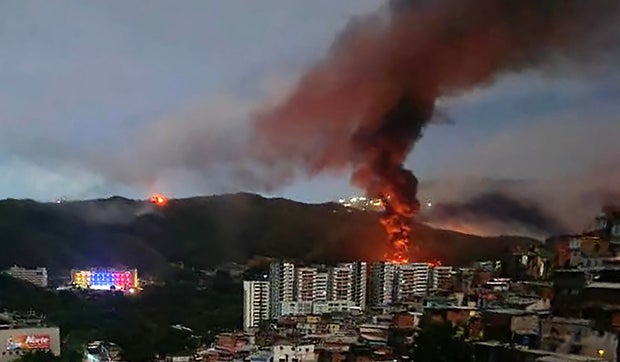
In a notice posted on its website, the department said the U.S. Embassy in Bogota, Colombia, was “aware of reports of explosions in and around Caracas, Venezuela.”
The U.S. has warned its citizens against traveling to Venezuela for months, citing the risk of “wrongful detention, torture in detention, terrorism, kidnapping, arbitrary enforcement of local laws, crime, civil unrest, and poor health infrastructure.”
Democratic Sen. Ruben Gallego: “This war is illegal”
Shortly after the U.S. launched strikes in Venezuela, Democratic Sen. Ruben Gallego of Arizona wrote on X: “This war is illegal.”
The senator, a U.S. Marine Corps veteran who was deployed in Iraq, called it the “Second unjustified war in my life time.”
Republican Sen. Mike Lee of Utah also expressed skepticism, saying in a post on X: “I look forward to learning what, if anything, might constitutionally justify this action in the absence of a declaration of war or authorization for the use of military force.”
In recent months, congressional Democrats and some Republicans have pushed back against the Trump administration’s military buildup in the region, forcing votes in the House and Senate on measures that would have barred the U.S. from striking Venezuela without congressional approval.
Those measures have been voted down.
Venezuelan government declares state of emergency, tells people to take to the streets
Venezuela’s government called on its supporters to take to the streets in the wake of the U.S. military strikes early Saturday.
“People to the streets!” the statement said. “The Bolivarian Government calls on all social and political forces in the country to activate mobilization plans and repudiate this imperialist attack.”
The statement said President Nicolás Maduro had “ordered all national defense plans to be implemented” and declared “a state of external disturbance.” That state of emergency gives him the power to suspend people’s rights and expand the role of the armed forces.
Venezuelan opposition leader has backed Trump’s strategy
Venezuelan opposition leader María Corina Machado told CBS News in mid-December she was “absolutely” supportive of President Trump’s strategy in the country.
“We, the Venezuelan people, are very grateful to him and to his administration, because I believe he is a champion of freedom in this hemisphere,” Machado said on “Face the Nation with Margaret Brennan.”
At the time, the president’s strategy was limited to attacks on suspected drug boats, the seizure of an oil tanker and economic and diplomatic pressure, but not land strikes.
Asked if she’d welcome U.S. military action in Venezuela, Machado did not rule it out, saying: “I will welcome more and more pressure so that Maduro understands that he has to go.”
A former lawmaker who was disqualified from running in Venezuela’s 2024 presidential election, Machado was awarded the Nobel Peace Prize this year, and collected the prize in Norway after a risky waterborne exit from Venezuela. She dedicated the prize to Mr. Trump.
Caracas military bases and major Venezuelan port hit by U.S. strikes, political opposition says
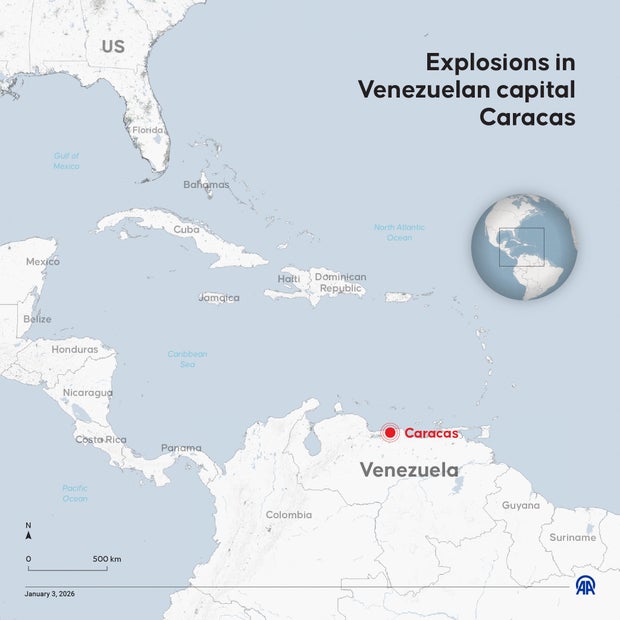
David Smolansky, a spokesman for Venezuelan opposition leader Maria Corina Machado, told CBS News the following locations were among those hit:
- Fuerte Tiuna — the main military base in Caracas
- La Carlota — the main airbase in Caracas
- El Volcán — signal antenna
- La Guaira Port — a seaport on the Caribbean coast
FAA bans commercial flights over Venezuela due to “ongoing military activity”
As the U.S. carries out strikes in Venezuela, the Federal Aviation Administration prohibited U.S. commercial air carriers from operating at all altitudes over Venezuela, citing “safety-of-flight risks associated with ongoing military activity.”
The notice was issued at 2 a.m. local time in Caracas (1 a.m. Eastern) on Saturday, and was set to end at 1 a.m. Caracas time on Sunday.
The order does not apply to foreign or military aircraft.
Maduro said earlier this week that he’s open to U.S. talks on drug trafficking
Before the U.S. strikes began, Maduro said in an interview on Venezuelan state TV earlier this week that he was willing to talk with the U.S. about drug trafficking, oil and migration issues.
The Venezuelan president said he was ready for talks “wherever they want to whenever they want,” and suggested he was open to an agreement to combat drug trafficking, or American investment in Venezuela’s oil sector.
Maduro has alleged for weeks that the U.S. is seeking his ouster.
“What are they seeking? It is clear that they seek to impose themselves through threats, intimidation and force,” he said this week.
Maduro has maintained hold on power despite disputed 2024 election
Maduro, 63, has maintained his grip on power in Venezuela since 2013, when he became president following the death of longtime leader Hugo Chávez.
Maduro has survived several serious threats to his hold on the presidency, most recently in 2024, when he stood for election for a third term. The Venezuelan government declared Maduro the victor, a result that was denounced by opposition leaders and international observers, who accused the regime of stealing votes.
The U.S. recognized the opposition candidate, Edmundo González, as the winner, and imposed sanctions against elections officials for allegedly rigging the outcome.
Despite the global outcry, Maduro was sworn in for his third term in January.
Trump repeatedly threatened to move from boat strikes to land strikes
President Trump repeatedly warned in recent months that his administration could attack accused drug traffickers who traverse Latin America by land “very soon,” which would mark an escalation in the U.S. military’s campaign of lethal strikes on alleged drug boats.
“We’re going to start doing those strikes on land, too,” Mr. Trump told reporters during a Dec. 2 Cabinet meeting when asked about the administration’s strikes at sea. “You know, the land is much easier … And we know the routes they take. We know everything about them. We know where they live. We know where the bad ones live. And we’re going to start that very soon, too.”
He said at the time that any country where illicit drugs are produced or trafficked could be subject to attack, not just Venezuela.
Cuba’s president denounces strikes on Venezuela as a “criminal attack by the U.S.”
Cuba’s President Miguel Díaz-Canel Bermúdez said in a social media post that his country denounced “the criminal attack by the U.S.” on Venezuela, and he called for urgent condemnation from the international community for what he described as “State terrorism against the brave Venezuelan people and against Our America.”
Venezuela accuses U.S. of “very serious military aggression”
In a statement early Saturday, the Venezuelan government said it “repudiates and denounces to the international community the very serious military aggression” by the U.S. government.
Venezuela said the strikes targeted civilian and military sites in the city of Caracas and the states of Miranda, Aragua and La Guaira.
The government vowed to defend against the apparent strikes, and accused the U.S. of seeking regime change.
“The whole country must be active to defeat this imperialist aggression,” the government’s statement read, adding a call for an immediate meeting of the United Nations Security Council.
Explosions heard in Caracas
U.S. officials confirmed to CBS News that President Trump had ordered strikes in Venezuela not long after reports started to emerge of explosions and low-flying aircraft in the country’s capital of Caracas in the early Saturday morning hours. Initially U.S. officials had said only that they were aware of the reports.
President Gustavo Petro in neighboring Colombia said in a social media post that someone was “bombing Caracas in this moment,” without saying who.
“Alert to the whole world, they have attacked Venezuela bombing with missiles,” he said, calling for a meeting of the United Nations.
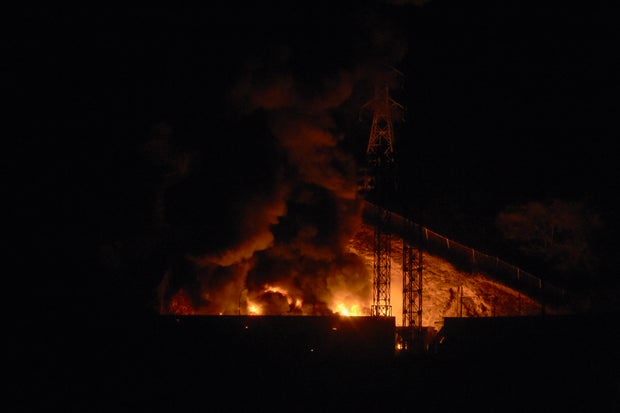
Smoke could be seen rising from the hangar of a military base in Caracas, and another military facility in the capital was without power, The Associated Press reported.
Trump approved Venezuela strikes days beforehand, sources say
President Trump gave the U.S. military the green light to conduct land strikes in Venezuela days before the actual operation occurred, according to two U.S. officials who spoke to CBS News under condition of anonymity to discuss national security matters.
Military officials discussed conducting the mission on Christmas Day, but U.S. airstrikes in Nigeria against ISIS targets took precedence, the sources said.
The days following Christmas opened more potential strike windows to U.S. military officials but the operation was held due to weather conditions. The officials said the U.S. military wanted weather conditions that were advantageous to mission success.
U.S. launches airstrikes on Venezuela
President Trump ordered strikes on sites inside Venezuela early Saturday morning, including military facilities, U.S. officials told CBS News.
The Pentagon referred all requests for comment to the White House.
Before land strikes, Trump said it would be “smart” for Maduro to leave
President Trump has been noncommittal on whether the goal of his military buildup is to oust Venezuelan President Nicolás Maduro. He told reporters on Dec. 22 it would be “smart” for Maduro to leave power, but it’s “up to him what he wants to do.”
White House chief of staff Susie Wiles has been more direct about the president’s intentions, telling Vanity Fair in November: “He wants to keep on blowing boats up until Maduro cries uncle.”
Mr. Trump said in mid-December that Venezuela was “completely surrounded by the largest Armada ever assembled in the History of South America.”
“It will only get bigger, and the shock to them will be like nothing they have ever seen before — Until such time as they return to the United States of America all of the Oil, Land, and other Assets that they previously stole from us,” he posted on Truth Social on Dec. 16.
Military action follows more than 30 boat strikes, seizure of oil tankers
Since early September, the U.S. military has carried out more than 30 strikes on alleged drug smuggling boats in the Caribbean and Eastern Pacific, killing over 110 people. The first of those attacks, on Sept. 2, sparked additional controversy when it emerged that the military launched a follow-on strike after spotting two survivors. Critics in Congress have called for an investigation into whether that constitutes a war crime.
Then on Dec. 10, the U.S. seized an oil tanker called The Skipper off the coast of Venezuela. The mission was launched from the USS Gerald R. Ford, an aircraft carrier that has been in the area for weeks as part of a broader buildup of U.S. forces in the region, sources told CBS News.
Attorney General Pam Bondi posted a 45-second video of the operation on X, showing armed personnel descending onto the vessel’s deck from a helicopter. She said the U.S. executed a seizure warrant on the vessel, and that it was “used to transport sanctioned oil from Venezuela and Iran.”
Less than a week later, President Trump announced a “total and complete blockade” of sanctioned oil tankers entering and exiting Venezuela. The U.S. later seized a second oil tanker off the coast of Venezuela on Dec. 20, and later pursued a third tanker that refused to be boarded and fled.
In what could be the campaign’s first known land strike, Mr. Trump said in late December the U.S. “knocked out” a “big facility” that was allegedly linked to drug trafficking. He described the target as a “dock area where they load the boats up with drugs,” but he didn’t specify its location or offer many further details.
The Venezuelan government has criticized the operations at sea, calling the oil tanker seizures acts of “piracy” and accusing the Trump administration of seeking regime change.
Trump administration accuses Maduro, Venezuelan groups of narcoterrorism
The U.S. has asserted that Venezuelan President Nicolás Maduro is complicit with armed criminal gangs smuggling drugs into the U.S. — allegations that Maduro has rejected.
The Trump administration has officially designated two groups as international terrorist organizations that it says are linked to the Maduro regime: the Cartel de los Soles and the gang Tren de Aragua, which are accused of international drug trafficking and violent attacks.
Some experts have questioned the designations. Analysts say the Cartel de los Soles is not a singular organization, but instead refers to elements within the Venezuelan government accused of colluding with drug cartels.
Secretary of State Marco Rubio told CBS News’ “Face the Nation with Margaret Brennan” in May that the administration believes Tren de Aragua is used as a tool of the regime — contradicting an assessment by the National Intelligence Council.
“There’s no doubt in our mind, and in my mind, and in the FBI’s assessment that this is a group that the regime in Venezuela uses, not just to try to destabilize the United States, but to project power,” Rubio said.
Maduro and several of his top lieutenants were charged in U.S. federal court in 2020 with narco-terrorism and drug trafficking, which he denied. “Maduro very deliberately deployed cocaine as a weapon” to harm the U.S., prosecutors alleged.
Over the summer, the Trump administration doubled the reward for Maduro’s arrest to $50 million.
Strikes come after months of U.S. military buildup in region
Over the past few months, the U.S. has ratcheted up the pressure on the Maduro regime in Venezuela in multiple ways, including an extensive military buildup in the region, live fire exercises and deadly strikes on alleged drug boats in the Caribbean and Eastern Pacific.
There are currently about 15,000 U.S. troops in the region. Some 11 naval vessels were in the Caribbean Sea as of Dec. 30, Navy officials told CBS News, including the USS Gerald R. Ford, the world’s most advanced aircraft carrier.
The U.S. naval buildup in the Caribbean also includes five guided missile destroyers, two guided missile cruisers, an amphibious assault ship and two amphibious transport dock ships, officials said.
There are also several dozen U.S. fighter jets stationed in Puerto Rico. And this month, the U.S. moved aircraft to the region that are designed to carry special forces, including CV-22 Ospreys and C-17 cargo planes, a source familiar with the matter told CBS News.