
The University of Florida has removed a syllabus for a graphic design course that violated Florida state law by offering potential accommodations to “queer and trans students, BIPOC students, first-gen students, and students navigating complex lives.” Florida law prohibits the expenditure of state or federal funds on any coursework or program that promotes “differential or preferential treatment of individuals” on the basis of race, sexual orientation, or gender identity.
The course, Workshop for Art Research and Practice (WARP), is mandatory for all graphic design majors at the University of Florida. The language appeared on the spring 2026 syllabus and violates a regulation passed by Florida’s Board of Governors in November 2023.
The syllabus included a section on “Accessibility, Diversity & Inclusion” appended to customary language about resources available to students who are sick or disabled. It indicated that “access riders”—statements used to explain hardship or special needs and request accommodations—for “neurodivergent, disabled, and chronically ill students” may also be available to “queer and trans students, BIPOC students, first-gen students, and students navigating complex lives.”
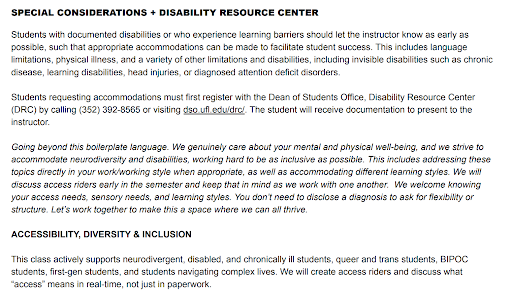
Asked for comment, the university’s interim vice president of strategic communications and marketing, Steve Orlando, said the offending language was a relic from an old syllabus and that the university had updated the document. “College of the Arts leadership was unaware of this syllabus but acted immediately upon learning of it,” Orlando said. “The faculty members who teach [the course] informed us they inadvertently included material in the syllabus that had appeared in a previous syllabus. The newer syllabus has been removed and will be replaced with the correct one to ensure compliance with state law.”
The new syllabus does not include the language. The incident sheds light on numerous ways the ideology of diversity, equity, and inclusion (DEI) has burrowed into the university system. Florida governor Ron DeSantis (R.), first elected in 2018, signed a bill in 2023 banning state colleges and universities from spending money on DEI, which he has dubbed “discrimination, exclusion, and indoctrination.”
While “access riders” are typically used by disabled students and professional artists to ensure legitimate special needs are met, the professors laid out a broad range of demands students might make of artistic “collaborators.” A PowerPoint presentation curated by WARP professors gave the following examples and told students, quoting the artist Johanna Hedva, that “access documents are used by rock stars and divas all the time—they’re simply called riders and no one bats an eye. This is because they are helpful for everyone involved.” The presentation encouraged students to “normalise asking collaborators for access riders!”
• “No cis-heterosexism, racism, ableism, classism, transphobia, homophobia or fatphobia.”
• “No work calls after 5pm unless otherwise agreed. Always send an email beforehand.”
• “I am a sick person with an invisible illness and I use a cane sometimes. … Don’t ask me about my cane or police other people’s use of their medical aids. I encourage you to be mindful of your language, especially of ABLEIST SLURS.”
• “I prefer the event prices to be on a sliding scale or free for all.”
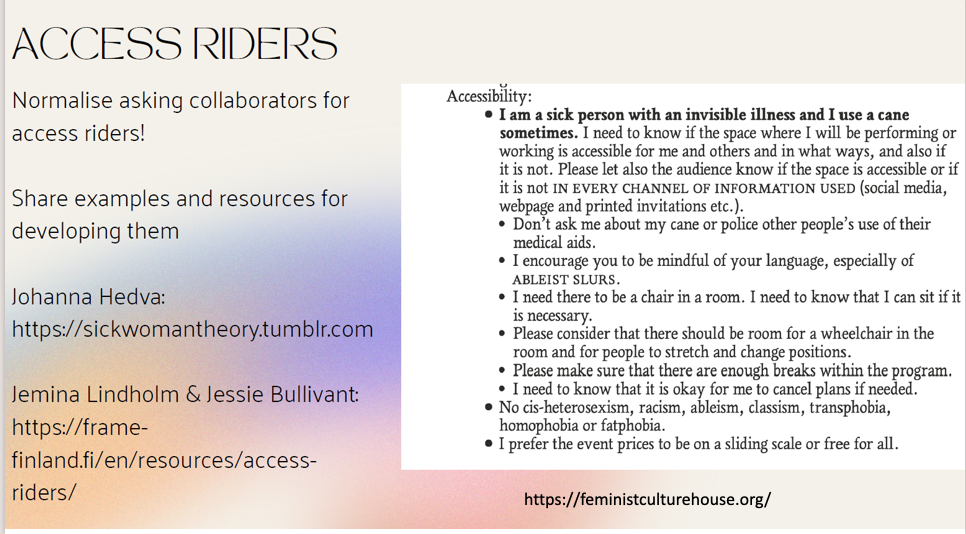
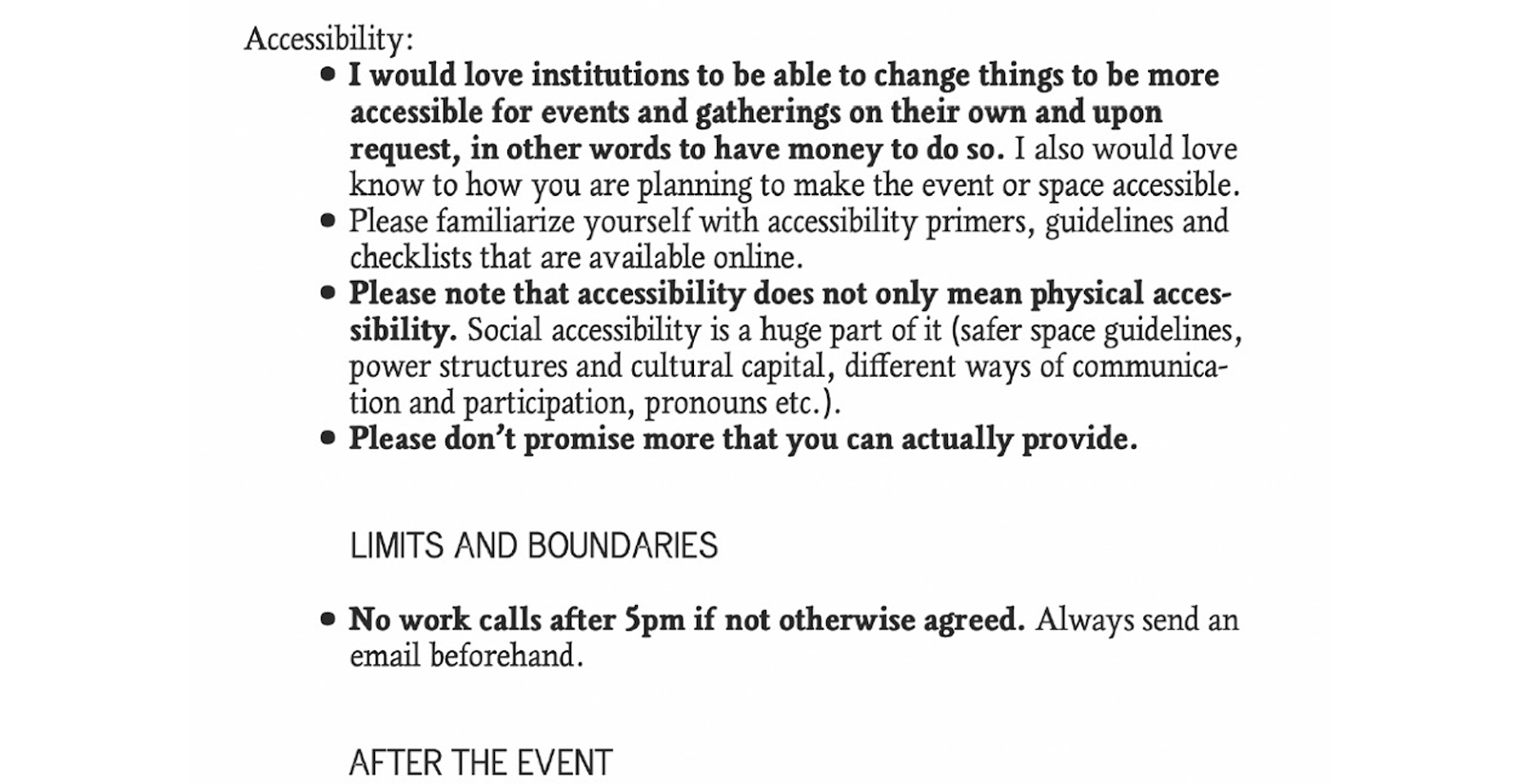
Course instructors and artists Peter Gouge and Flounder Lee required no explanation for the demands made on access riders and instructed students to list them “without explaining further (unless you wish to).”
Florida Regulation-9.016 prohibits universities from providing “differential or preferential” treatment to people based on “color, sex, national origin, gender identity, or sexual orientation, to equalize or increase outcomes, participation or representation as compared to other individuals or groups.”
Students in the WARP program say that the offending language is part of a broader ideological pattern and was not “inadvertent.” One student, who requested to remain anonymous, said Gouge and Lee read the syllabus aloud in class.
All instructors at the University of Florida are required to submit course syllabi to the College of Arts for approval, so it stands to reason that the school either approved the old syllabus or that Gouge and Lee, both artists, violated school policy by not sharing it with administrators. Gouge, Lee, and the college did not respond to a request for comment about whether the professors submitted the syllabus for review.
Lee’s professional biography indicates that his hometown was built on the “ancestral lands” of the “Yuchi, Shawnee, Muscogee/Creek, and Cherokee peoples,” who were “forcibly removed in the 1800s to make way for settlers such as his ancestors who were from Europe.”
“His PhD project deals with a quotidian, decolonial future through both an artistic and curatorial perspective,” Lee’s biography goes on. “He works using anti-oppressive practices—anti-racist, anti-colonial, anti-patriarchal, anti-heteronormative, inclusive, and intersectional with decolonial, resistance-based, and curatorial activism approaches.”
It is unclear what, if any, accommodations have been provided to current WARP students based on race or sexual orientation to date, given that such requests are kept confidential, or whether Gouge and Lee will honor previously offered accommodations. The university did not respond to a request for comment regarding whether students have submitted access riders based on race, sexual orientation, or gender identity and, if so, whether the existing requests would be honored.
Rocco Barbusca is a senior at the University of Florida and the managing editor of the Florida Finibus, an independent student publication.