
As pathways to freedom have narrowed in immigration courts across the United States, a record number of detainees are giving up their cases and voluntarily leaving the country.
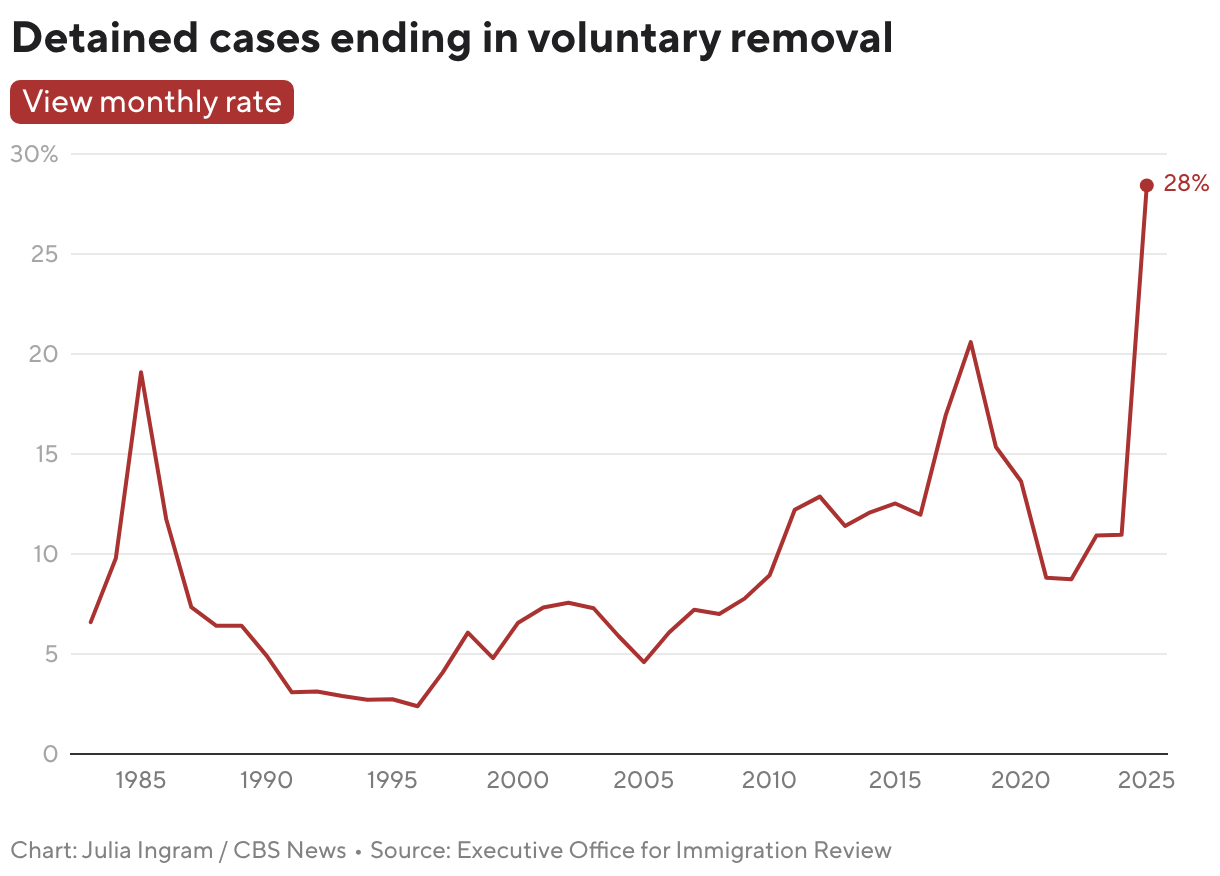
Last year, 28% of completed immigration removal cases among those in detention ended in voluntary departure, a higher share than in any year prior, a CBS News analysis of decades of court records found.
That figure only appears to be climbing as the Trump administration’s immigration crackdown widens and detention populations swell. The percentage of voluntary departures among those detained grew nearly every month of 2025, reaching 38% in December. The analysis does not include those who were not given a hearing before an immigration judge, such as immigrants in expedited removal proceedings.
“It’s set up for every individual who is detained to get to the point where they’re just emotionally drained and exhausted through it all of the way that we’re being treated, to just say, ‘OK, all I want is my freedom,'” said Vilma Palacios, who agreed to return to Honduras in late December after being detained for six months in Basile, Louisiana.
Palacios, 22, had been in the U.S. since she was 6 years old. Last June, a month after she graduated from nursing school at Louisiana State University, ICE agents arrested her at a local police station after she brought in a car for a routine inspection. She has no criminal record.
Palacios said she and her family were apprehended and detained for a month at the border when they arrived in 2010 but were released and pursued an asylum case in the years following. Court records show her case was administratively closed in 2015, when she was 12 years old, meaning it was taken off the docket indefinitely.
In a statement to CBS News, a Department of Homeland Security spokesperson wrote that Palacios “freely admitted to being in the U.S. illegally” and “never sought or gained any legal status.”
Palacios pushed back on claims that she never sought legal status, saying she had been awaiting a work permit renewal when she was arrested.
Since then, Palacios says she had an immigration attorney helping her navigate the immigration court proceeding process and thought she was doing everything necessary to remain in the U.S. lawfully. She says she was shocked when immigration agents detained her.
She said her subsequent six-month stay in detention — during which she had no contact with family or friends — was emotionally exhausting.
“Everything was taken from me, like being ripped apart from every person that I loved, and being surrounded with people that I had never met in my life, and [ICE] having control over every movement that I made, was just something very difficult to me,” she said. “It got to the point where I didn’t see that I had no other option but just to say, OK, just please give me my freedom back.”
Palacios said she tried to offer medical care to fellow detainees in need when they faced delays in accessing doctors and nurses, but detention facility staff told her not to.
“Many women would always come up to me, or come up to the officers, and complain about the waiting time, that they weren’t receiving the treatment that they needed, that they were sick, and still had to wait two, three, four weeks, even months after, to be called,” Palacios said.
About 73,000 people were being held in ICE detention in mid-January, the highest level ever recorded by DHS, CBS News previously reported.
“The conditions in the detention centers have never ever been worse because they’re so overcrowded,” said Jen Grant, a supervising attorney at the Legal Aid Society in New York.
Palacios asked an immigration judge for a bond for her release from detention, but her request was denied.
“They weren’t looking at the roots that I created in the United States,” Palacios said. “The job that I had lined up, the career, the life that I had built for myself, they never took nothing into consideration.”
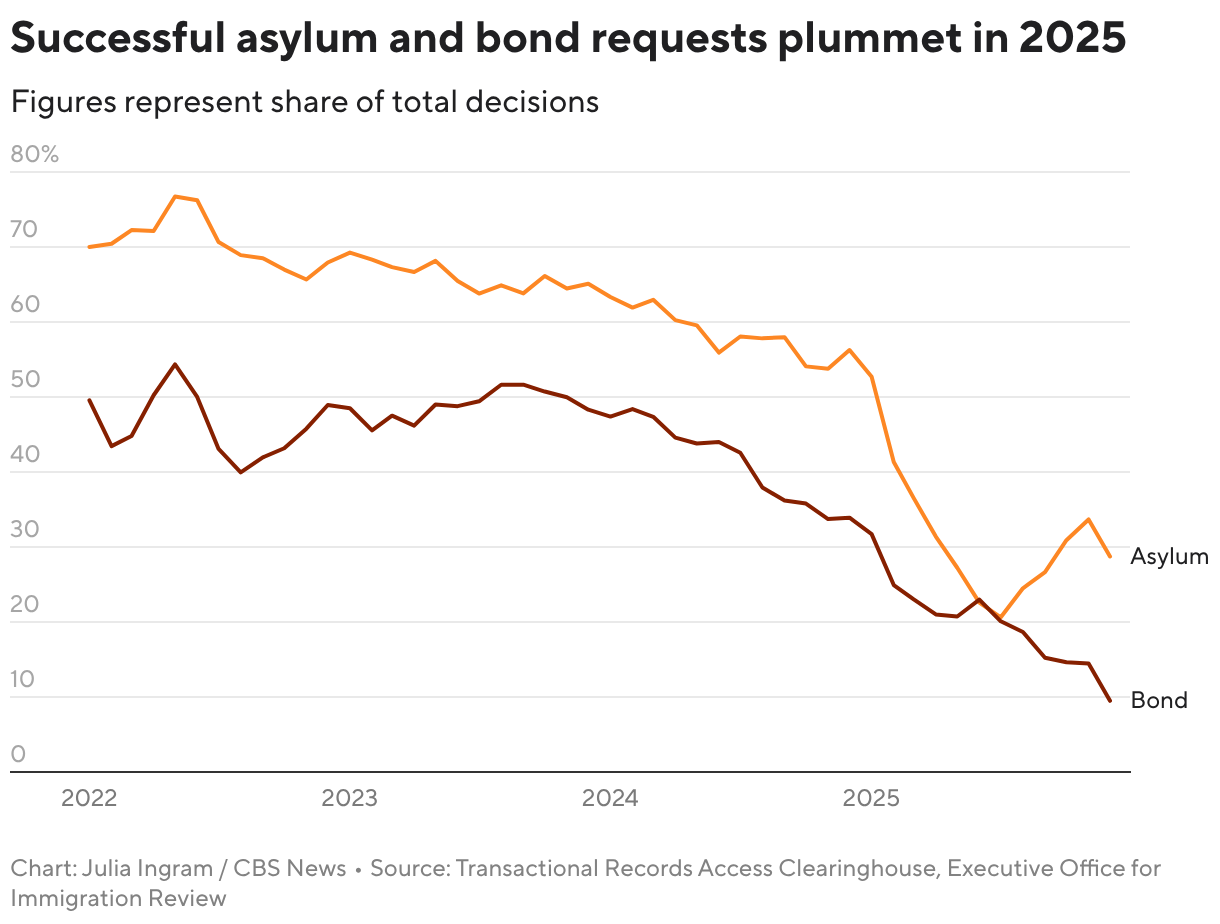
She’s not the only one who struggled to get out of detention while her case was pending. Last year, 30% of rulings on bond were favorable to detainees, down from 59% in 2024, the CBS News analysis found.
Under the Trump administration, DHS has moved to subject anyone who entered the U.S. illegally to mandatory detention, rather than only those apprehended near the border, removing judges’ authority to grant bond. In December, a California district judge ruled that DHS’s sweeping use of mandatory detention is unlawful, but the chief immigration judge issued guidance telling immigration judges the ruling was not binding, according to a memo obtained by the American Immigration Lawyers Association.
Judges may also be afraid to rule out of step with the administration’s deportation agenda, Grant said, as the Trump administration has fired dozens of judges.
A spokesperson for the Executive Office for Immigration Review, which oversees the nation’s immigration courts, wrote in a statement that “immigration judges are independent adjudicators and decide all matters before them, including requests for voluntary departure, on a case-by-case basis, according to U.S. immigration law, regulations, and precedent decisions.”
DHS did not respond to inquiries about the increase in voluntary departures and use of mandatory detention.
Many detainees are seeking release by filing habeas corpus petitions in federal court, which compel a judge to evaluate the legality of their detention. In some cases, that shifts the burden of proof onto the government to show that a detainee is a flight risk. But not everyone has the resources to file a habeas corpus petition, Grant said, and not all petitions are successful.
One immigrant who asked that CBS News identify her only by her initials, U.G., as she is still seeking legal pathways to appeal her deportation, was relieved when a judge finally ordered for her deportation after 13 months in detention. Although she didn’t ask for voluntary departure, at one point she tried to convince her legal team to ask for her removal.
“I couldn’t fathom just continuing to sit there,” she said. “Every day that I sit here, I’m choosing to sit here. I can sign and have them remove me in three days.”
Even if she had been granted her claim for relief, she believed DHS would appeal it, leaving her in detention for even longer, or try to send her to a country other than her native Mexico, she said.
“They believe that the likelihood of them winning their case is so much lower than it ever used to be,” attorney Christopher Kinnison said of some of his clients. He has been working as an immigration lawyer in Louisiana for 15 years.
Many of the people in removal proceedings are seeking asylum, and asylum grant rates have plummeted, according to immigration court data analyzed by the Transactional Records Access Clearinghouse. More than half of asylum requests were granted each month from 2022 to 2024, but 29% were granted by December 2025.
In recent months, DHS has also moved to cut thousands of asylum cases short by asking judges to send asylum seekers to third countries.
“People have no hope,” Grant said. “It’s from seeing other people in court who fight their cases, who get their cases denied, who have bond hearings … and then they get denied.”
After a judge granted Palacios’ request for voluntary departure, she was flown to Honduras in handcuffs, with additional metal chains around her waist and feet.
“It’s something that I feel like it’s very inhumane, the way that we are shackled and brought to our country,” she said. “It doesn’t seem like it’s a voluntary departure. It seemed that you’re still being held as a criminal, kind of like a hostage.”
Now in a country that she can hardly remember, Palacios is beginning to rebuild her life, even volunteering at a local toy drive in her new community.
Pacios did not appeal her case after being sent back to Honduras, but she tells CBS News she hasn’t given up hope of returning to the U.S. one day.
“My goal and dream is still to be a nurse in the United States,” Palacios said. “If I receive an opportunity here, to be able to gain experience, in the meantime, to be able to continue making an impact… to be able to help those in need, I always say, why not?”