
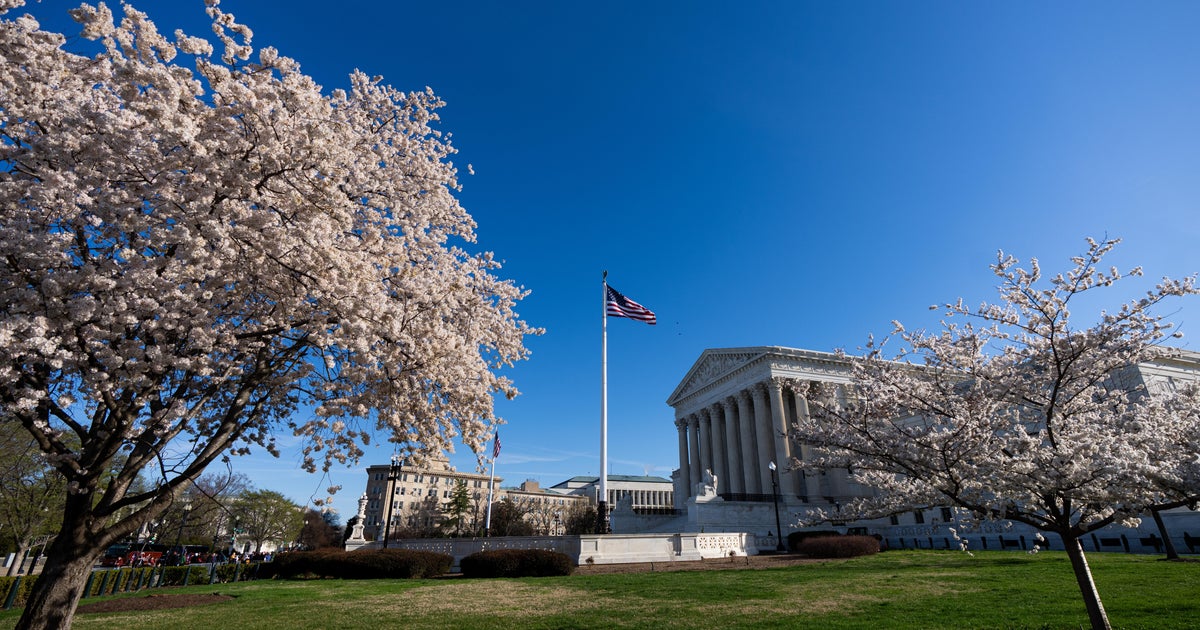
Washington — The Supreme Court is set to convene Wednesday to consider the legality of President Trump’s executive order that seeks to end birthright citizenship.
The case is a major test of a key pillar of Mr. Trump’s immigration agenda and is the first in which the high court will weigh the legal merits of one of the president’s immigration policies.
The question before the Supreme Court is whether the president’s executive order on birthright citizenship violates the Citizenship Clause of the 14th Amendment and a provision of federal law that codified that clause. That statute was first enacted through the Nationality Act in 1940 and then reenacted in the Immigration and Nationality Act in 1952.
The Citizenship Clause states that “all persons born or naturalized in the United States and subject to the jurisdiction thereof, are citizens of the United States and of the state wherein they reside.”
A decision in the case is expected by the end of June or early July. If the high court rules against the Trump administration, it would mark the second major loss for the president in his second term. In a 6-3 decision in February, the Supreme Court struck down many of his tariffs issued under an emergency powers law.
Ahead of the arguments, President Trump claimed that other countries are “selling citizenships” to the U.S., and attacked the federal court system as “stupid.”
“‘Dumb Judges and Justices will not a great Country make!'” he wrote on Truth Social on Monday.
Here is what to know about Trump v. Barbara, the birthright citizenship case before the Supreme Court:
What does the president’s executive order do?
Mr. Trump signed his executive order on birthright citizenship on the first day of his second term. The directive denies U.S. citizenship to children born to a mother in the country unlawfully and a father who is either not a citizen or a lawful permanent resident; or to a mother who has lawful temporary status and a father who is not a citizen or lawful permanent resident.
According to Mr. Trump’s executive order, the Citizenship Clause of the 14th Amendment “has never been interpreted to extend citizenship universally to everyone born within the United States. The Fourteenth Amendment has always excluded from birthright citizenship persons who were born in the United States but not ‘subject to the jurisdiction thereof.'”
Mr. Trump’s measure directs federal agencies not to issue or accept documents recognizing U.S. citizenship to children whose parents are in the U.S. temporarily or unlawfully. The executive order applies to babies born more than 30 days after the date it takes effect.
The directive, however, hasn’t yet become effective since its legality was challenged soon after it was signed by the president and it’s been blocked by lower courts.
Hasn’t the executive order already been before the Supreme Court?
Sort of, though the Supreme Court did not address the merits of the birthright citizenship executive order. Three different cases that challenged Mr. Trump’s directive, which were consolidated, were before the high court in its last term, but the issue was the scope of injunctions that blocked enforcement of the policy nationwide.
The Trump administration had argued then that lower court judges do not have the power to impose that universal relief, and the Supreme Court agreed to curtail judges’ ability to issue nationwide injunctions.
Lower courts were directed to reevaluate their orders blocking the president’s birthright citizenship directive to ensure the injunctions weren’t “broader than necessary” to provide complete relief to the plaintiffs that sued.
So how did this case get to the Supreme Court?
On the heels of that Supreme Court decision last June on nationwide injunctions, the American Civil Liberties Union and other groups filed a class-action lawsuit on behalf of three plaintiffs who had children last year who were at risk of being denied citizenship under Mr. Trump’s plan.
They argued in their lawsuit that the executive order violates the Constitution’s Citizenship Clause and the provision of the Immigration and Nationality Act that codified the clause’s language.
U.S. District Judge Joseph Laplante, who sits in New Hampshire, provisionally certified as a class all children who would be denied citizenship under Mr. Trump’s executive order and blocked the administration from enforcing the order against them.
The Trump administration appealed that decision to the U.S. Court of Appeals for the 1st Circuit, but also asked the Supreme Court to leapfrog the 1st Circuit and go straight to reviewing the birthright citizenship policy.
The high court said in December it would take up the case and decide the legality of Mr. Trump’s directive.
No lower court that has considered challenges to the birthright citizenship order has embraced the Trump administration’s interpretation of the 14th Amendment’s Citizenship Clause.
Has the Supreme Court considered citizenship by birth before?
Yes, more than a century ago. In the 1898 case United States v. Wong Kim Ark, decided 30 years after the 14th Amendment’s ratification, the Supreme Court affirmed the rule of citizenship by birth, with limited exceptions for the children of foreign diplomats, occupying enemies and members of Native American tribes.
The case involved a California man named Wong Kim Ark, who was born in San Francisco in 1873 to parents who were Chinese citizens but had resided in the United States.
In 1894, Wong Kim Ark visited his parents and family in China and, upon his return to the U.S. in 1895, was denied entry back into the country on the grounds that he was not a citizen and therefore prohibited from coming into the U.S. under the Chinese Exclusion Acts.
The question before the Supreme Court was whether a child born in the U.S. to parents of Chinese descent who have a “permanent domicil and residence” in the U.S. is a citizen under the 14th Amendment.
In an opinion authorized by Justice Horace Gray, the Supreme Court split 6-2 in finding that the 14th Amendment granted Wong Kim Ark citizenship because he was born in the U.S.
What does the Trump administration say?
The Trump administration is urging the Supreme Court to uphold Mr. Trump’s executive order. The 14th Amendment, it said, does not grant citizenship to children born in the U.S. to parents who are in the country unlawfully or temporarily, like those in the U.S. through the Visa Waiver Program or with student or work visas.
Instead, Solicitor General D. John Sauer said the clause guarantees citizenship only to those who are “completely subject” to the nation’s political jurisdiction, meaning they owe “direct and immediate allegiance” to the U.S. and may claim its protection.
For people in the U.S. with temporary status, Sauer argued that their children don’t have sufficient ties to the U.S. and are unlikely to develop them since their parents will presumably return to their home countries. For undocumented immigrants, he said that they’re by definition in violation of the law, and that defiance is “inconsistent with establishing the requisite allegiance” to the U.S.
Sauer wrote that the Supreme Court’s decision in Wong Kim Ark recognized that the 14th Amendment guarantees citizenship to children born in the U.S. to citizens and foreign nationals with a “permanent domicil and residence” — or a fixed and permanent home — in the country. He claimed the executive branch has “misread” the Citizenship Clause since the mid-20th Century.
That misinterpretation has “powerfully incentivized illegal entry into the United States and encouraged ‘birth tourists’ to travel to the United States solely to acquire citizenship for their children,” he said.
Sauer argued in Supreme Court filings that Mr. Trump’s executive order seeks to correct that “misreading” and address several problems that have arisen as a result of birthright citizenship, including illegal migration to the U.S.; national security and public safety risks, and the rise of “birth tourism.”
Birthright citizenship for children of undocumented immigrants and people in the U.S. temporarily “degrades the meaning and value of American citizenship,” he claimed.
“Aliens could obtain the priceless gift of U.S. citizenship for their children by violating the United States’ immigration laws — and by jumping in line ahead of others who are complying with the law,” Sauer said. “Such aliens could then obtain derivative benefits for themselves, including by asserting their children’s citizenship as a basis for avoiding their own removal.”
On the question of whether the executive order violates federal immigration law, the Trump administration said its scope depends on what the Citizenship Clause actually means, not what Congress thought it meant in 1940 and 1952. By using the phrase “subject to the jurisdiction thereof” from the 14th Amendment in the Immigration and Nationality Act, Congress incorporated the meaning from the Constitution, Sauer argued.
What do the ACLU and plaintiffs say?
In their own filings with the Supreme Court, lawyers for the children who would be impacted by Mr. Trump’s executive order argued that the 14th Amendment guarantees citizenship based on birth, regardless of their parents’ immigration status, nationality or domicile, with narrow exceptions.
“The government is asking for nothing less than a remaking of our Nation’s constitutional foundations,” they wrote. “The Order may be formally prospective, applying to tens of thousands of children born every month, and devastating families around the country. But worse yet, the government’s baseless arguments — if accepted — would cast a shadow over the citizenship of millions upon millions of Americans, going back generations.”
The ACLU and other groups challenging Mr. Trump’s order said that under the English common law, the rule was citizenship by birth, and there is no domicile requirement for children born in the U.S. to foreign-national parents. The phrase “subject to the jurisdiction” means subject to U.S. law, they argued.
The plaintiffs cited a 1844 decision from the New York Court of Chancery in the case Lynch v. Clarke, which was one of the first to address the concept of citizenship by birth. In that case, the state court upheld the U.S. citizenship of a child born in New York to Irish parents “during their temporary sojourn” and found that “every person born within the dominions and allegiance of the United States, whatever were the situation of his parents, is a natural born citizen.”
Fifty-four years later in Wong Kim Ark, the Supreme Court recognized the citizenship of children born in the U.S. to “virtually all foreign nationals.”
The ACLU argued that the Trump administration is seeking to disturb that 128-year-old decision but provides “no good reason” for doing so.
“To the extent the government’s complaint is that birthright citizenship is part of what draws immigrants to this country, that is simply one of many features of American life that the Framers embraced, alongside freedom and equality,” the group said. “They deliberately chose a rule that would apply to the children of immigrants, and that choice — enshrined in the Constitution and reflective of our national values — is a pillar of American culture and society.”
The plaintiffs said that if the Trump administration believes birthright citizenship should be changed, it should propose a constitutional amendment.
As to whether the birthright citizenship executive order violates federal immigration law, the plaintiffs said that it does because Congress in 1940 and 1952 understood that “subject to the jurisdiction thereof” incorporated the common-law rule of citizenship by birth.
How could the Supreme Court rule?
The high court could uphold the order on both the constitutional and statutory grounds. It could also go the other way and strike it down.
If the Supreme Court rules against the Trump administration, it could find the policy violates federal immigration law and may decline to address whether it complies with the 14th Amendment’s Citizenship Clause.
What would a decision in favor of the president mean for people born to parents in the country illegally or temporarily?
The Trump administration has said that the executive order is prospective and directs federal agencies not to issue citizenship documents for babies born more than 30 days after it takes effect.
Though the directive remains blocked, U.S. Citizenship and Immigration Services and the Social Security Administration issued guidance last July on how the order would apply to different categories of immigrants and how individuals could prove their citizenship.
While the government claims the president’s executive order is prospective, the ACLU said that is “cold comfort” for millions of American citizens who the Trump administration claims don’t qualify for citizenship under the 14th Amendment.
“The Order may be prospective, but the interpretation the government advances would be the beginning, not the end, of a constitutional revolution rippling out in innumerable ways — some of which can be anticipated, others perhaps not,” the group wrote.
A group of more than 200 Democratic members of Congress similarly warned that if the Trump administration prevails before the Supreme Court, “millions of Americans will suddenly no longer be citizens” because they no longer meet the criteria for citizenship under the Constitution and federal law. As a result, they’ll be barred from voting, obtaining passports and more, the Democrats said.
“The Administration cannot change that by announcing that it will (for now) treat those erstwhile Americans as if they were citizens, giving them benefits the law forbids them to have,” they wrote in a friend-of-the-court brief.